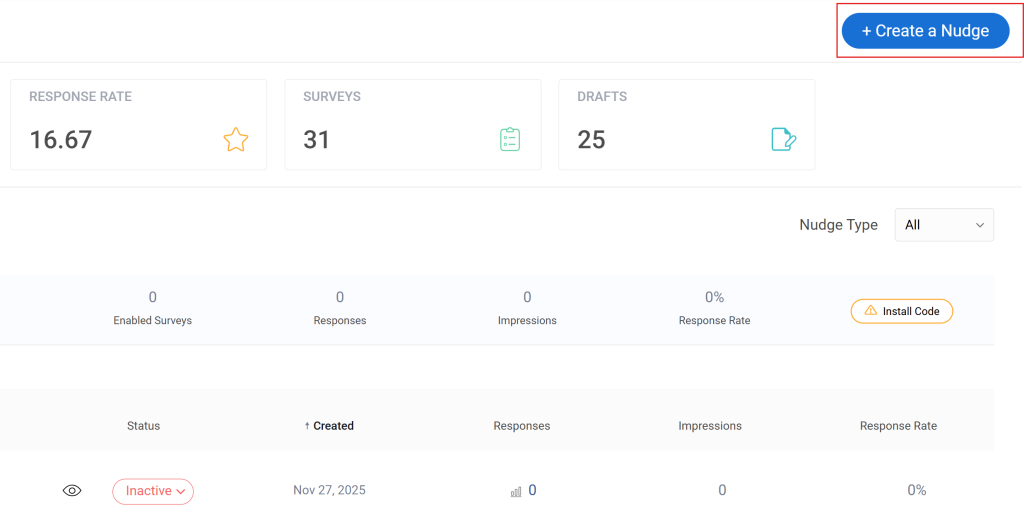

Picking employee engagement software usually starts the same way. Your current tool has become expensive, your response rates have dropped, or leadership wants proof that engagement work is paying off.
The 10 tools below are not ranked by feature count. They are organized by the problem each one actually solves, since most engagement programs fail due to execution gaps, not a missing dashboard.
ProProfs Survey Maker sits at the top of this list because it is the rare tool that scales from a 10-person pulse check to a company-wide rollout without a pricing conversation.
I have used ProProfs Survey Maker, PeopleGoal, Lattice, Bonusly, and Motivosity directly.
For the rest, this guide draws on public reviews, vendor documentation, and conversations with HR peers who have run them.
What Is Employee Engagement Software?
Employee engagement software is a category of HR tools used to collect structured employee feedback through pulse surveys, eNPS, or lifecycle surveys, track sentiment over time, and route results to managers so that feedback turns into action rather than sitting in a report nobody reads.
It is infrastructure, not a morale booster. A good platform gives you clean data, an anonymity layer employees trust, and a way to segment results by team or role. It will not fix a weak manager or a broken culture by itself.
If there is no plan to act on the results, even the best employee engagement software will fail. What you do with the data is what actually moves the needle.
The Best Employee Engagement Software Options
Scan the table first to shortlist by fit, then read the full breakdown below for the tools that make your list.
| Tool | Best For | Starting Price | Capterra Rating |
| ProProfs Survey Maker | Scalable engagement surveys with no per-user fees | Free plan; paid from $19.99/month | 4.8/5 |
| PeopleGoal | Goal clarity and manager-led follow-through | Free trial; paid from $4/user/month | 4.5/5 |
| Lattice | Performance-linked engagement and accountability | Paid from $4/seat/month | 4.5/5 |
| Bonusly | Everyday peer recognition | Paid from $5/user/month | 4.8/5 |
| Workvivo | Culture and internal communication | Custom pricing, demo required | 4.7/5 |
| Vantage Circle | Rewards, recognition, and benefits | Custom pricing, demo required | 4.7/5 |
| Leapsome | Engagement plus reviews and learning | Custom pricing, demo required | 4.6/5 |
| Motivosity | Community-driven peer recognition | Custom pricing, demo required | 4.8/5 |
| Culture Amp | Research-backed surveys and benchmarking | Custom pricing, demo required | 4.6/5 |
| Qualtrics Employee Experience | Enterprise-scale experience programs | Custom pricing, demo required | 4.6/5 |
Here is the full breakdown of each one, including where it fits and where it does not.
1. ProProfs Survey Maker: Best for Easily Creating Custom Customer Surveys, CSAT, CX, & NPS Forms Using AI
ProProfs Survey Maker is honestly one of the few employee engagement survey tools I have stuck with for years because it scales incredibly well without the usual headaches.
You can go from sending a quick poll to 10 early employees to pushing a full engagement survey to a workforce of thousands, and nothing breaks.
No surprise bills, no begging your rep for more quota. The AI builder is genuinely handy here. Give it a prompt like “create a quarterly engagement pulse with follow-ups for low scores,” and it hands back a branching survey in seconds.
You can try the AI survey builder here, using “Create an employee engagement survey for a company of 300-400 employees”:
Let ProProfs AI Build a Survey
Describe your survey and we'll create it for you
Pros:
- AI-powered survey creation with the AI Survey Maker
- Access to 100+ professional templates, including engagement and eNPS
- Full branding and white-label capabilities
- 20+ question types plus skip logic, branching, and scored surveys
- Salesforce and HubSpot integration for CRM-connected workflows
Cons:
- No dark interface for long survey-building sessions
- Dedicated onboarding is limited to paid plans
Capterra Rating: 4.8/5
Pricing: Free plan available with all premium features. Paid starts at$19.99/month, followed by Business at $49.99 and Enterprise at $149.99.
2. PeopleGoal: Best for Connecting Engagement to Goals and Manager Follow-Through
I used PeopleGoal at a company where engagement was not really the problem. Unclear goals and inconsistent check-ins were.
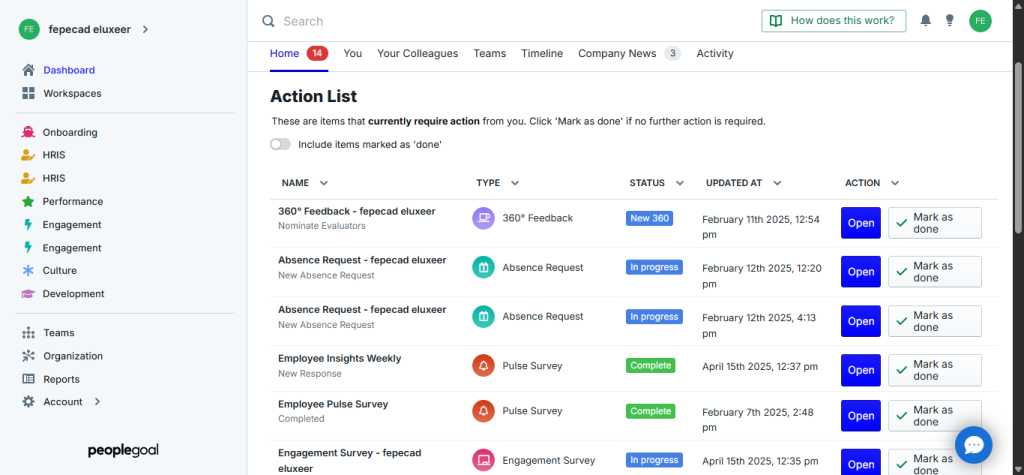
Goals, check-ins, and feedback all live in one place, so engagement shows up naturally in one-on-ones instead of a separate survey event.
The pulse surveys work more like a temperature check than a full diagnostic. The real value is that it forces managers to slow down and follow through.
Pros:
- Goal-setting tied to OKRs and company objectives
- Pulse surveys that support regular check-ins
- One-on-one tracking and feedback documentation
- Easy for managers to adopt with minimal training
Cons:
- No on-premise or downloadable version
- No dark interface option
Capterra Rating: 4.5/5
Pricing: Free trial available. Paid plans start at $4 per user per month.
3. Lattice: Best for Performance-Linked Engagement and Manager Accountability
A former manager of mine brought in Lattice after getting tired of engagement scores that never tied back to anything measurable.
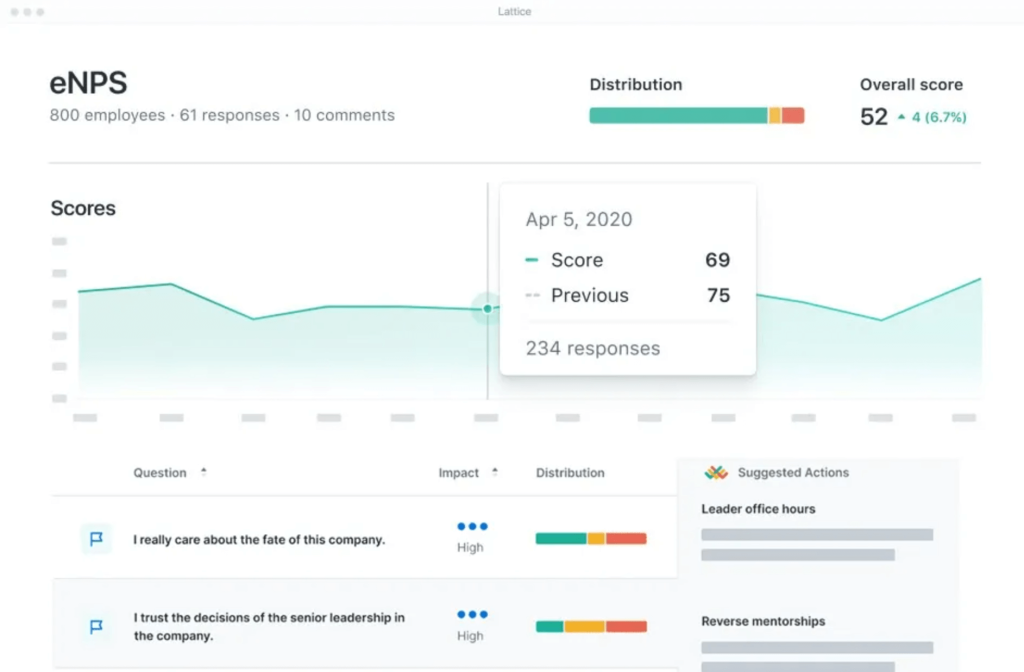
Pulse surveys and eNPS are simple to run, but the real value is how Lattice nudges managers to close the loop.
Engagement data feeds straight into goals, reviews, and feedback cycles instead of sitting in its own silo.
Pros:
- Pulse surveys and eNPS are built into performance workflows
- Manager dashboards that surface issues and track follow-up
- Strong integration ecosystem with HR and calendar tools
Cons:
- Requires upfront planning and internal alignment to set up
- Seat-based pricing adds up quickly at scale
Capterra Rating: 4.5/5
Pricing: Paid plans start at $4 per seat per month.
4. Bonusly: Best for Everyday Peer Recognition and High Adoption
I picked up Bonusly after a colleague switched teams and mentioned her new company used it to keep recognition visible between review cycles.
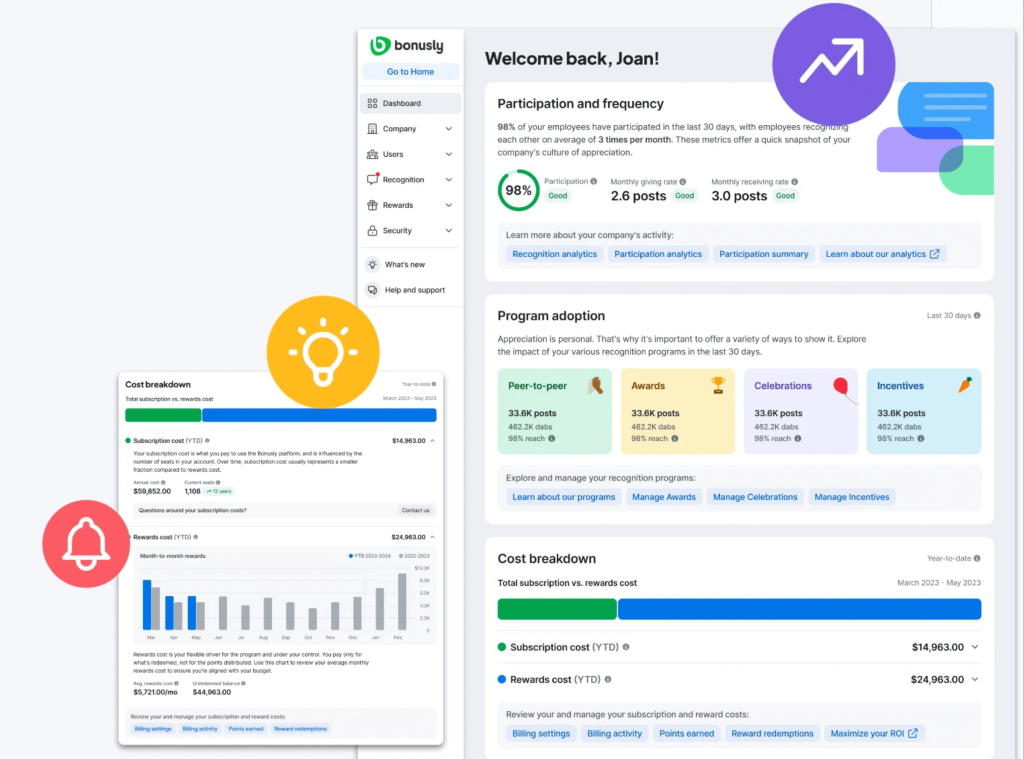
It fits naturally into Slack and Teams, which is why adoption tends to be high without much change management.
It is not a substitute for structured feedback or deep analytics, but it fills the gap between quarterly surveys.
Pros:
- Peer-to-peer recognition with redeemable rewards
- High adoption through Slack, Teams, and email integrations
- Dashboards showing recognition activity and trends
Cons:
- Reward budgets need ongoing oversight as teams scale
- Limited diagnostic depth compared to survey-first tools
Capterra Rating: 4.8/5
Pricing: Paid plans start at $5 per user per month.
5. Workvivo: Best for Company Culture and Internal Communication at Scale
I first heard about Workvivo from an internal comms lead who was replacing a stack of scattered emails and an underused intranet.
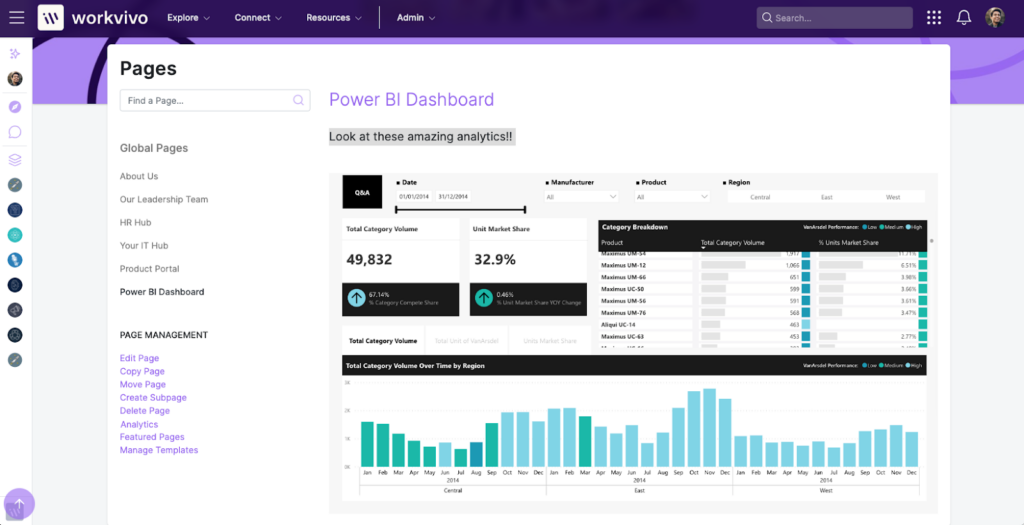
It works best when your engagement problem is really a communication problem. Surveys and polls sit alongside a company activity feed, so listening becomes part of the daily flow instead of a quarterly event.
Pros:
- Central activity feed for updates and recognition
- Built-in polls and surveys alongside daily communication
- Strong adoption in distributed or frontline-heavy teams
Cons:
- Overkill if surveys are your primary need
- Requires ongoing content ownership to stay effective
Capterra Rating: 4.7/5
Pricing: Custom pricing. Demo required.
6. Vantage Circle: Best for Rewards, Recognition, and Benefits Programs
A consultant I worked with recommended Vantage Circle for a client that already had a survey tool but needed a stronger rewards layer.
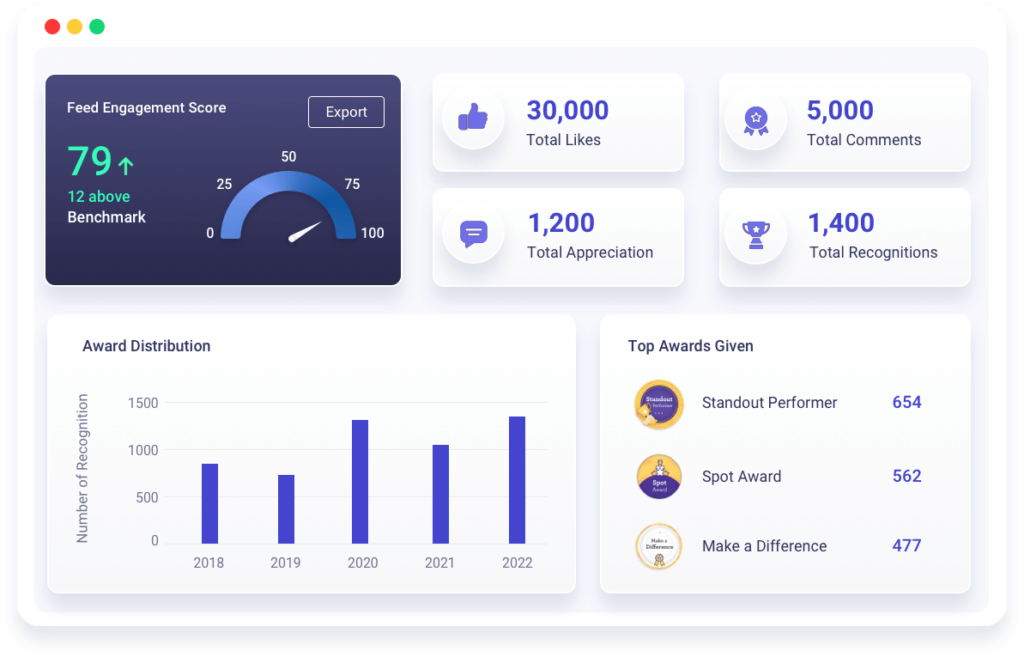
It works best when recognition and benefits are your core engagement lever. If deep diagnostics or manager-led action planning is the priority, you will likely need to pair it with a dedicated survey tool.
Pros:
- Centralized recognition and rewards platform
- Corporate wellness and benefits are built in
- Works well for large, distributed teams
Cons:
- Reporting depth varies by module used
- Less suited to advanced engagement diagnostics
Capterra Rating: 4.7/5
Pricing: Custom pricing. Demo required.
7. Leapsome: Best for Combining Engagement with Performance Reviews and Learning
Leapsome usually comes up with teams that already run performance reviews, but feel those reviews are disconnected from how people actually feel day-to-day.
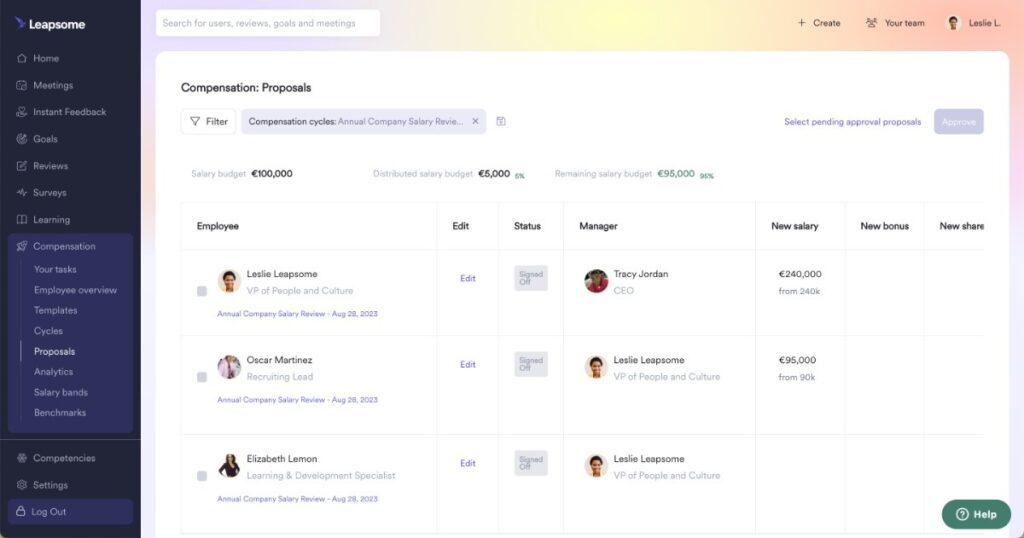
Engagement surveys sit alongside reviews and learning paths here, so a dip in scores has a growth conversation or skills plan sitting right next to it.
Pros:
- Pulse surveys are built into review cycles
- Learning paths tied to performance conversations
- Clean analytics for tracking trends over time
Cons:
- Customization can feel limited for complex programs
- Sales-led pricing slows quick evaluation
Capterra Rating: 4.6/5
Pricing: Custom pricing. Demo required.
8. Motivosity: Best for Peer Recognition and Community-Driven Engagement
I tried Motivosity at a company going through a quiet dip in team energy. Nothing alarming, just less celebration of wins than there used to be.
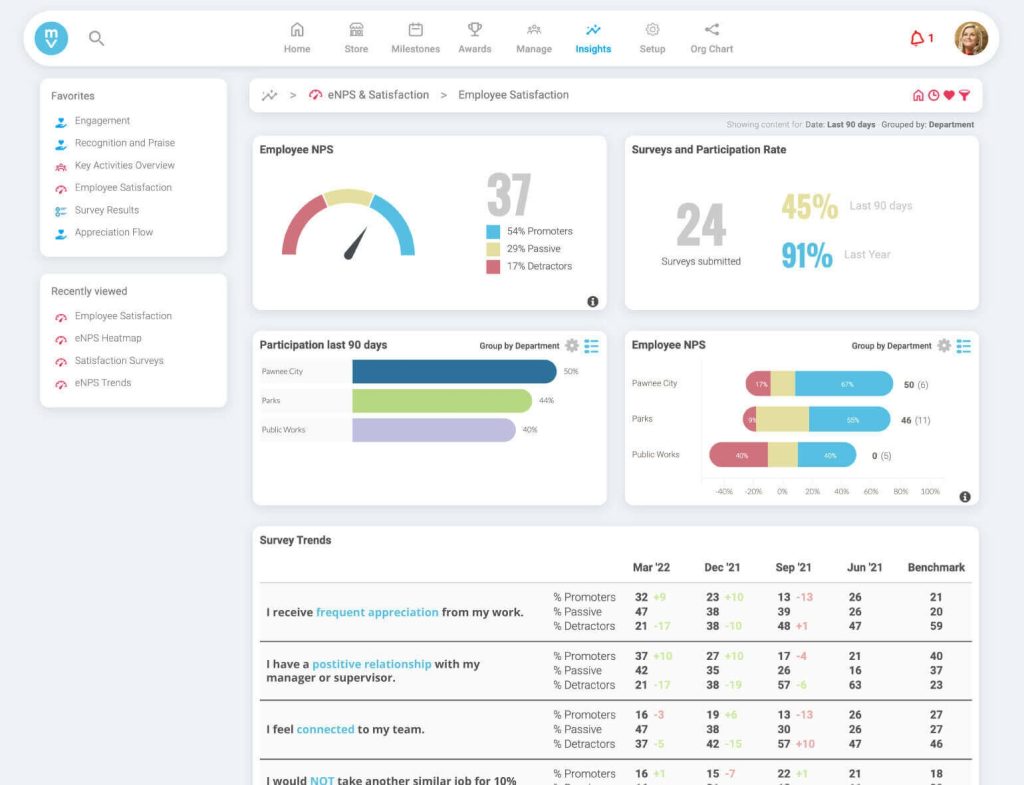
The social layer is the draw here. Recognition is public, frequent, and easy to participate in. It works best once you already understand your engagement issues, since it reinforces good behavior rather than diagnosing what is broken.
Pros:
- Peer recognition with points and redeemable rewards
- Social feed that keeps appreciation visible
- Easy rollout without heavy setup
Cons:
- Limited depth for engagement diagnostics
- Mobile app reliability has been inconsistent
Capterra Rating: 4.8/5
Pricing: Custom pricing. Demo required.
9. Culture Amp: Best for Research-Backed Surveys and Benchmarking
I heard about Culture Amp from a friend in HR who needed to know whether an engagement score was actually good, or just good for their industry.
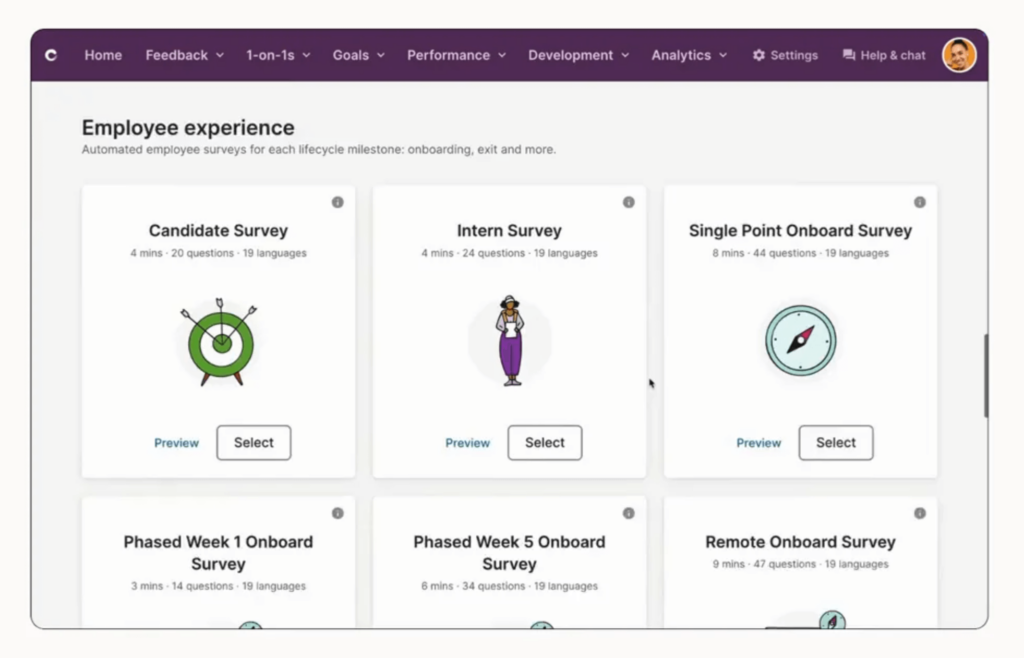
Its strength is a validated survey design and peer benchmarking. It can feel heavy for quick, scrappy pilots and works best as a structured, recurring program with leadership buy-in.
Pros:
- Research-backed survey design and validated questions
- Strong industry and peer benchmarking
- Advanced analytics to identify engagement drivers
Cons:
- No free plan or self-serve trial
- Setup and analysis take time
Capterra Rating: 4.6/5
Pricing: Custom pricing. Demo required.
10. Qualtrics Employee Experience: Best for Enterprise-Scale Experience Programs
A People Analytics contact mentioned Qualtrics whenever the conversation shifted to presenting engagement data straight to executives.
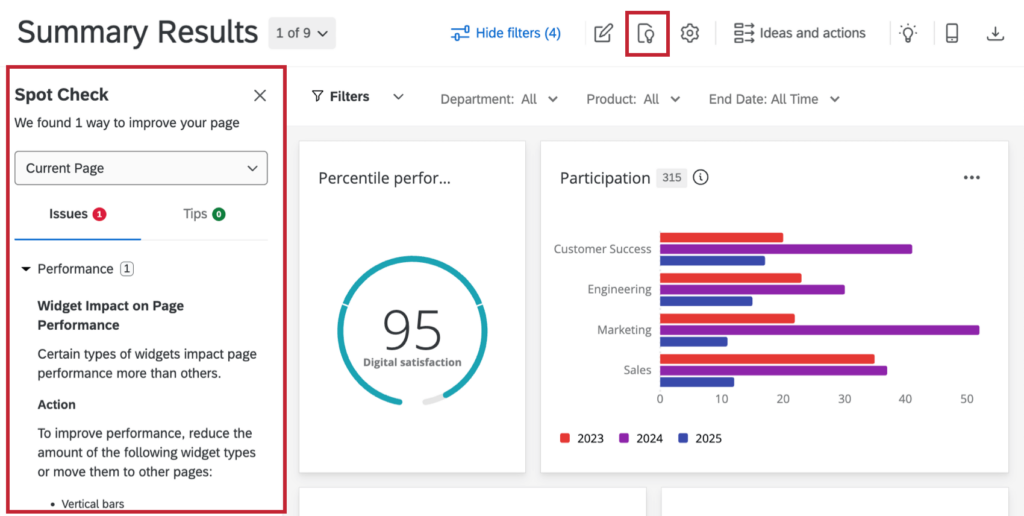
It shines when engagement is part of a broader experience strategy that integrates lifecycle feedback and sentiment analysis within a single ecosystem. Implementation takes time, and there is a real learning curve for new teams.
Pros:
- Advanced analytics and segmentation across the employee lifecycle
- Strong action planning and progress tracking
- Built for enterprise scale and governance
Cons:
- Steep learning curve for new teams
- Expensive compared to lighter-weight tools
Capterra Rating: 4.6/5
Pricing: Custom pricing. Demo required.
My Top 3 Picks and Why
These three come up repeatedly because they solve different engagement problems cleanly. This is not best to worst, each one wins in a specific scenario.
1. ProProfs Survey Maker
ProProfs Survey Maker is the pick when reliable engagement surveys need to scale without friction.
If your program leans on recurring pulses, clean data, and a setup your team can run without constant vendor support, this is where I would start. What actually sold me on it in the long term is the pricing model.
You are not paying per employee, so a 40-person team and a 4,000-person team pay for the same plan tier based on responses collected, not headcount.
That matters a lot if you have ever watched an enterprise survey tool’s renewal bill climb every year, regardless of how much you actually use it.
Moreover, the AI Survey Maker also removes the blank-page problem.
2. Lattice
Lattice earns a top pick when engagement needs to drive manager behavior, not just get measured.
Pulse surveys and eNPS are simple to run, but the real value is how scores feed directly into goals, reviews, and ongoing feedback cycles, so managers cannot treat a low score as someone else’s problem.
Pick this if your organization already runs structured reviews and OKRs and wants engagement folded into that same rhythm.
Skip it if you only need lightweight pulse surveys without the performance-management layer attached.
3. Bonusly
Bonusly is the pick for teams that already understand their engagement gaps and need day-to-day appreciation to feel less occasional.
It works because recognition happens inside Slack, Teams, and email, the places people already work, so adoption tends to be high without a change-management push.
Pick this if culture and morale, not diagnostics, are the priority, and you already have a survey tool covering the measurement side.
Skip it if you need deep benchmarking, manager accountability, or performance-linked analytics.
How I Evaluated These Employee Engagement Software Tools
I did not compare these on feature lists alone. I looked at what breaks in real programs and filtered for the tools that help you avoid that.
User Reviews and Ratings: I pulled Capterra ratings and patterns from community threads for a ground-level read on real employee satisfaction, not just vendor claims. Recurring complaints told me more than the star average.
Essential Features and Functionality: I checked each tool against the survey types, follow-up workflows, and reporting depth that a real engagement program actually needs, not just a long feature list.
Ease of Use and Adoption Friction: How quickly a non-technical HR person can launch a survey, and whether the tool fits into channels employees already use, like Slack or email, instead of asking for another login.
Customer Support: How much onboarding help is available, since lean HR teams without a dedicated analyst depend on it more than larger teams do.
Value for Money and Pricing Transparency: I compared cost to actual capability delivered and modeled each tool’s pricing at 2x current headcount, since per-seat and per-response models scale very differently as a team grows.
Anonymity and Trust: I checked whether responses can stay anonymous without inviting duplicates, and whether the tool feels safe to use on a shared device. If this is shaky, every score downstream is noise.
Action, Not Just Measurement: I looked for follow-up workflows and manager visibility, not just a dashboard. A tool that only measures is a reporting layer, not an engagement program.
Adoption Friction: I favored tools that integrate with what employees already use and rely on simple link-based access instead of another app to install.
Scale Behavior: I tested how each tool talks about behavior at 50 users versus 5,000, since bulk setup and reporting speed change a lot at scale.
FREE. All Features. FOREVER!
Try our Forever FREE account with all premium features!
How Do You Prove Employee Engagement Software Is Actually Working?
Leadership does not need a long explanation. They need a small set of signals that show movement and tie back to action.
Response Rate: Tells you whether people trust the process. Low participation means the program is broken before it starts.
Action Completion Rate: Track how many agreed actions are closed within 30 to 60 days. This is the clearest sign that feedback is turning into behavior change.
Trend Movement: One survey is noise. Two or three cycles of movement in the same direction is a signal.
Business Indicators: Pair engagement data with metrics leadership already tracks, such as regretted attrition, absenteeism, or internal mobility.
Keep the reporting simple: show the score, show the action taken, show what changed next cycle. Most rollouts stumble on the same handful of mistakes, covered in the FAQs below, not on picking the wrong software.
Pick the Tool You Can Actually Run Every Quarter
Every tool on this list can collect a survey.
The difference shows up three cycles in, when the pricing model has either scaled with your headcount or against it, and when someone has either owned the follow-up or let it slide.
If you are the person who has to launch the next pulse, hand managers their team’s results, and defend the line item next budget cycle, pick software that stays out of your way on all three.
That is the actual job employee engagement software needs to do, not just collect an answer.
Frequently Asked Questions
What are the 5 C's of employee engagement?
The 5 C's are Clarity, Connection, Contribution, Confidence, and Consistency. Together they describe whether employees understand what is expected of them, feel connected to their team, believe their work matters, trust leadership, and experience engagement efforts as a regular practice rather than a one-off initiative that gets forgotten after the results meeting.
How much does employee engagement software typically cost?
Pricing splits into per-seat and per-response models. Per-seat tools like Lattice or Bonusly start at around $4-$5 per user per month and increase quickly as headcount grows. Per-response tools like ProProfs Survey Maker start at $19.99 per month and scale with the number of responses collected, not with the number of employees on payroll.
How do you collect honest employee feedback at scale?
For honest employee feedback, you need to use clear anonymity rules, secure access links rather than shared logins, and keep surveys short enough to complete in a few minutes. Employees give more honest answers when they trust that the process will not identify them and when they can see that previous survey results have actually led to a visible change.
How do you make sure survey feedback actually leads to action?
Assign an owner and a deadline for every action item before you launch the survey, not after results come in. Give managers direct access to their own team's results instead of routing everything through HR first, and report back on what changed so employees see the connection between feedback and action.
Is employee engagement management software different from recognition software?
Yes. Engagement management software focuses on measuring sentiment through structured surveys and routing results to the right owner for action. Recognition software, like Bonusly or Motivosity, focuses on day-to-day peer appreciation and rewards instead of diagnosis. Many HR teams end up running both, since they solve different parts of the same problem.
What is the difference between an eNPS survey and a full engagement survey?
An eNPS survey is a single engagement survey question asking how likely employees are to recommend the company as a place to work, and it takes seconds to answer. A full engagement survey covers multiple dimensions, such as clarity, manager relationships, and growth opportunities, and takes several minutes to complete since it asks for more context than one score can capture.
What are the most common mistakes when rolling out employee engagement software?
The most frequent ones are launching without assigning action owners, running surveys too often without acting on the results, and leaving managers without direct access to their own team's data. All three kill employee trust faster than any bug or missing feature ever will, and trust is what response rates depend on.
How often should you run employee engagement surveys?
Quarterly pulse surveys work well for most teams, paired with one deeper annual survey to spot longer-term trends. Weekly or monthly check-ins only make sense if leadership can realistically act on feedback that fast, since a cadence you cannot keep up with does more damage than running surveys less often.
FREE. All Features. FOREVER!
Try our Forever FREE account with all premium features!

 We'd love your feedback!
What did you like & how can we make it even better?

 Thanks for your feedback!
 Ask Your Question
Have a question? Get expert help to make your decision easier.