

Most organizations know they should run engagement surveys. The part they get wrong is treating a list of questions as a measurement program.
A survey with no thematic structure and no post-survey plan produces scores that feel informative and change nothing.
The right employee engagement survey questions, grouped by theme and designed for honest responses, give you data you can actually use to reduce attrition, strengthen retention, and build a workplace people choose to stay in.
This guide gives you 50+ ready-to-use questions organized by the five themes that matter most, a step-by-step process for building and launching your survey using AI, and a framework to turn results into action before the next cycle begins.
What Are Employee Engagement Survey Questions?
Employee engagement survey questions are structured prompts used to measure employees’ emotional commitment, motivation, and investment in their work and organization. Unlike satisfaction questions, which measure contentment with specific conditions, engagement questions assess whether employees are actively contributing, intend to stay, and are willing to advocate for the organization.
Gallup’s 2026 State of the Global Workplace report found that global engagement fell to 20% in 2025, its lowest level since 2020, costing an estimated $10 trillion in lost productivity.
In the U.S., the figure sits at 31%, an 11-year low. Manager engagement dropped from 27% to 22% in a single year, the steepest decline on record.
When managers are as disengaged as the people they lead, generic questions about “company culture” or “overall satisfaction” will not tell you where the breakdown is happening. Specific, theme-grouped questions will.
Why It Matters for Your Business: Highly engaged workforces deliver 23% higher profitability, 14% greater productivity, and 81% lower absenteeism compared to disengaged ones, according to Gallup’s 2025 Employee Engagement vs. Employee Satisfaction study. Engagement is not a soft outcome. It has a hard number attached to it.
50+ Best Employee Engagement Survey Questions to Ask
The most important structural decision is how you group your questions. Most surveys dump a long list into a single form with no organizing logic.
The result is a report that shows you overall scores, but cannot tell you whether the problem is leadership trust, career growth, workload, or something else entirely.
Grouping by five core themes solves this. When a theme scores low, you know exactly which intervention to run next, without guesswork.
The five themes are: leadership and management, communication and transparency, growth and development, culture and values, and well-being and workload.
Which Questions Should You Ask About Leadership and Management?
According to Gallup’s 2026 workplace study, 70% of the variance in team engagement is directly attributable to the manager.
When this theme scores low, every other theme becomes harder to move.
Split this theme into two separate layers. Employees who trust their direct manager but distrust senior leadership score very differently on each, and averaging the two hides the source of the problem.
Here Are 4 Direct Manager Questions:
| Question | What It Surfaces |
| Does your manager give you feedback that actually helps you improve? | Coaching quality vs. task-only management |
| Can you raise concerns with your manager without worrying about the consequences? | Psychological safety at the team level |
| Does your manager show genuine interest in your career goals? | Development-focused vs. output-only management |
| Does your manager recognize you when you do good work? | Recognition frequency and quality |
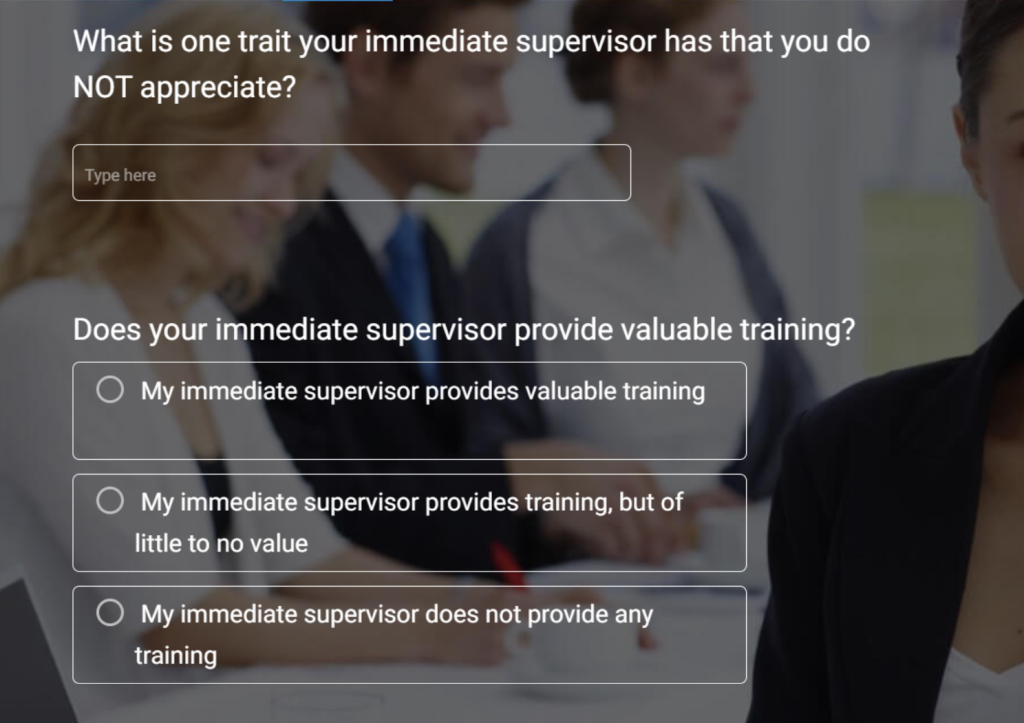
Here’s a managerial feedback employee engagement survey template:
Here Are 3 Senior Leadership Questions:
| Question | What It Surfaces |
| Does senior leadership communicate decisions clearly and explain the reasoning? | Transparency and communication quality |
| Does the organization follow through on commitments it makes to employees? | Institutional trust and credibility |
| Do you trust that senior leadership makes decisions in the interest of employees? | Perceived values-to-behavior alignment |
If direct manager scores are high but senior leadership scores are low, you have a corporate trust problem.
If both are low, you have a systemic management development issue. These two patterns require completely different interventions.
Which Employee Survey Questions Should You Ask About Communication?
Over 35% of employees say their leadership could improve operations simply by making it easier for employees to share feedback, according to the Axios HQ 2026 Internal Communication Report.
Communication breakdowns are often the earliest signal of broader disengagement.
Here Are 5 Communication-Related Employee Survey Questions:
| Question | What It Surfaces |
| Do you feel well-informed about what is happening in the organization? | Information flow from leadership to employees |
| Do you feel comfortable sharing honest feedback with your manager? | Upward communication safety |
| Are decisions that affect your work explained to you in a timely way? | Transparency and decision communication |
| Do you feel your ideas and opinions are genuinely considered? | Voice and influence within the organization |
| Does your team communicate effectively to get work done? | Lateral communication and collaboration quality |
Employees who feel uninformed or unheard stop investing in organizational goals.
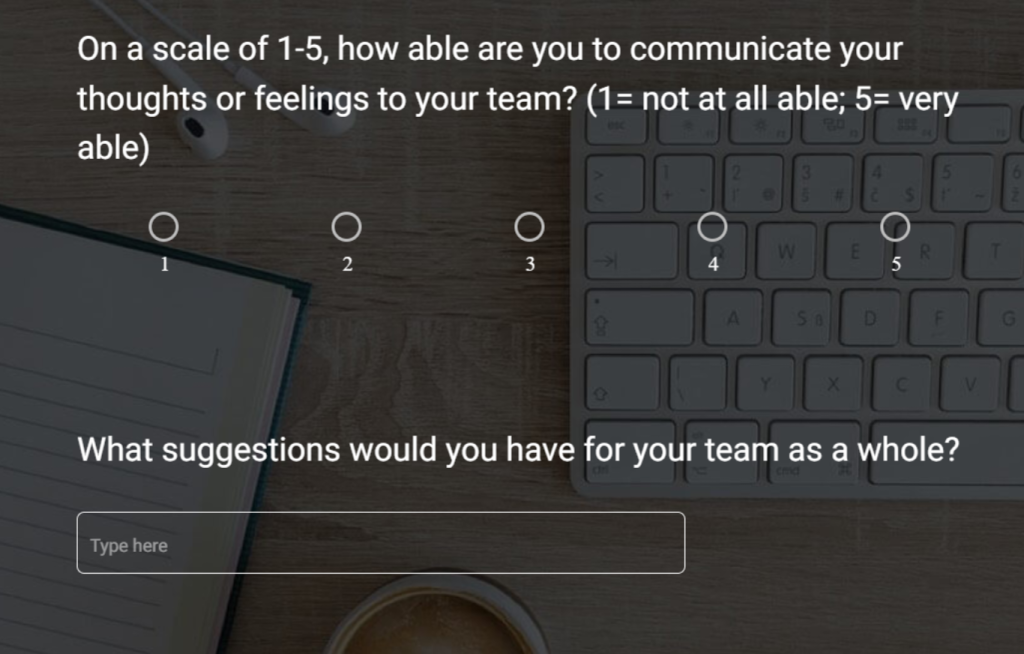
They are also significantly less likely to complete future surveys honestly, which degrades the data you rely on to make decisions. Here’s a quick communication feedback template:
For a deeper look at building two-way communication through surveys, watch this video on anonymous surveys:
Which Engagement Questions Reveal Growth & Development Gaps?
Lack of career growth remained one of the leading drivers of voluntary turnover across more than 20,000 exit interview cases, according to the Work Institute 2024 Retention Report.
When this theme scores low, flight risk is high, especially among top performers.
Here Are 6 Engagement Questions That Reveal Growth and Development Gaps:
| Question | What It Surfaces |
| Does your role challenge you to grow professionally? | Role stretch and growth fit |
| Do you see a realistic path to advance your career within this organization? | Promotion clarity and perceived career ceiling |
| Has anyone invested in your professional development in the past six months? | Whether growth support is real or just stated |
| Does your manager regularly discuss your career goals with you? | Development-focused management behavior |
| Are you building skills here that will be valuable to you long-term? | Long-term skill value and retention signal |
| Do you have enough autonomy in your role to do your best work? | Ownership and empowerment |
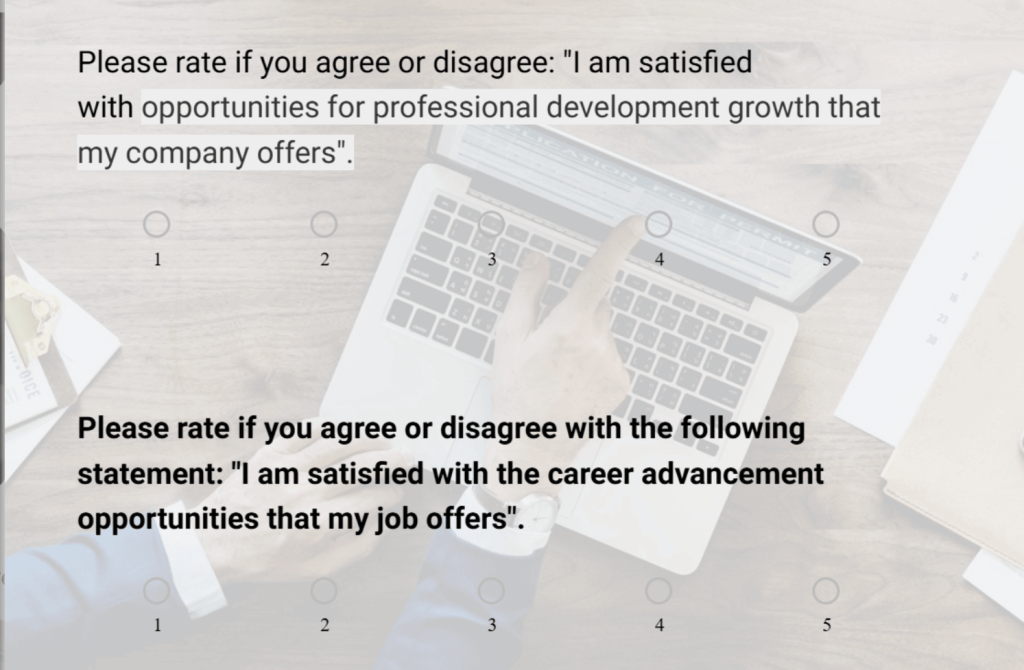
Here’s a quick career development survey template:
Which Workplace Engagement Questions Measure Culture & Values?
Culture questions reveal whether stated values are lived or laminated on office walls.
A beautifully written values statement and a culture that actively contradicts it are common. This theme shows you which reality employees are actually experiencing.
Here Are 5 Workplace Culture and Values Questions:
| Question | What It Surfaces |
| Do you feel a sense of belonging on your team? | Inclusion and team cohesion |
| Does the organization treat employees fairly regardless of background? | Equity and inclusion in practice |
| Are company values reflected in how decisions are actually made? | Values-to-behavior alignment |
| Are you proud of the work you produce here? | Intrinsic motivation and connection to output |
| Would you recommend this organization as a great place to work? | Employer brand and internal eNPS signal |
Segment the fairness question by department, tenure, and team size. It often looks fine at the aggregate level and reveals significant gaps when broken down.
Equity and inclusion problems frequently hide inside numbers that appear healthy company-wide.
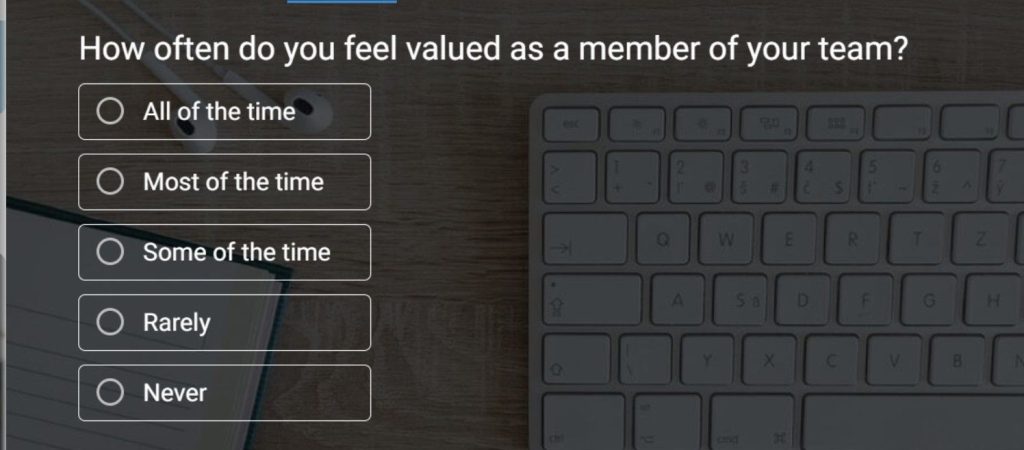
Here’s a quick belongingness and inclusion survey template:
Which Employee Feedback Survey Questions Reveal Well-Being and Workload Issues?
Burnout is a leading predictor of both disengagement and attrition.
Employees who are overloaded cannot give you honest answers about anything else because exhaustion distorts every other perception.
Here Are 5 Wellbeing-Related Employee Engagement Survey Questions:
| Question | What It Surfaces |
| Is your workload consistently manageable? | Capacity and workload sustainability |
| Does this organization support a healthy work-life balance? | Structural support for employee well-being |
| Do you feel your mental well-being is taken seriously here? | Psychological safety at the organizational level |
| Do you have the tools and resources you need to do your job well? | Operational enablement and friction removal |
| How would you describe your overall experience at work right now? | Neutral, unprimed baseline sentiment |
The last question is a strong candidate for the very first question of your entire survey.
“How would you describe your overall experience at work right now?” captures honest, unprimed feedback. Here’s a quick wellbeing employee survey template:
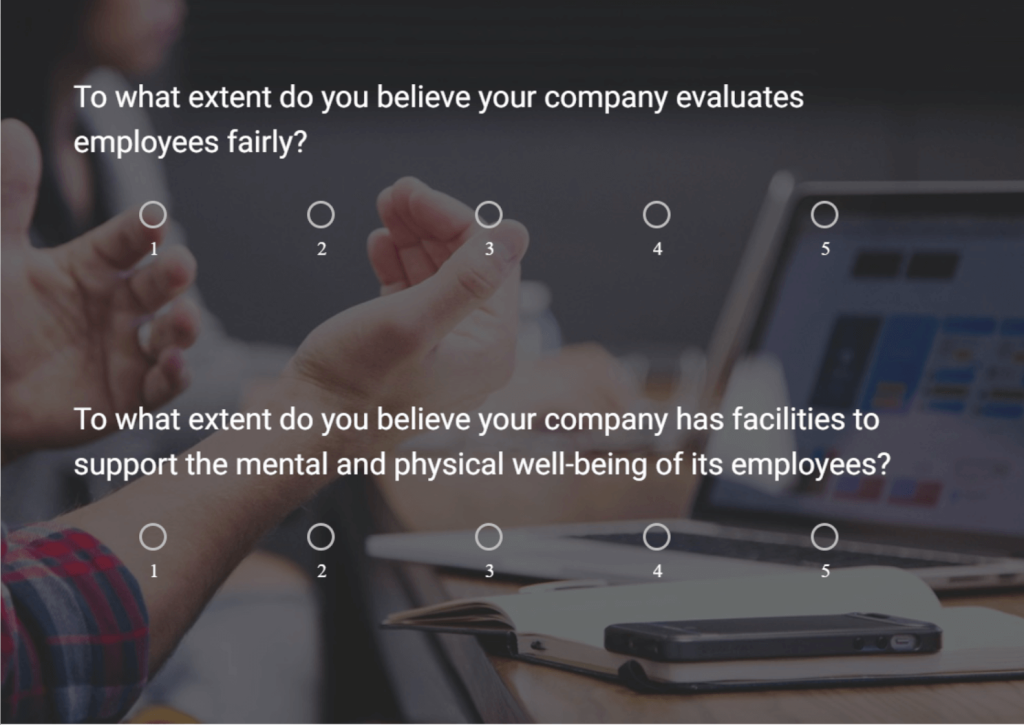
Compare it to “Are you proud to work here?”, which assumes pride as the default and pushes employees toward a socially desirable response.
Which Open-Ended Questions Get Employees to Say What They Actually Think?
Quantitative scales tell you where the problems are. Open-ended questions tell you why. Use two to four per survey, placed near the end.
More than four, and completion rates drop, and responses pile up faster than anyone can read them.
Here Are 5 Open-Ended Employee Engagement Survey Questions:
| Question | Best Used For |
| If you could change one policy or practice, what would it be? | Identifying the highest-friction operational issue |
| Describe a recent moment when you felt disengaged. What caused it? | Surfacing specific triggers vs. vague dissatisfaction |
| What would make you feel more supported in your role? | Uncovering unmet support needs by the team |
| Is there anything leadership is not hearing right now? | Revealing sensitive or systemic gaps |
| What should never change about working here? | Identifying engagement anchors worth protecting |
Here’s a quick open-ended employee survey template:
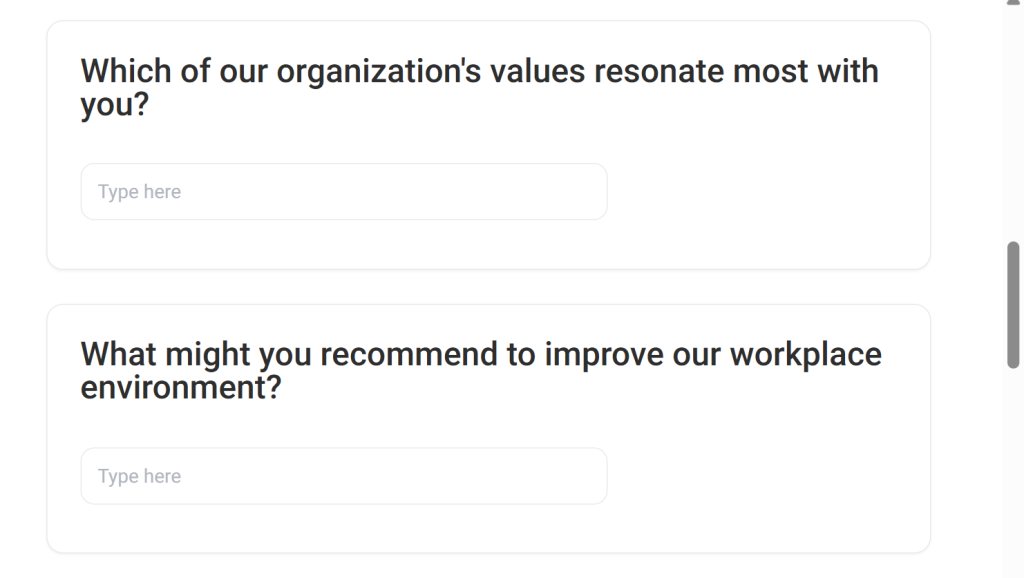
By the time employees reach the open-ended questions, they have already organized their thinking through the structured questions above.
Responses tend to be more focused and actionable when they arrive at the end of a well-structured survey.
How Do You Create an Employee Engagement Survey Using ProProfs AI Survey Maker?
You now have 50+ questions and a design framework.
Here is how to go from that to a live, anonymous, theme-structured survey in under five minutes using ProProfs AI Survey Maker so you can start instantly:
Step 1: Describe Your Survey in One Sentence
Open ProProfs Survey Maker and go to the AI survey builder. Type a single sentence describing exactly what you need. Or upload files like PDF, DOCX, etc., if you have your survey plan prepared.
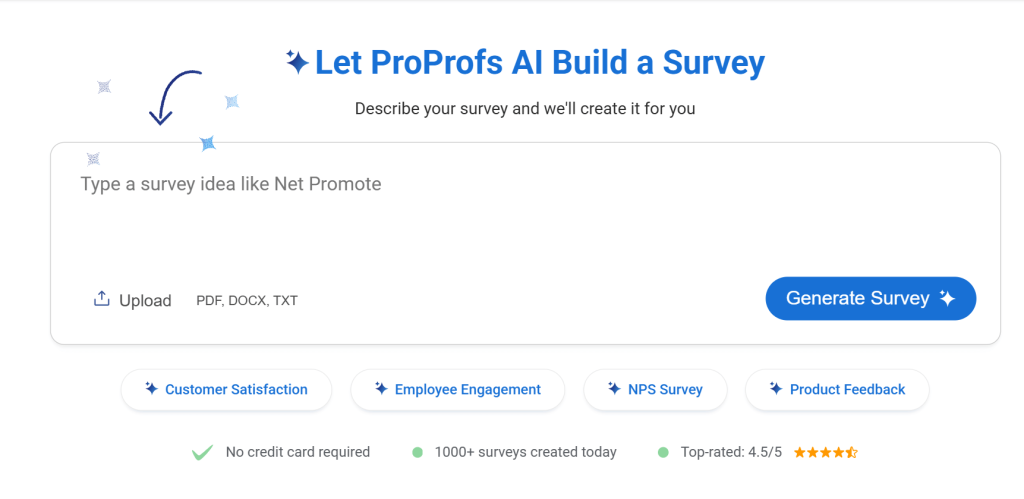
For example: “Employee engagement eNPS survey for a 200-person team focused on manager trust, career growth, retention intent, and work-life balance.
Include Likert scale questions, an NPS question, and two open-ended prompts.”
That is all the input ProProfs AI Survey Maker needs.
Within seconds, it generates a complete, structured survey drawing on a bank of over 1,000,000 ready-to-use HR questions, so the output is not a generic draft.
It is already calibrated to HR use cases and written in neutral language. Questions are grouped by theme, not scattered.
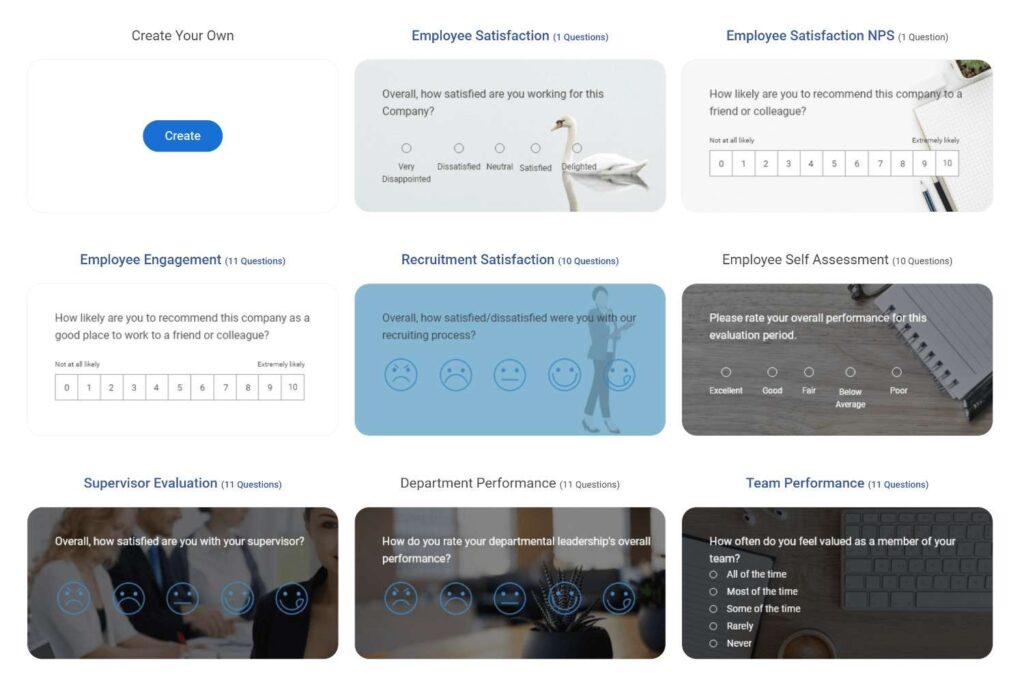
You can also pick from our library of employee survey templates:
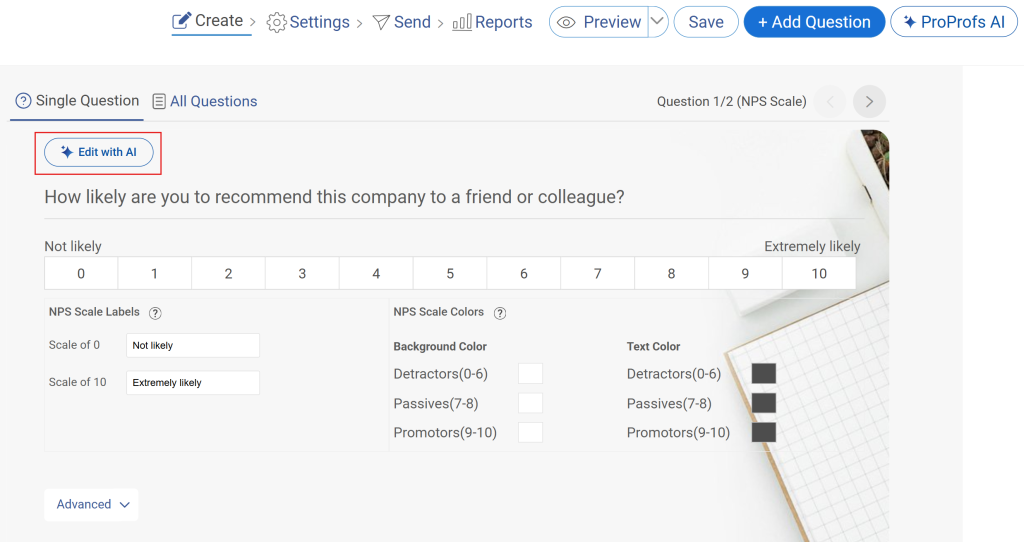
Step 2: Edit, Not Rewrite
Scan what the AI produced. You are not starting over.
Adjust a phrase to match your company’s tone, reorder a question if the flow feels off, and cut anything that duplicates a theme already covered.
Add skip logic here if you want conditional follow-ups: a low score on a leadership question can automatically trigger “What would help you feel more confident in leadership’s direction?”
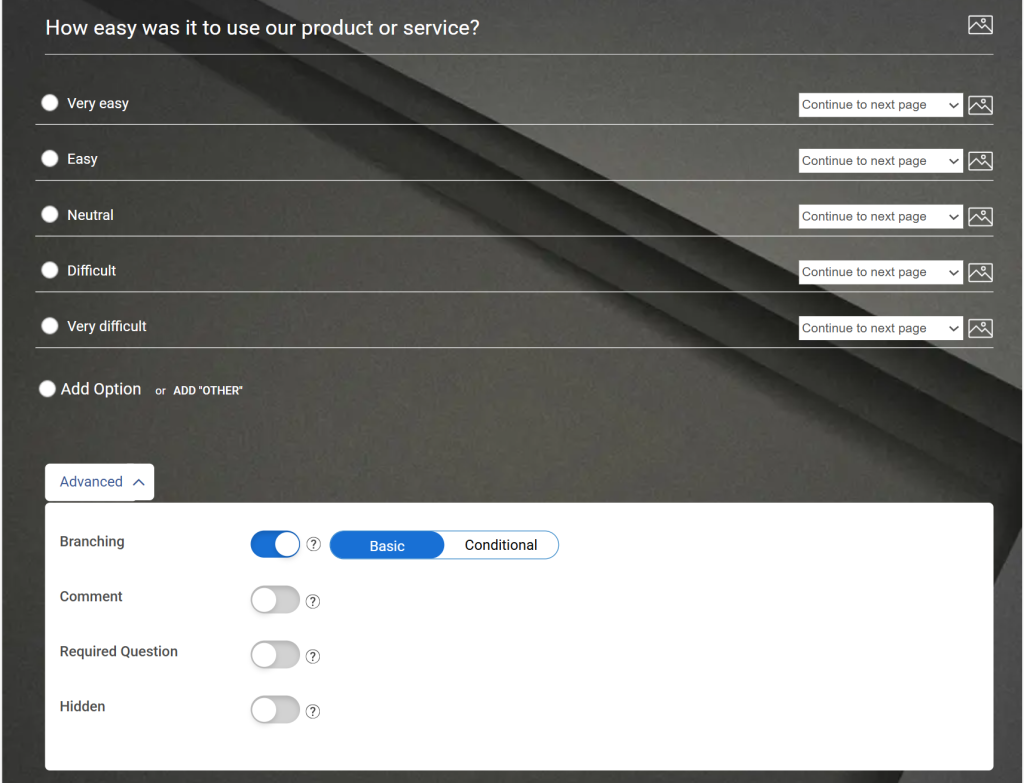
This surfaces the why without making the survey longer for everyone who scores well.
Step 3: Turn on Anonymous Mode Before Anything Else
This is the single most important distribution setting. Anonymous mode removes individual response tracking at the distribution level, not just at the reporting stage.
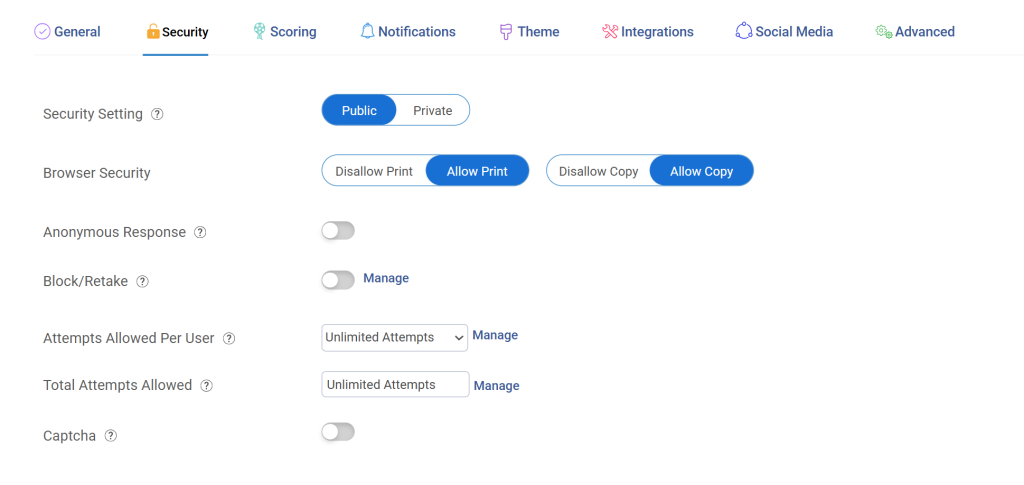
Employees in small teams (under ten) consistently report feeling identifiable even in surveys described as anonymous.
Turning this on before launch is the structural factor that separates honest data from safe, middle-of-the-road scores. Explicitly communicate the anonymity policy at the start of the survey.
Step 4: Brand and Preview on Mobile
Add your logo, match brand colors, and set the font. This takes under a minute and makes the survey look intentional rather than like a last-minute form.
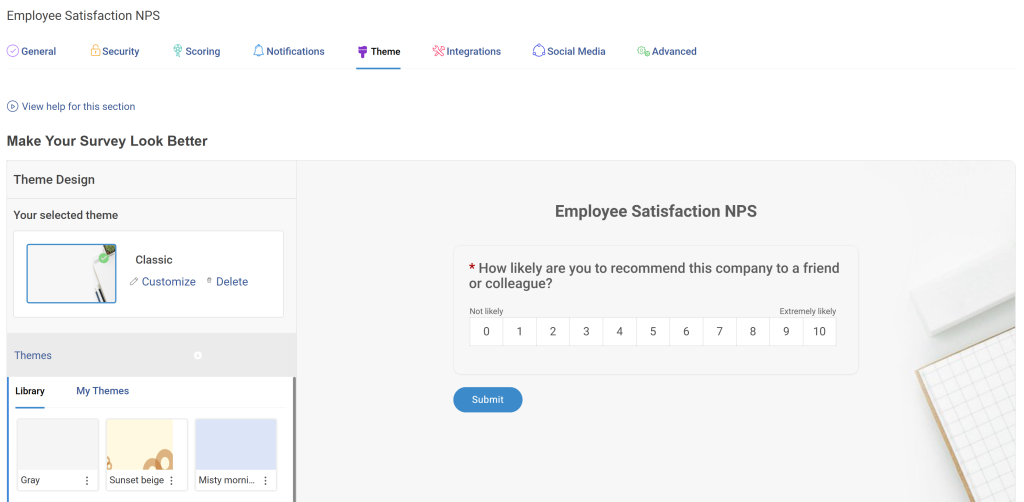
Then preview on mobile before sending.
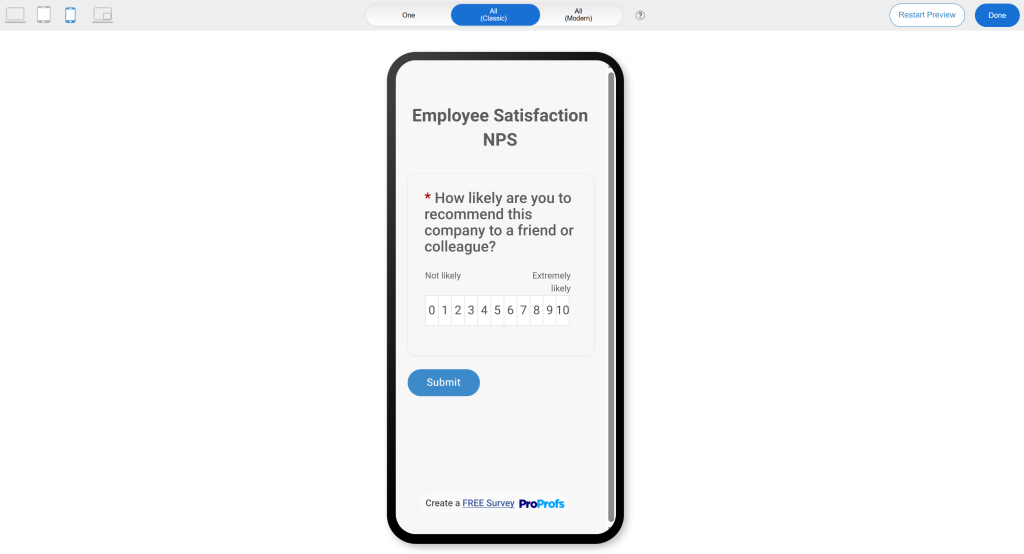
Most employees will open the survey on their phone. If the layout is cramped or buttons are hard to tap, response rates drop before anyone reads a single question.
ProProfs renders a live mobile preview so you can catch layout issues before they affect your data.
Step 5: Distribute Through the Right Channel
Choose the channel where your employees already are, not the one easiest for HR to manage.
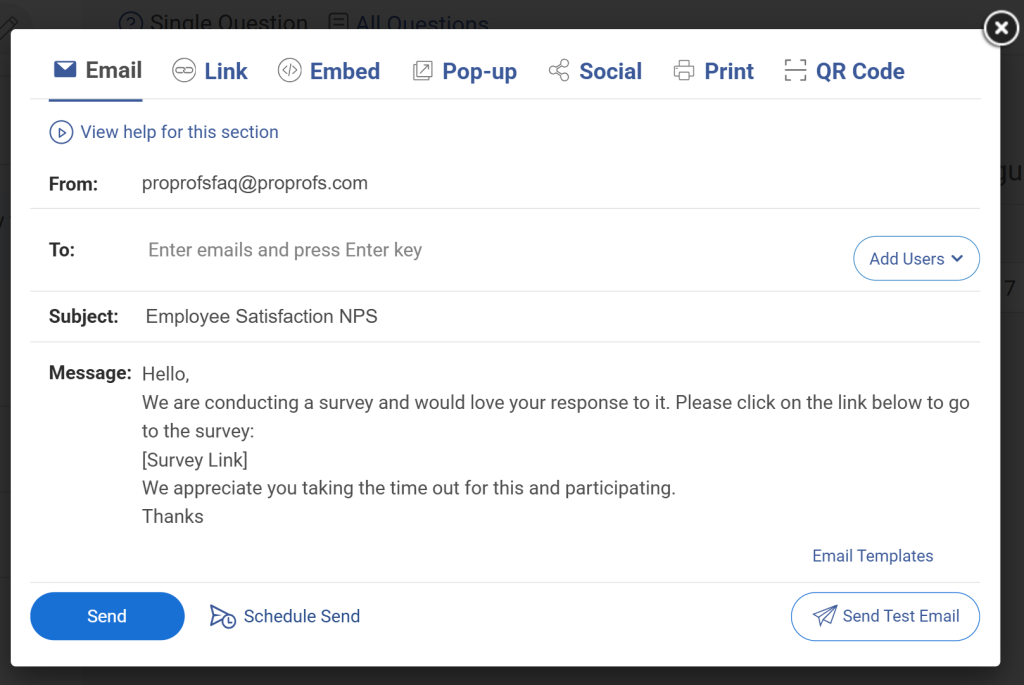
Options include direct email to your employee list, intranet, or an embedded page on internal tools, a QR code for field teams without regular computer access, and a popup triggered after a specific action, such as completing onboarding.
For global teams, ProProfs Survey Maker generates and distributes surveys in 70+ languages, ensuring culturally appropriate phrasing rather than a translated copy of an English original.
Step 6: Monitor Responses and Pull Your Report
Once the survey is live, ProProfs tracks completion rates in real time. You can see where people drop off and send reminders to non-responders without managing a manual list.
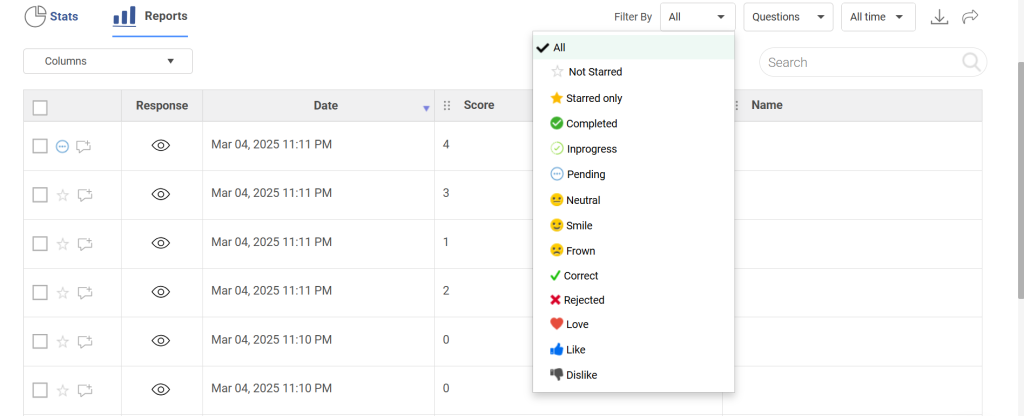
When the survey closes, the reporting dashboard scores each theme section separately, flags the lowest-performing areas automatically, and presents results in a format that non-technical stakeholders can read and act on without rebuilding a spreadsheet.
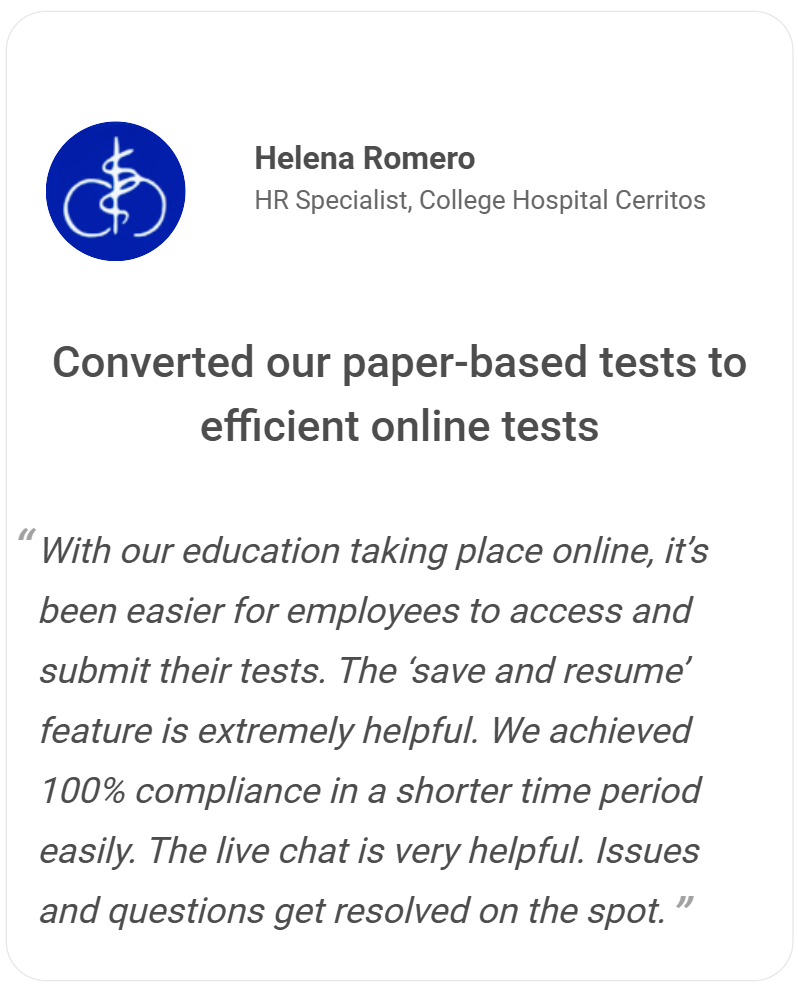
Helena Romero, HR Specialist at College Hospital Cerritos, used ProProfs Survey Maker to achieve 100% survey compliance in a shorter time period than previous cycles, a result she attributed directly to the ease of distribution and the clarity of the reporting dashboard.
How Do You Turn Survey Results Into Action Before Trust Erodes?
Survey fatigue is not caused by survey length. It is caused by employees completing surveys and watching nothing change.
Here’s how you can turn your survey results into quick action before your employees are burnt out:
1. Share Results Within 30 Days: Employees who completed the survey deserve to see the results. Share overall scores and key themes. Never share individual-level data or results from groups smaller than ten respondents.
2. Pick Three Priority Themes, Not Ten: Spreading action across every theme produces mediocre movement everywhere, rather than meaningful improvement where it counts. Focus on the two or three lowest-scoring themes from the current cycle.
3. Run Team-Level Workshops: Managers have a local context that aggregate data cannot provide. A growth score of 2.8 means something different in engineering than it does in customer support. Teams need space to interpret what the numbers actually mean for them before any action plan is written.
4. Set Specific, Measurable Commitments: Not “we will improve communication.” Instead: “Every team will have a 30-minute monthly sync where leadership shares updates and takes questions, starting in June.” Specificity is what makes a commitment credible to employees who have seen vague promises before.
5. Assign Ownership and a Deadline to Every Action: Every commitment needs a named person responsible for it. Without both ownership and a deadline, commitments disappear into the next planning cycle.
6. Run a Pulse Survey in 90 Days: Measure whether the targeted themes have shifted. This closes the loop and signals to employees that the survey led somewhere. Employees who see change happen are significantly more likely to participate honestly in the next annual cycle.
FREE. All Features. FOREVER!
Try our Forever FREE account with all premium features!
How Do You Start Running an Engagement Survey Program That Actually Works?
Most organizations already have a survey.
What they do not have is a program, and that is the gap that turns honest employee feedback into a PowerPoint that sits on a shared drive until next year’s survey goes out.
A program has three things a one-off survey does not: a theme-based structure that makes results interpretable, a distribution setup that produces honest data, and a post-survey commitment that employees can see.
None of those requires a large budget or a complex tool. They require decisions made before the survey launches, not after the results come in.
The questions in this guide are ready to use. The five-theme framework tells you where each one belongs.
The six-step ProProfs AI Survey Maker process gets you from a blank page to a live, anonymous, mobile-ready survey in under five minutes.
And the post-survey action plan ensures that when employees see the results communicated and a named person responsible for each change, they show up for the next survey and tell you what they actually think.
That last part is the whole game. The survey is not what retains people. The proof that someone read it, believed it, and changed something because of it is what retains people.
Frequently Asked Questions
What is the difference between an employee engagement survey and an employee satisfaction survey?
Satisfaction surveys measure contentment with specific conditions, such as pay, benefits, or the physical work environment. Engagement surveys measure emotional commitment, motivation, and intent to stay or advocate. An employee can be satisfied but disengaged: comfortable enough to remain, but not invested enough to contribute beyond the minimum.
How many questions should be in an employee engagement questionnaire?
Annual surveys should include 30 to 40 questions completable in under 10 minutes. Pulse surveys should include 8 to 12 questions completable in under 5 minutes. Add two to four open-ended questions to either format. Anything longer risks partial responses and rushed answers that skew your results.
What is a good employee engagement questionnaire sample I can use immediately?
For a quick pulse survey, use two questions per theme across all five: leadership, communication, growth, culture, and well-being. Add one NPS question ("How likely are you to recommend this organization as a place to work") and two open-ended questions. That gives you a 13-question survey completable in under five minutes, with enough structure to identify your biggest problem area by theme.
How often should you run employee engagement surveys?
Run a full annual survey once per year as your baseline diagnostic. Run pulse surveys quarterly or within 60 to 90 days after major organizational changes such as a reorg, leadership transition, or return-to-office policy shift. The annual survey sets the baseline. Pulse surveys tell you whether your responses to that baseline are working.
What causes employee survey fatigue, and how do you prevent it?
Fatigue is almost never caused by survey frequency. It is caused by surveys that produce no visible change. When employees see results shared but no action follows, they stop answering honestly. Prevent it by sharing results within 30 days, committing to specific and named improvements, and running a follow-up pulse survey 90 days later to demonstrate that feedback led somewhere.
How do you increase employee engagement survey response rates?
Keep surveys short, distribute through channels employees already use, communicate the anonymity policy explicitly, set a clear deadline, and send one reminder to non-responders before closing. Most importantly, share results after every cycle. Employees who have seen previous surveys produce real changes are significantly more likely to participate in the next one.
How do you analyze employee engagement survey results effectively?
Score each of the five themes separately. Identify the two or three lowest-scoring themes and prioritize those. Segment results by department, tenure, and location to find where low scores are concentrated rather than averaged out. Cluster open-ended responses by recurring pattern to understand why scores look the way they do, not just that they are low.
What is the right question format for an employee engagement questionnaire?
Use a Likert scale (1 to 5 or strongly disagree to strongly agree) for quantitative theme tracking. Use an NPS scale (0 to 10) for retention intent and employer brand measurement. Use open-ended text for the qualitative "why" behind any score that surprises you. Mix all three formats within a single survey for the most complete picture.
FREE. All Features. FOREVER!
Try our Forever FREE account with all premium features!

 We'd love your feedback!
What did you like & how can we make it even better?

 Thanks for your feedback!
 Ask Your Question
Have a question? Get expert help to make your decision easier.