

If you’re searching for a company culture survey, you’re trying to make a business call with better data.
You want to know where culture is helping performance, where it’s creating drag, and where the risk is quietly building (attrition, burnout, manager issues, collaboration breakdowns). Not in a vague “how’s morale” way. In a “what do I fix first, and how do I prove it’s working” way.
I’ve watched teams run culture surveys that produce polite averages and zero clarity. Then leadership assumes everything’s fine, and the real problems show up later as missed targets and surprise resignations.
A culture survey works when it’s run like an operating system, with a clear purpose, tight questions, trust guardrails, clean segmentation, and a visible follow-through plan.
In this guide, I’ll walk you through the full playbook: how to run a company culture survey, when to run it by company size, which corporate culture survey questions to use, and how to analyze results by department.
Let’s begin!
What Is a Company Culture Survey?
A company culture survey is a structured questionnaire you send to employees to capture how work actually feels and functions inside your organization.
It focuses on the lived experience, not the official narrative. Think of it as a reality check on everyday norms: how decisions get made, how people work together, how fair things feel, and whether the environment supports consistent performance.
This is not a “rate your happiness” form.
The goal is to turn something fuzzy (culture) into clear, comparable inputs you can review, discuss, and use to guide next actions. When done well, it gives you a defensible snapshot of what is working and what is not, based on patterns across the organization, not individual anecdotes.
One more point that matters: the survey is only as useful as the honesty you can earn. If people believe the process is safe and worthwhile, you get a signal. If they don’t, you get noise.
How to Run A Company Culture Survey (Step-By-Step)
If I make this feel like a 9-step compliance ritual, you will either skip it or over-engineer it. Here’s the quickest and easiest way to run a company culture survey:
1. Set the Outcome & Scope
Start with two decisions:
- What decision will this survey support? (Pick one.)
- Who are you surveying? (Company-wide, or a specific unit.)
Examples of clear outcomes:
- “Identify the top 3 cultural blockers slowing execution this quarter.”
- “Validate whether leadership communication is landing consistently.”
If you cannot name the decision, you will not know what to do with the results.
2. Pick the Right Tool & Build a Lean Survey
This is where most teams either get stuck or get sloppy.
Choose a tool that gives you:
- AI Survey Builder (need of the hour)
- Link and QR distribution (so you can reach non-desk teams)
- Mobile-friendly completion
- Strong anonymity controls
- Reporting that supports segmentation without manual work
You can go for a tool like ProProfs Survey Maker. You can use AI to create your survey, start from a template, customize quickly, distribute through multiple channels, and review results in dashboards without duct-taping spreadsheets. Here’s a quick video to help you create your survey:
Then keep the survey lean:
- Core rating questions (the measurable signals)
- A few open-text prompts (the “why” behind the scores)
Aim for 5 to 10 minutes to complete.
3. Launch With Clear Expectations
Your invite message should read like a straightforward internal memo:
- Why are you running this now
- How long will it take
- When will the results be shared
- What happens after the results are reviewed
I keep this tight on purpose. If your message is vague, your data will be vague.
4. Collect Responses Without Over-Reminding
Run the survey for 7 to 10 days.
During the window:
- Send two reminders, spaced apart
- Use the channels your teams actually use (email plus Slack or Teams, plus QR where needed)
The goal is frictionless access, not pressure.
5. Close the Survey & Commit to Next Steps
On the close date, immediately communicate the timeline:
- When will you share the results
- When you announce priorities and owners
- When will the first progress update go out
This one move prevents the fastest way to kill future response rates: silence after submission.
When to Run a Company Culture Survey (by Company Size)
Survey cadence is not a calendar decision. It is a capacity decision.
If you run culture surveys more often than you can act, you train people to ignore them. If you run them too rarely, you end up managing culture through rumors and exit interviews.
Here’s a practical cadence that works across most organizations:
| Company Size | Recommended Cadence | Why This Works | What to Watch For |
|---|---|---|---|
| 10 to 50 Employees | Twice a year | Culture shifts quickly. You can still review results and act without bureaucracy. | Avoid over-segmentation. Small groups create privacy risk and diluted insights. |
| 51 to 250 Employees | Annual baseline plus one mid-year check-in | You get trend visibility without exhausting teams. | Keep the check-in short. Reuse the same core questions for a clean comparison. |
| 251 to 1,000 Employees | Annual baseline plus quarterly light tracking | Subcultures form by team. Quarterly tracking catches drift early. | Do not expand the survey every quarter. Keep the backbone stable. |
| 1,000 plus Employees | Annual core survey plus staggered follow-ups | Participation stays higher when rollouts are planned around operational load. | Plan access for frontline teams. Email-only rollouts miss real segments. |
Workplace Culture Survey Questions (Question Bank)
This is the section most people overcomplicate.
You do not need too many questions. You need a tight core that captures the signals you can act on, plus a small number of open-text prompts that explain the score.
Before you copy anything, set two constraints:
- Keep the completion time to 5 to 10 minutes.
- Use one consistent scale for most questions so results stay comparable over time.
A practical default is a 1 to 5 agreement scale (strongly disagree to strongly agree). Then add a couple of frequency questions that involve behavior.
Core Company Culture Survey Questions (Use These First)
Use 12 to 15 of these as your baseline set:
- I understand what our organization expects from me in my role.
- I have the tools and resources I need to do my job well.
- Priorities are clear enough for me to do my work without constant rework.
- Workload expectations here are realistic and sustainable.
- My manager communicates clearly and follows through on commitments.
- I receive recognition that feels fair and tied to actual contribution.
- People on my team collaborate effectively and resolve issues quickly.
- Cross-team collaboration is effective and does not feel political.
- Decisions that affect my work are explained with enough context.
- I trust senior leadership to make decisions in the best interest of the organization and employees.
- I feel comfortable raising concerns or disagreeing without negative consequences.
- When mistakes happen, the focus is on learning and fixing the system, not blame.
- People are treated with respect, regardless of background or role.
- Opportunities for growth and advancement feel fair.
- Overall, I would recommend this organization as a good place to work.
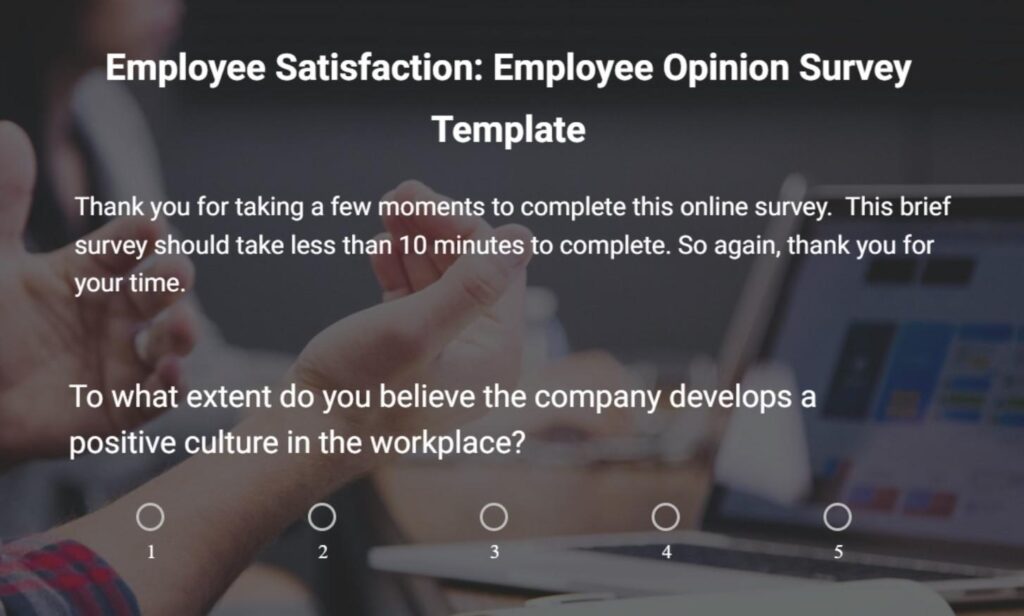
Here’s a company culture survey template you can tweak and use:
Open-Text Questions (Pick 2 or 3)
These are the differences between “we got scores” and “we understand what is behind the scores.”
- What is one thing we should stop doing because it is hurting how work gets done?
- What is one change that would most improve your day-to-day work experience?
- Where do you see the biggest gap between our stated values and how work actually happens?
- What is one thing we should protect because it is working well?
Tip: keep open-text optional if you want higher completion. You will still get enough signal if you ask the right prompts.
Leadership & Transparency Questions (Optional Module)
Use this module if you are diagnosing decision clarity and leadership trust. Pick 5 to 7.
- Leadership communicates the “why” behind major decisions.
- Information flows fast enough for me to do my job well.
- I trust leadership to address problems rather than avoid them.
- Leaders are visible and accessible when it matters.
- Changes are communicated early enough to prepare.
- Leadership behavior aligns with the values we talk about.
- I believe leadership will act on feedback from this survey.
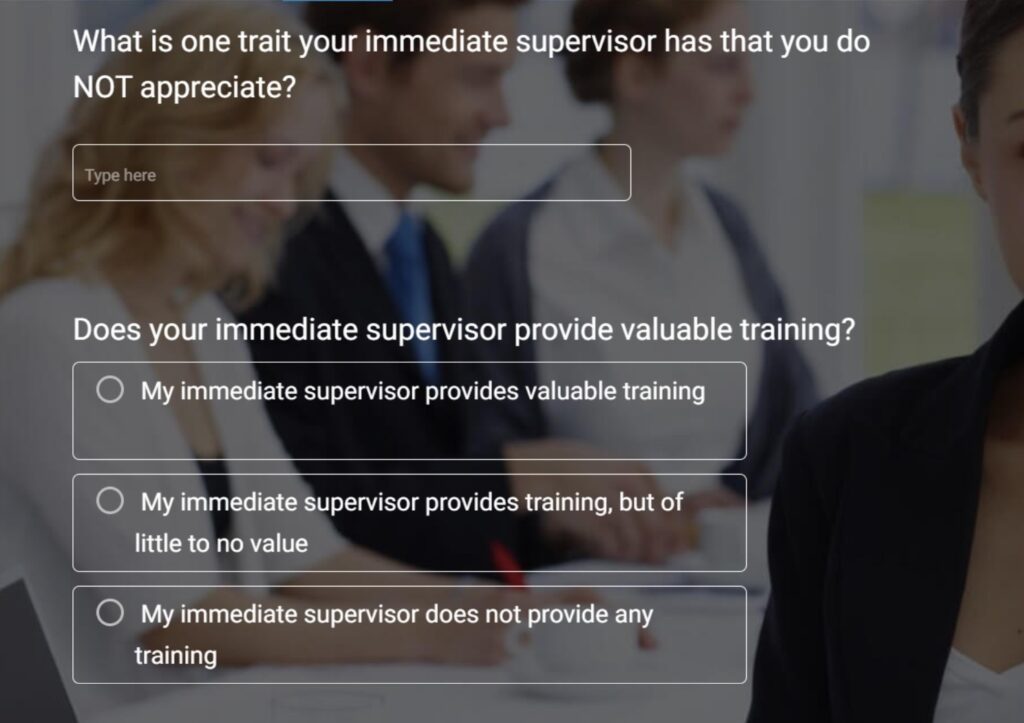
Here’s a quick and easy leadership survey template:
Psychological Safety & Speaking Up Questions (Optional Module)
Use this module if dissent is low, meetings are quiet, or issues surface late. Pick 5 to 7.
- I can ask questions without feeling judged.
- I can challenge decisions respectfully without risking my standing.
- I can raise issues before they become bigger problems.
- People listen to different viewpoints, even when they disagree.
- It is safe to admit mistakes on my team.
- Conflict is handled directly and professionally.
- I believe retaliation for speaking up is not tolerated here.
Inclusion & Fairness Questions (Optional Module)
Use this module if you are seeing uneven experiences across groups. Pick 5 to 7.
- People are treated fairly across teams and roles.
- Promotions and opportunities are based on performance, not favoritism.
- Different perspectives are respected in decision-making.
- I feel included in my team’s day-to-day work.
- Disrespectful behavior is addressed quickly.
- I trust the organization to handle sensitive issues appropriately.
- I feel comfortable being myself at work.
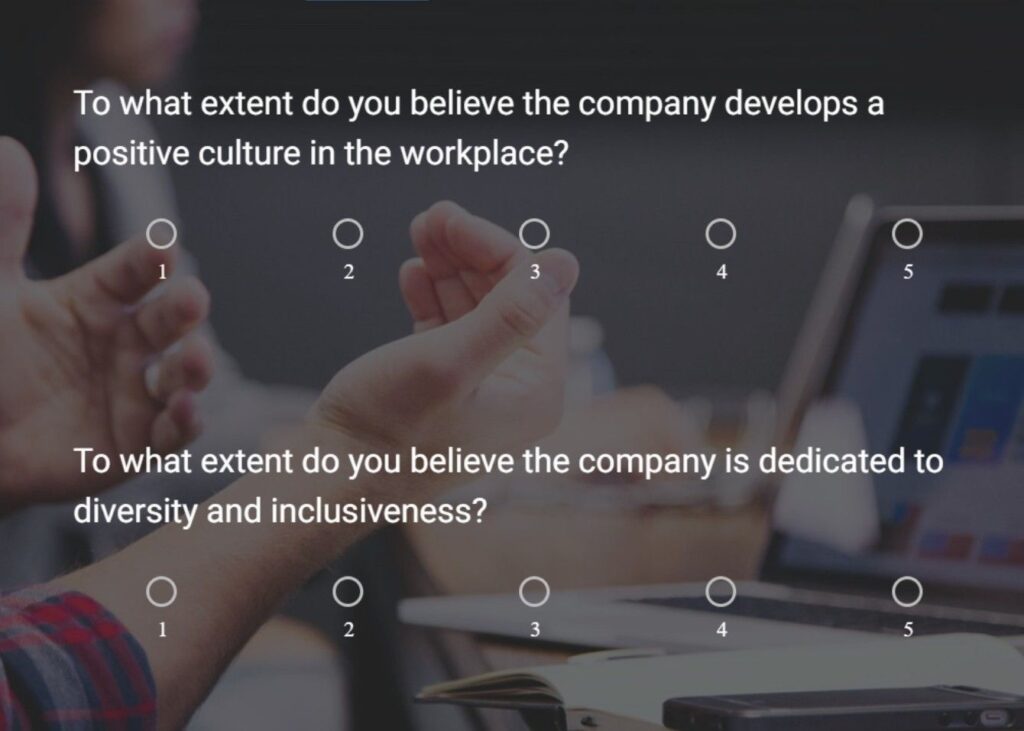
Here’s an inclusion survey template for you to tweak and customize:
Workload & Sustainability Questions (Optional Module)
Use this module if burnout, churn, or constant urgency is showing up. Pick 5 to 7.
- My workload is manageable within normal working hours.
- Deadlines are realistic given staffing and priorities.
- I can focus on high-impact work without constant interruptions.
- Meetings are run efficiently and respect time.
- I have enough autonomy to manage my work effectively.
- I can take time off without work piling up unreasonably.
- The organization makes adjustments when the workload becomes unsustainable.
Quick Question Design Rules (so the Data Stays Clean)
- Ask one idea per question.
- Avoid leading phrases like “How successful is…” and use neutral wording instead.
- Keep the scale consistent across most questions.
- Do not ask for identifying details in open-text responses.
If you build the survey in ProProfs Survey Maker, you can keep these questions as reusable sections, then turn modules on or off based on what you need to diagnose in a given cycle. You can also use employee survey templates for company culture and other sensitive topics.
FREE. All Features. FOREVER!
Try our Forever FREE account with all premium features!
How to Analyze Company Culture Survey Results
Once responses come in, the temptation is to jump straight to averages. That is how you end up with a “3.8 out of 5” culture score and no idea what to do next.
I analyze culture results the same way I analyze any operational system: coverage first, signal second, action third.
Start With Coverage (Before You Trust Any Insights)
You are checking whether the data represents reality or just the loudest pockets.
Look at:
- Response rate overall
- Response rate by major function (Sales, Support, Operations, Product)
- Response rate by location, if relevant
If one major group is missing, treat your insights as directional, not definitive.
Identify the Highest-Leverage Signals
Do not rank every question. Pick the ones that actually shape day-to-day execution.
I usually start by pulling:
- The lowest-scoring themes (your biggest friction)
- The highest-scoring themes (what you must protect)
- The biggest gaps between groups (where experience diverges)
This keeps you out of spreadsheet theater.
Use Open-Text Responses to Explain the Scores
Open text is not for collecting essays. It is for explaining patterns.
Here’s the workflow that stays efficient:
- Scan for repeated phrases and recurring issues.
- Group comments into 5 to 7 themes max.
- Count the frequency of themes, so you know what is widespread versus isolated.
- Pull a few anonymized, non-identifying examples to illustrate each theme internally.
Avoid sharing raw verbatim comments publicly if they can identify individuals or teams. Summaries are safer and more useful.
Create a Simple Tracking Baseline
You need a way to prove movement.
Pick:
- A small set of repeat questions you will keep constant next time
- One operational metric per priority (attrition hotspot, cycle time, internal escalations, manager 1:1 cadence adherence)
A culture survey is useful when it becomes a repeatable measurement system, not a one-time event. For a complete, 360-degree system, you can opt for a smarter employee learning suite.
What to Do After the Survey (so It Leads to Real Change)
If you want future culture surveys to be honest, the follow-through matters more than the questions. People stop responding when nothing changes. The fix is straightforward; just communicate fast, choose a small number of priorities, and show progress on a predictable cadence.
| Timeline | What You Do | What You Publish Internally | Output You Should Have |
|---|---|---|---|
| Within 48 Hours | Acknowledge participation and set expectations. | Thank you message. Date for sharing results. Date for announcing priorities. | A clear timetable that prevents silence and rumors. |
| Within 2 Weeks | Share results in a tight summary, not a data dump. | Top 3 strengths to protect. Top 3 friction points to fix. 5 to 7 open-text themes (summarized). | A shared view of reality without noise or defensiveness. |
| Within 30 Days | Commit to a short list of priorities with ownership. | 2 to 3 priorities. One owner per priority. 30 to 90-day plan. One measurable signal per priority. | A real action plan that can be tracked and held accountable. |
| 30 to 90 Days | Ship quick wins and start deeper fixes. | What shipped. What is next? What is blocked? Support is needed from teams. | Visible proof that the survey changed decisions and behavior. |
| Ongoing Monthly | Track progress on a stable cadence. | Monthly progress update per priority. Simple metrics trend. | Momentum is not a one-time activity. |
| Before the Next Survey | Close the loop with proof and prepare the next run. | “You said. We did.” recap. What is still in progress? | Higher trust and higher response quality next cycle. |
A practical rule I follow: if you cannot name the priorities, owners, and first shipping date, you are not “acting on results.” You are collecting feedback for decoration.
Trust And Sensitive Topics: How to Get Truth Without Creating Risk
At this point, assume one thing: a portion of your workforce will treat culture surveys with suspicion. Not because they are cynical, but because they have seen “anonymous feedback” used badly elsewhere.
Your job here is to remove the most common reasons people self-censor. That is what turns your survey into a usable signal. First, make your surveys genuinely anonymous. Here’s how you can do it:
Where Trust Breaks In Real Life
Fear of Retaliation: People worry their feedback will come back to them through inference, writing style, or small-team math. When that fear exists, they answer in safe, middle-of-the-road language. You get clean-looking averages and no diagnostic value.
Fear of Exposure Through Comments: Open-text responses feel risky because they reveal context. Even when names are not mentioned, specifics can identify the author.
Fear of Wasted Effort: If previous surveys led to vague announcements and no visible movement, leaders are not fighting “survey fatigue.” They are fighting learned indifference.
How to Include Sensitive Topics Without Turning the Survey Into an Incident Channel
If you want to measure sensitive areas like harassment, discrimination, or bullying, design it to measure the environment and reporting confidence, not to collect case narratives.
Use these principles:
- Keep questions tightly structured so responses can be aggregated without revealing identity.
- Avoid prompts that invite storytelling about a specific person or event.
- Use time-bounded phrasing so results reflect a defined window and can be tracked.
Build a Culture Survey System You Can Run Every Quarter
A company culture survey is not a one-off initiative. It is a repeatable operating system for reducing friction inside the business.
Run it with a clear objective. Keep the instrument lean. Time it based on your ability to follow through, not your desire for fresh data. Ask questions that produce comparable signals. Analyze results in a way that highlights where execution is breaking. Then make a small set of priorities visible, owned, and measurable.
If you do that, you do not just “improve culture.” You improve throughput, retention, and decision quality because the day-to-day experience starts matching the standard you expect.
When you are ready to launch, ProProfs Survey Maker can help you move faster by giving you templates, flexible distribution options, and reporting workflows in one place.
Frequently Asked Questions

What are the 4 types of company culture?
A common model groups culture into four types: Clan (collaboration and belonging), Adhocracy (innovation and experimentation), Market (competition and results), and Hierarchy (stability and process). Most organizations are a blend, but one style usually dominates. Use your survey to see which behaviors are rewarded in practice across teams and leaders.
What are the 4 C's of company culture?
Frameworks vary, but a practical set of four C’s is: Clarity (people know what good looks like), Consistency (standards apply across teams), Communication (decisions and context flow fast), and Commitment (leaders back values with time, budget, and consequences). Survey each C to find where culture breaks operationally in daily work.
How often should I run a company culture survey?
Run a comprehensive company culture survey annually to set a baseline and measure year-over-year movement. Add a short quarterly pulse using the same core questions to spot drift early. For smaller teams, twice yearly may be enough. Only increase frequency if you can act visibly between runs consistently.
How do I reach employees who do not have a company email for a culture survey?
Design distribution for ground-level access. Use a short link and QR codes posted in common areas, plus shared tablets or kiosks on site. Keep the survey mobile-friendly for personal phones. If you must authenticate, use employee IDs or PINs so you can prevent duplicates without requiring individual email-based logins.
FREE. All Features. FOREVER!
Try our Forever FREE account with all premium features!

 We'd love your feedback!
What did you like & how can we make it even better?

 Thanks for your feedback!
 Ask Your Question
Have a question? Get expert help to make your decision easier.