Emma David, a seasoned market research professional, specializes in employee engagement, survey administration, and data management. Her expertise in leveraging data for informed decisions has positively impacted several brands, enhancing their market position.
Distinguish race (physical) vs ethnicity (cultural) and use a two-question flow: ethnicity first, then race with multi-select and an "Other," then standardize wording to keep data comparable and more inclusive.
Choose approaches that reduce friction—warm intros, open-ended self-descriptions, or an integrated format—then train HR/L&D and managers to model respectful asks and update forms without overburdening respondents.
Protect people and usefulness—explain purpose, ensure confidentiality, avoid stereotypes, and plan reporting by segment—then turn insights into targeted support, fair policies, and measurable DEI outcomes.
Navigating the topic of race and ethnicity in surveys can be tricky. We all want to ask the right questions, but how do we do it without causing offense or discomfort?
This guide will walk you through all the answers, along with practical tips and examples.
First, let’s look at a quick tutorial on creating online surveys.
Watch: How to Create a Survey Using ProProfs Survey Maker
Let’s begin by understanding the difference between race and ethnicity. Although used interchangeably, these two terms have a subtle difference and refer to different aspects of identity.
Race typically refers to physical characteristics such as skin color, facial features, and hair texture. It’s a social construct used to categorize and divide people based on these observable traits.
Ethnicity, on the other hand, relates to cultural factors such as nationality, language, religion, and traditions. Ethnicity is also more complex in nature, as a person’s race is physical and unchangeable, while their ethnicity is cultural and can be more fluid.
For instance, an American-born woman might identify as Asian racially, but her ethnicity could be European, Indo-American, or another specific cultural identity.
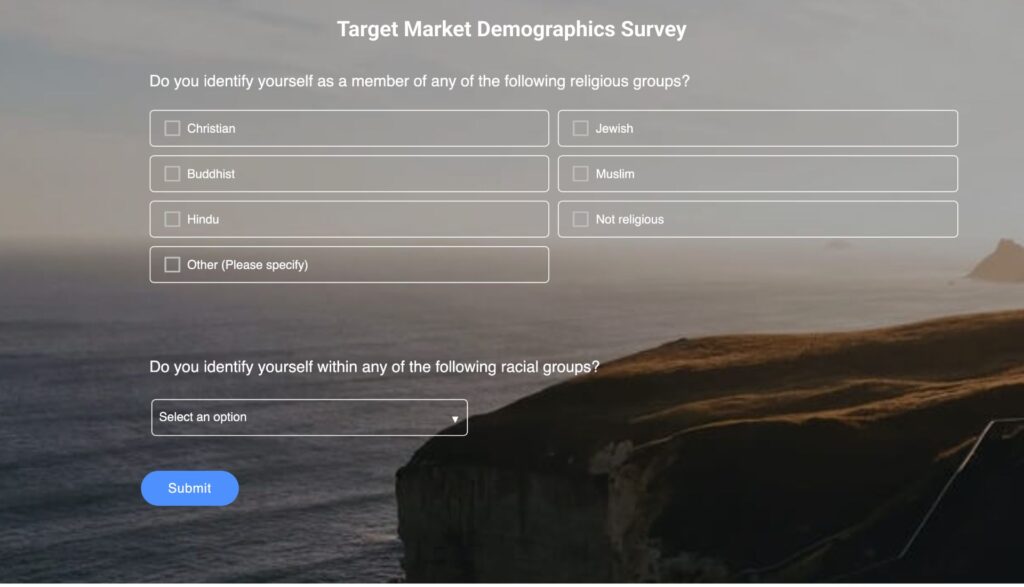
Race and ethnicity questions are often paired in surveys to get a fuller picture. FDA recommends a two-question format to get the most accurate responses: first, ask about ethnicity, then follow with a question about race.
For example:
1. What would you describe yourself as? (Ethnicity)
Hispanic or Latino
Non-Hispanic or non-Latino
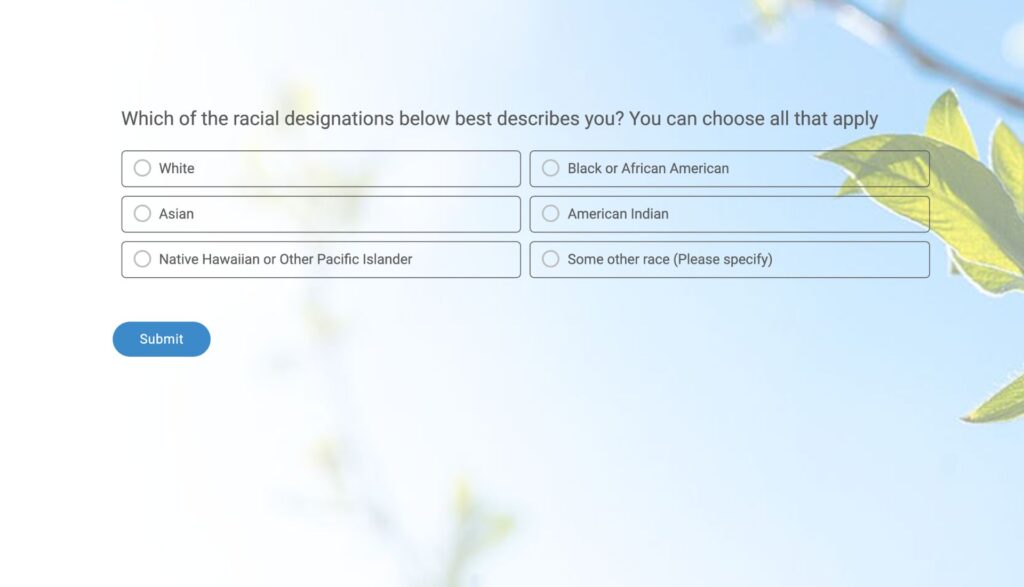
2. Which of the race designations below best describes you? You can choose all that apply.
","text/html");
function clean(node){
if(node.nodeType===3){var t=node.textContent.replace(/\s+/g," ").trim();return t?t:"";}
if(node.nodeType!==1)return "";
var tag=node.tagName;
if(!allowed[tag])return Array.prototype.map.call(node.childNodes,clean).join("");
if(tag==="BR")return " ";
var inner=Array.prototype.map.call(node.childNodes,clean).join("");
if(tag==="A"){
var href=(node.getAttribute("href")||"").trim();
if(!/^https?:\/\//i.test(href))return inner;
return ''+inner+"";
}
return "<"+tag.toLowerCase()+">"+inner+"";
}
return Array.prototype.map.call(doc.body.childNodes,clean).join("");
}
function addBot(html,stacked){var r=document.createElement("div");r.className="proprofs_ai_chat__row";r.innerHTML='
'+(stacked?'':'')+'
'+linkify(html)+'
';scroll.appendChild(r);scrollToBottom();}
function addUser(t){var r=document.createElement("div");r.className="proprofs_ai_chat__row proprofs_ai_chat__row--user";var b=document.createElement("div");b.className="proprofs_ai_chat__user-bubble";b.textContent=t;r.appendChild(b);scroll.appendChild(r);scrollToBottom();}
function addCrisis(){var r=document.createElement("div");r.className="proprofs_ai_chat__row";r.innerHTML='
';scroll.appendChild(r);scrollToBottom();}
function typingOff(){var t=document.getElementById("proprofs_ai_chat_typing");if(t)t.remove();}
function typingOn(){typingOff();var r=document.createElement("div");r.className="proprofs_ai_chat__row";r.id="proprofs_ai_chat_typing";r.innerHTML='
';scroll.appendChild(r);scrollToBottom();}
function respond(text,questionType){
questionType=(questionType===1)?1:0;
startAiChatDurationTimer();
if(crisisLatch||hitsTripwire(text)){
crisisLatch=true;
addCrisis();
saveChatTurn(text,CRISIS.title+" "+CRISIS.body.replace(/<[^>]+>/g," "),true,questionType);
return;
}
busy=true;sendBtn.disabled=true;typingOn();
history.push({role:"user",content:text});
fetch(PROXY_URL,{
method:"POST",headers:{"Content-Type":"application/json"},
body:JSON.stringify({messages:history,articleTitle:ARTICLE_TITLE,artile_description:artile_description,coachName:"ProProfs Survey AI Coach"})
}).then(function(r){return r.json();}).then(function(data){
typingOff();
var reply=(data&&data.reply)?data.reply:"Sorry, something went wrong. Please try again.";
history.push({role:"assistant",content:reply});
saveChatTurn(text,reply,false,questionType);
var chunks=reply.split(/\n\s*\n/).map(function(c){return c.trim();}).filter(Boolean);
if(chunks.length===0){busy=false;sendBtn.disabled=false;return;}
var delay=0;
chunks.forEach(function(chunk,idx){
setTimeout(function(){
typingOff();
addBot(sanitizeHtml(chunk),idx>0);
if(idxYou could start with';
STARTERS.forEach(function(q){var b=document.createElement("button");b.className="proprofs_ai_chat__starter";b.textContent=q;b.addEventListener("click",function(){send(q,1);});st.appendChild(b);});
scroll.appendChild(st);
})();
Examples and Approaches to Asking Race and Ethnicity Questions
Creating race and ethnicity survey questions can be challenging, but there are several effective methods to ensure respondents feel comfortable and respected. Here are three approaches:
Approach 1: The “Personal Connection” Approach
Start with a friendly tone to build rapport with respondents. This makes the survey feel more conversational and less formal, encouraging openness.
Example:
What’s your name?
It’s great to meet you, [Name]! Can you share a bit about your cultural background?
This approach eases into more personal questions by creating a sense of familiarity and trust.
Approach 2: The “Describe Yourself” Approach
Use open-ended questions to give respondents the freedom to describe their identity in their own words. This method acknowledges the complexity of identity and provides rich, detailed data.
Example:
Can you tell us about your ethnic background?
How would you describe your race and ethnicity?
Open-ended questions allow respondents to express their identity more fully, capturing nuances that predefined options might miss.
Approach 3: The “Integrated Question” Approach
Combine race and ethnicity questions into a streamlined format. This reduces survey fatigue and simplifies the data collection process.
Example:Race Identification (Select one or more):
American Indian or Alaska Native
Asian
Black or African American
Native Hawaiian or Other Pacific Islander
White
Another race (please specify): ___________
Ethnicity:
Are you of Hispanic, Latino, or Spanish origin?
Yes
No
Additional Details (Optional):
Please specify your ethnic background or cultural identity: ___________
This integrated approach ensures clarity and comprehensiveness, making it easier for respondents to provide accurate information.
Where to Use Race and Ethnicity Survey Questions?
Race and ethnicity survey questions are crucial in various contexts to gather valuable demographic data. Here are some key areas where they are commonly used:
1. Healthcare Research:
To identify health disparities among different racial and ethnic groups.
To develop targeted health intervention policies.
2. Educational Institutions:
To understand the diversity of the student population.
To tailor educational programs and support services.
3. Market Research:
To segment the market and develop products that meet the needs of diverse groups.
To create inclusive marketing strategies.
4. Public Policy and Government Surveys:
To inform policy decisions and allocate resources effectively.
To ensure representation and equity in public services.
5. Workplace Diversity and Inclusion:
To assess and improve diversity initiatives.
To create an inclusive work environment.
6. Sociological and Demographic Studies:
To study population trends and social dynamics.
To understand cultural integration and identity issues.
Advantages and Disadvantages of Race and Ethnicity Survey Questions
Asking race and ethnicity questions in surveys can provide a wealth of valuable insights, but it’s important to weigh the benefits against potential drawbacks. Let’s explore both sides:
Advantages:
Informed Decision-Making: Collecting race and ethnicity data helps organizations make informed decisions about policies, programs, and services tailored to diverse populations.
Promoting Inclusion: These questions can highlight underrepresented groups, fostering inclusivity and ensuring their needs and perspectives are considered.
Identifying Disparities: In sectors like healthcare and education, understanding racial and ethnic backgrounds can reveal disparities, guiding efforts to address inequities and improve outcomes.
Market Insights: Businesses can use this data to understand their customer base better, leading to products and marketing strategies that resonate with different demographic groups.
Enhancing Diversity Initiatives: In workplaces, gathering this information supports diversity and inclusion efforts, helping to create a more equitable environment.
Limitations:
Sensitivity and Privacy Concerns: Asking about race and ethnicity can be sensitive. Respondents might feel uncomfortable or perceive the questions as intrusive, affecting their willingness to participate.
Risk of Misinterpretation: If not phrased carefully, these questions can be misunderstood, leading to inaccurate data. It’s crucial to provide clear definitions and context.
Potential for Bias: There’s a risk that the collected data could reinforce stereotypes or be used to discriminate if not handled responsibly and ethically.
Complexity in Responses: Race and ethnicity are complex and multifaceted. Standard categories might not fully capture an individual’s identity, leading to oversimplification.
Data Sensitivity Management: Collecting this data requires careful management to protect respondents’ privacy and comply with legal and ethical standards.
FREE. All Features. FOREVER!
Try our Forever FREE account with all premium features!
Best Practices for Writing and Asking Race and Ethnicity Survey Questions
1. Be Clear and Transparent
Explain why you’re asking for race and ethnicity information, how it will be used, and how it will be protected. This builds trust and encourages honest responses.
2. Use Inclusive Language
Avoid outdated or offensive terms. For instance, instead of “Oriental,” use “Asian.” Provide options that reflect modern understandings of identity.
3. Allow for Multiple Selections
Enable respondents to select multiple categories. A single option might not be adequate enough to cover all aspects of the respondent’s identity and will lead to false data or incomplete surveys.
4. Provide an “Other” Option
Include an open-ended option such as “Other (please specify)” to respect identities not listed. This allows individuals to self-identify more accurately and inclusively.
5. Be Sensitive to Complexity
Recognize that identity can be complex and nuanced. Avoid broad categories that might misrepresent someone’s background. For instance, instead of just “Asian,” consider options like “East Asian,” “South Asian,” and “Southeast Asian.”
6. Separate Race and Ethnicity Questions:
Use a two-question format: first, ask about ethnicity (e.g., “Are you of Hispanic, Latino, or Spanish origin?”), then follow with a race question (e.g., “What is your race? Select all that apply: White, Black or African American, Asian, etc.”). This also aligns with the recommended question format and helps clarify responses.
7. Ensure Confidentiality
Clearly communicate the confidentiality of responses and ensure you will uphold it. If your survey is anonymous, state, “Your answers will remain confidential and are used only for statistical analysis” to ease participants’ minds and garner more responses.
Create Inclusive and Effective Ethnicity Survey Questions
Asking the right questions about race and ethnicity can transform your surveys from routine tasks into powerful tools for inclusivity and insight. It’s about more than gathering data—it’s about showing respect for the diverse identities of your respondents.
When you choose your words carefully, offer inclusive options, and ensure privacy, you don’t just get better data—you build trust and show your commitment to equality. Approach your surveys with thoughtfulness and respect, and you’ll make an impact.
If you think you need a nudge in the right direction, use tools with pre-made survey templates and make sure it includes as many question types as possible to truly capture the data you seek.
Collecting race data helps to understand and address disparities, promote inclusivity, and make informed decisions based on demographic insights.
2. Where does race data come from?
Race data is provided by respondents who self-identify their racial background on surveys and forms.
3. How to ask questions on ethnicity
Ask about ethnicity using clear and respectful language. Provide multiple options, including an “Other” category for self-description and separate ethnicity questions from race questions.
Let ProProfs AI Build a Survey
Describe your survey and we'll create it for you
FREE. All Features. FOREVER!
Try our Forever FREE account with all premium features!
Emma David is a seasoned market research professional with 8+ years of experience. Having kick-started her journey in research, she has developed rich expertise in employee engagement, survey creation and administration, and data management. Emma believes in the power of data to shape business performance positively. She continues to help brands and businesses make strategic decisions and improve their market standing through her understanding of research methodologies.



![How to Ask Race & Ethnicity Survey Questions_ A Professional Guide [With Examples]](https://www.proprofssurvey.com/blog/wp-content/uploads/2024/12/How-to-Ask-Race-Ethnicity-Survey-Questions_-A-Professional-Guide-With-Examples.png)

 We'd love your feedback!
 Thanks for your feedback!