

If you are running quarterly all-hands meetings, annual conferences, or recurring training days for a team of 30 to 50 people, you already know the pattern.
The event ends, a few people leave comments in a chat, and you are left guessing what actually worked and what to fix before the next one.
That guess becomes the brief for next quarter’s budget conversation, and the cycle repeats.
The difference between event teams that improve year over year and those that stagnate is not the events themselves.
It is the feedback infrastructure around them. Specifically, what questions they ask, when they ask them, and which stakeholder groups they ask.
This guide gives you a complete question bank across every stage and audience type: the question formats that produce analyzable data, how to structure surveys for high response rates, and a step-by-step walkthrough for building your own three-stage event feedback system.
What Are Event Survey Questions?
Event survey questions are structured prompts sent to attendees, sponsors, speakers, or volunteers before, during, or after an event to collect feedback on their experience, expectations, and outcomes. For recurring events, they function as the measurement layer that tells you whether each cycle is improving, stagnating, or regressing, and what specifically to change before the next one.
The gap between useful and useless event survey questions is specificity.
“Did you enjoy the event?” gives you a satisfaction rate that means nothing without context.
“Which session gave you the most practical value today?” tells you what to anchor the next event around and what to cut.
Every question in your survey should map to a decision you need to make before the next cycle.
Types of Survey Questions About Events
Before you choose questions, choose the right format.
For teams without a research function, question type determines not just how respondents engage but how quickly you can turn answers into decisions.
| Question Type | Best Used For | When to Use It |
| Rating Scale (1-5 or 1-10) | Overall satisfaction, session quality, speaker effectiveness | Every post-event survey, pick one scale and stick with it across all events for trend tracking |
| NPS (0-10) | Future attendance intent, word-of-mouth potential | Place second in every post-event attendee survey |
| Multiple Choice | Session preferences, logistics feedback, format choices | Anywhere you need fast, analyzable data from a small response pool |
| Yes/No | Binary confirmations: tech issues, dietary needs, session attendance | Pre-event logistics and mid-event pulse checks |
| Open-Ended | Improvement ideas, standout moments, unexpected friction | One to two questions maximum per survey; place at the end |
| Likert Scale | Measuring agreement with outcome statements | Useful for L&D teams tracking whether training events changed behavior or confidence |
One consistent scale across all your recurring events matters more than most teams realize.
If you use 1-5 one quarter and 1-10 the next, you lose the ability to compare satisfaction over time, which is exactly the trend data leadership wants to see.
Pre-Event Survey Questions to Ask Registrants
Most event managers send surveys after. The pre-event survey is where significant leverage is left on the table.
According to SpotMe’s 2025 data, drawing on data from over 12,000 event builders, getting registrants to interact with event content before the event increases actual attendance by up to 60%.
For a recurring conference or training day where no-shows are a persistent problem, that is a meaningful number.
Beyond attendance, pre-event questions give you what you need to calibrate content before it is too late to change anything.
If 70% of your registrants are beginners and you have planned an advanced session, a pre-event survey catches that gap a week out, not the morning of.
Send this survey 5-7 days before the event, immediately after registration confirmation. Keep it to 5-8 questions. Registrants have not attended yet, and their motivation to complete a long survey is low.
| # | Question | What It Gauges |
| 1 | What are you hoping to get out of attending this event? | Whether your content plan matches actual attendee goals |
| 2 | Which topics or sessions are you most looking forward to? | Session demand so you can allocate time and room capacity correctly |
| 3 | How familiar are you with the main topic of this event? (Beginner / Intermediate / Advanced) | Audience expertise level so speakers can calibrate depth and not lose the room |
| 4 | What is your biggest challenge related to [event topic] right now? | The real problem your attendees are trying to solve, which is what your content should address |
| 5 | Do you have any dietary restrictions or accessibility needs we should know about? | Day-of operational requirements that are expensive to fix at the last minute |
| 6 | Are you planning to attend the networking session? | Headcount for breakout planning, so you do not under-resource or cancel it |
| 7 | What is your preferred format for receiving event materials? (Digital / Printed / Both) | Materials planning so you do not over-print or under-prepare |
| 8 | Is there a specific question you are hoping to get answered at this event? | Unmet needs you can address in Q&A or speaker briefings before the day |
Questions 1, 4, and 8 are the content brief for your speakers. Questions 3 and 6 are the logistics brief for your operations.
Questions 5 and 7 prevent the small-team fire drills that eat up morning-of bandwidth.
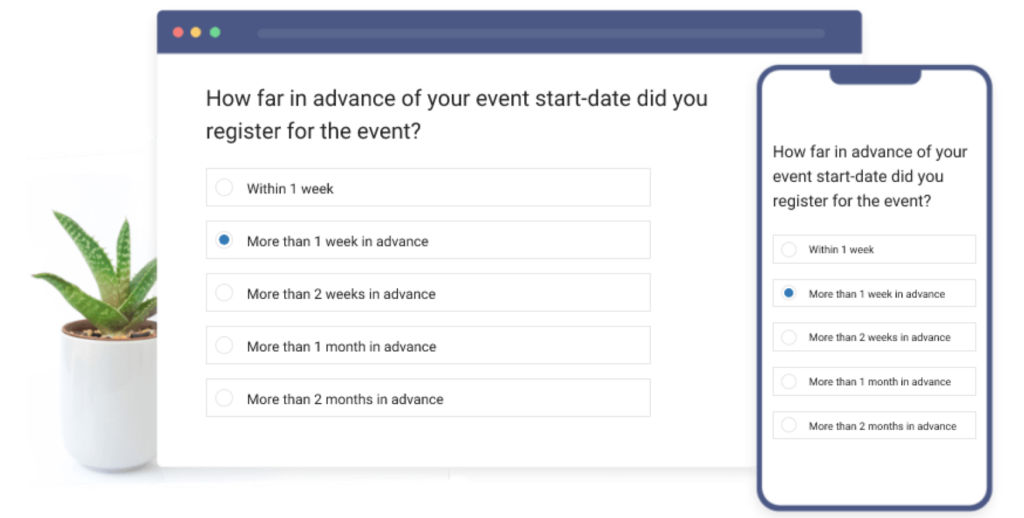
Here’s a quick pre-event survey template you can use:
Post-Event Survey Questions to Ask Attendees
Post-event attendee surveys are the most commonly used category and the most commonly done wrong. The two most common failure modes are sending too late and asking too many questions.
Keep the survey to 5-8 questions. Put the most important question on the first screen so you capture it even from respondents who drop off.
Here is how this plays out for an HR team running a quarterly all-hands:
The survey goes out within two hours of the session ending, covers seven questions, and by the end of business, the team has a satisfaction score, an NPS, a session ranking, a logistics rating, and five to eight open-ended improvement suggestions.
That is enough to write a one-page brief for the leadership team and adjust the format for the next quarter before the planning window closes.
| # | Question | What It Gauges |
| 9 | Overall, how would you rate this event? (1-5 scale) | Your baseline satisfaction score to track across recurring events |
| 10 | How likely are you to recommend this event to a colleague? (0-10 NPS scale) | Whether attendees would bring others next time, which is your growth signal |
| 11 | Which session or speaker did you find most valuable, and why? | What to anchor the next event around, and what to cut or restructure |
| 12 | Did the event meet the expectations set by our pre-event communications? | Whether your promotion and agenda are aligned with what you actually delivered |
| 13 | How would you rate the event logistics? (registration, venue, timing) | Operational execution score to present to vendors and justify budget decisions |
| 14 | What is one thing we should change for the next event? | The single most actionable improvement input you will get from the entire survey |
| 15 | Would you attend another event from us in the next 12 months? | Repeat attendance intent, which is the most direct proxy for event program ROI |
Question 11 is the one most teams underuse. It does not just tell you what was popular.
It tells you whether the value came from the speaker’s delivery, the topic depth, or the practical takeaways. Those three answers point to three different fixes if the score is low.
Question 15, framed alongside your NPS from question 10, gives you the two strongest signals for a leadership ROI conversation: would they come back, and would they bring someone with them?
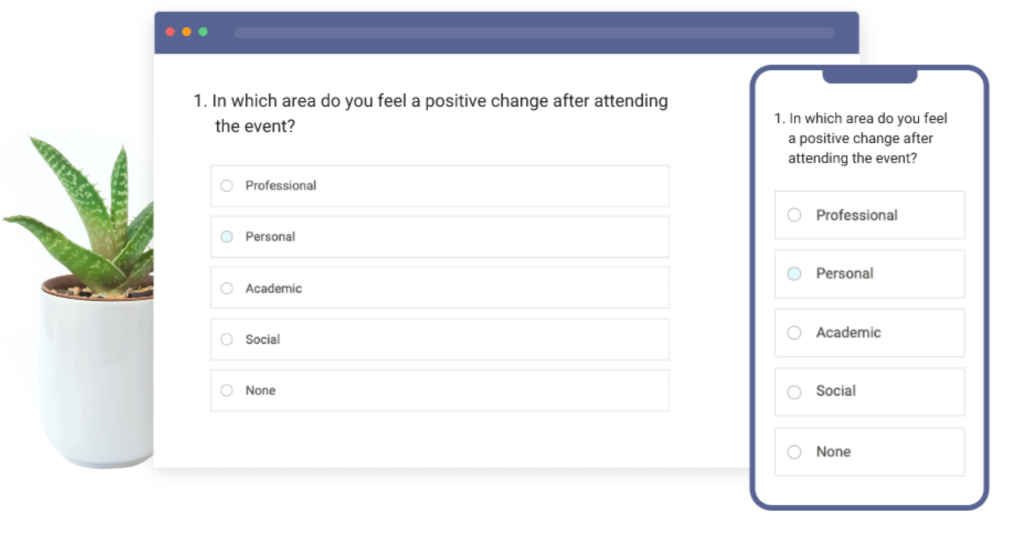
Here’s a post-event survey template for you to use:
FREE. All Features. FOREVER!
Try our Forever FREE account with all premium features!
Good Post-Event Survey Questions for Sponsors
For business services firms and consulting organizations running client advisory boards or industry conferences, sponsors are not peripheral.
They are how the event budget stays solvent and how the next event gets funded.
A sponsor who feels their brand was invisible to attendees will not renew, and most will not tell you why unless you ask directly.
Send the sponsor survey within 48 hours, separately from your attendee survey.
Keep it shorter, around five to seven questions. Sponsors have less patience for long feedback forms than attendees do.
| # | Question | What It Gauges |
| 16 | How satisfied were you with the sponsorship experience overall? (1-5 scale) | Overall sponsor satisfaction to track across event cycles |
| 17 | Did the event audience align with your target customer profile? | Whether the audience you delivered matched what you promised in the sponsorship pitch |
| 18 | How effective was the event in showcasing your brand to attendees? | Brand visibility, which is the primary thing sponsors are paying for |
| 19 | What type of attendee interaction did you experience at your booth or session? | Whether the engagement was lead-quality or just foot traffic |
| 20 | Would you consider sponsoring future events from our organization? | Renewal likelihood, which is the number you need to bring into the next cycle’s budget planning |
| 21 | What would make the sponsorship package more valuable for your goals? | Exactly how to restructure your packages before the next pitch cycle |
| 22 | How would you rate the communication and support you received from our team? | Whether your team’s operational support is a retention factor or a churn risk |
Question 21 is the most important one on this list. It is the question sponsors want to answer and that almost no one asks.
The answers tell you whether to adjust logo placement, add dedicated networking time, create speaking slots, or change audience targeting in your event promotion.
That is your next sponsorship sales brief.
Survey Questions to Ask Your Event Speakers
For recurring events, speaker quality is a retention driver, not just a day-of execution detail. Attendees remember speakers.
If the same names appear every cycle because you cannot attract new talent, satisfaction scores will flatline even if logistics improve.
Speaker surveys tell you two things: whether your operational support was strong enough that they would come back, and whether they would refer other speakers in their network to you.
That second signal is how you build a speaker pipeline without a dedicated events team.
| # | Question | What It Gauges |
| 23 | How well did the event team support you in preparing for your session? | Whether your pre-event speaker onboarding is a strength or a gap |
| 24 | Were the AV and technical facilities adequate for your presentation? | Whether your venue and tech setup meet professional expectations |
| 25 | How would you describe the quality of audience engagement during your session? | Whether the room composition matched the speaker’s content level |
| 26 | Did you experience any issues on the day that we should address for future events? | Day-of operational friction that your team may not have seen from the organizer’s side |
| 27 | How would you rate the overall event organization? | The event-wide impression that drives referrals to other speakers in their network |
| 28 | Would you speak at one of our future events? | Your speaker retention rate, which is a direct input to the next cycle’s programming budget |
| 29 | What is one thing we could do to improve the speaker experience? | The specific operational change that turns a one-time speaker into a recurring one |
If question 28 comes back negative at any meaningful scale, you have a speaker experience problem that will compound over time as your talent pool shrinks.
Question 29 tells you what is driving it.
Survey Questions That Work Best for Virtual Events
Virtual and hybrid events present a specific set of friction points that do not appear in in-person surveys.
Platform usability, screen fatigue, audio and video quality, and the structural absence of corridor conversations all affect the attendee experience in ways that a standard post-event survey will not surface unless you ask for them directly.
For HR teams and consulting firms that shifted quarterly town halls or client briefings to virtual formats, response rates for virtual event surveys also tend to run lower than in-person equivalents.
The most effective approach is a short pulse survey embedded inside the platform during the event, followed by a 5-7 question post-event survey sent within 24 hours while the experience is still fresh.
| # | Question | What It Gauges |
| 30 | How would you rate the overall virtual platform experience? (1-5 scale) | Whether the platform itself created friction that affected your content |
| 31 | Did you encounter any technical issues? If yes, please describe briefly. | The specific tech gaps your team needs to address before the next virtual cycle |
| 32 | How engaging did you find the sessions in the virtual format? | Whether your content format translates to a virtual audience or needs restructuring |
| 33 | Were the networking or interaction opportunities sufficient for a virtual event? | Whether attendees felt connected or isolated, which is the most common failure point in virtual events |
| 34 | How would you rate the audio and video quality throughout the event? | Production quality, which is the baseline expectation attendees have for virtual attendance |
| 35 | What features of the virtual platform did you find most useful? | Which platform investments are worth renewing, and which can be cut |
| 36 | What would improve your experience at our next virtual event? | Structural changes, not just technical fixes, that would change the format next time |
Question 33 is consistently where virtual events lose attendees across cycles. If scores here are low, the content was probably fine.
The problem is structural: not enough breakout rooms, no peer interaction mechanism, or sessions that run too long without audience participation. That is a format change, not a content change.
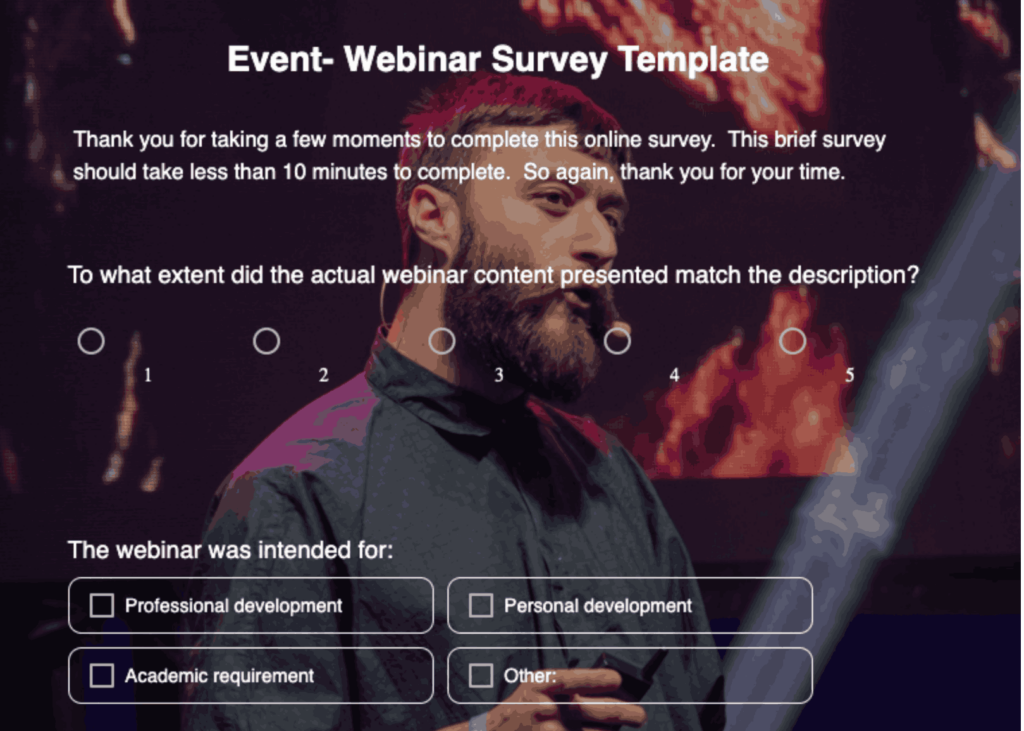
Here’s a webinar virtual event survey template you can tweak and use:
Best Survey Questions to Ask During a Live Event
Mid-event surveys are not about comprehensive feedback. They exist for one purpose: catching problems while you can still fix them.
If your registration desk caused a 20-minute queue, a mid-event pulse at the lunch break tells you before the closing session starts.
If a speaker ran 15 minutes over and compressed the Q&A everyone came for, you know, before the post-event survey goes out. That is data you can act on in hours, not weeks.
The most effective delivery mechanism for an event team is a QR code on screen between sessions, linking to a three-question mobile form.
More than three questions, and completion rates drop to the point where the data is not useful.
| # | Question | What It Gauges |
| 37 | How are you finding the event so far? (1-5 scale) | Real-time satisfaction so you can flag a problem to leadership before the day ends |
| 38 | Is there anything that is not meeting your expectations today? | Specific friction points you can address in the afternoon sessions or at the next break |
| 39 | What has been your favorite session or moment so far? | The standout so far, which is useful context when you write your post-event debrief |
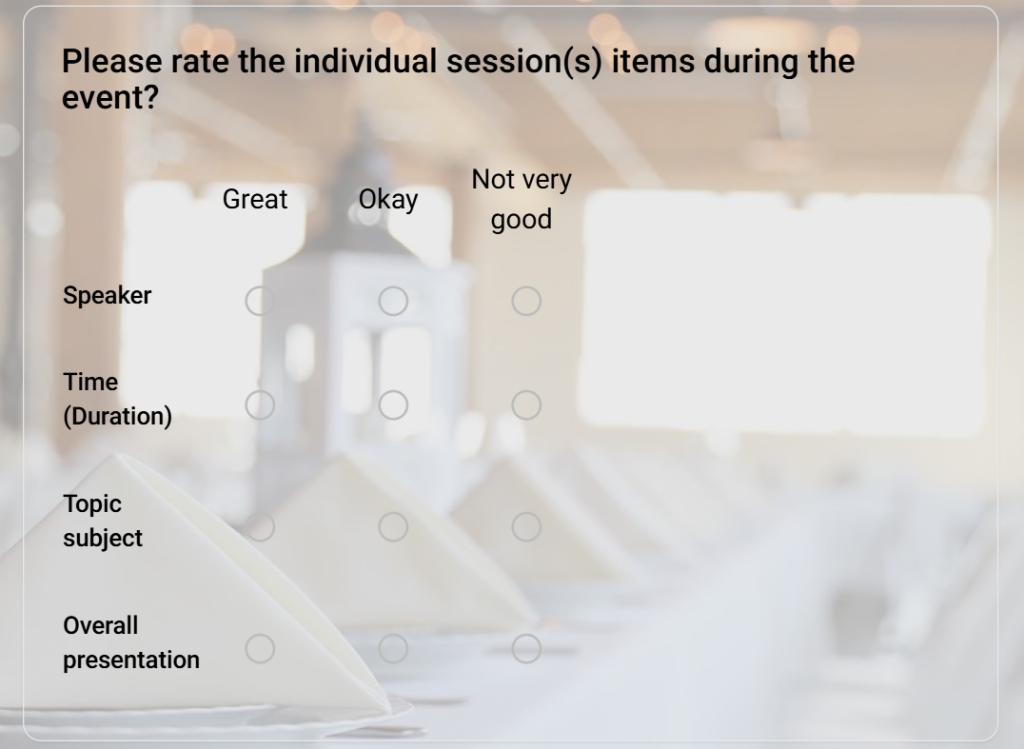
Here’s an event satisfaction survey template:
FREE. All Features. FOREVER!
Try our Forever FREE account with all premium features!
How Do You Create an Event Survey Using ProProfs Survey Maker?
If you are running three or four recurring events a year without a dedicated research team, rebuilding your survey from scratch each time is a planning tax you should not be paying.
The right tool lets you set up your three-stage feedback system once and reuse it across every event cycle.
Here is how event managers and HR teams use ProProfs Survey Maker to build their entire event feedback workflow:
Here’s the step-by-step breakdown:
Step 1: Choose Your Starting Point
Open ProProfs Survey Maker and either describe your event type and feedback goals in plain language to let the ProProfs AI Survey Maker generate a complete, ready-to-send survey in seconds.
You can try here using this prompt: [Create a post-event survey for a recurring corporate event attended by 30-50 professionals. The goal is to measure overall satisfaction, identify the most and least valuable sessions, rate event logistics, and capture one specific improvement for the next cycle.]:
Let ProProfs AI Build a Survey
Describe your survey and we'll create it for you
Or, you can browse the event survey templates to find one matched to your event format.
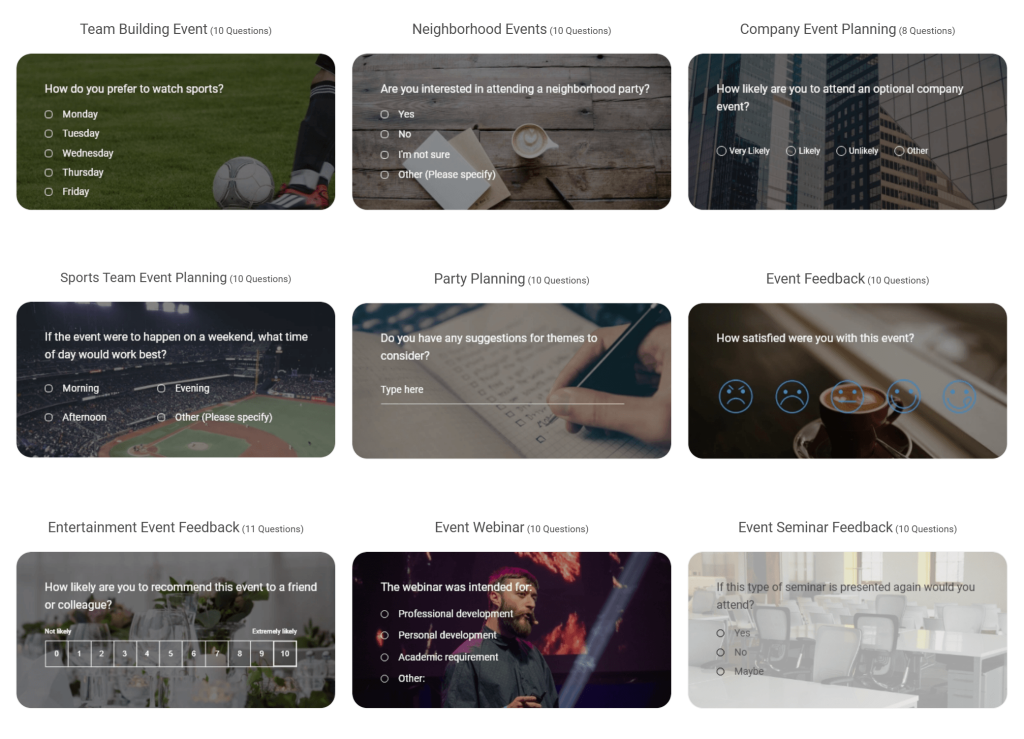
For recurring events, save your customized template once and reuse it each cycle with minor updates.
Step 2: Customize Your Questions
Add, remove, or reorder questions from the template using 1,000,000+ ready-to-use questions across the question bank.
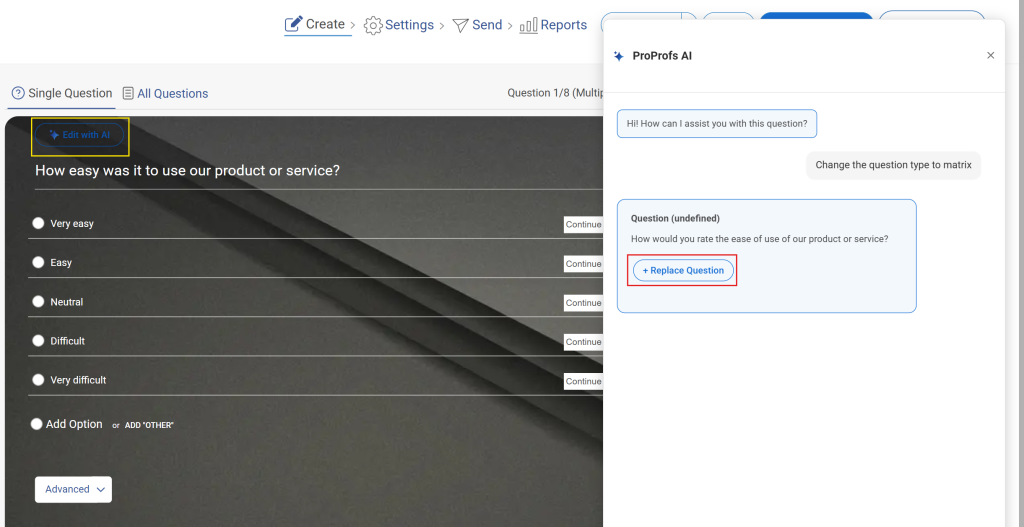
Select the right type for each question: rating scale for satisfaction tracking, NPS surveys for advocacy signals, multiple choice for session preference data, and open-ended for improvement input.
Step 3: Set Up Skip Logic
Use branching and skip logic so respondents only see questions relevant to them. Attendees who skipped the networking session do not see the networking questions.
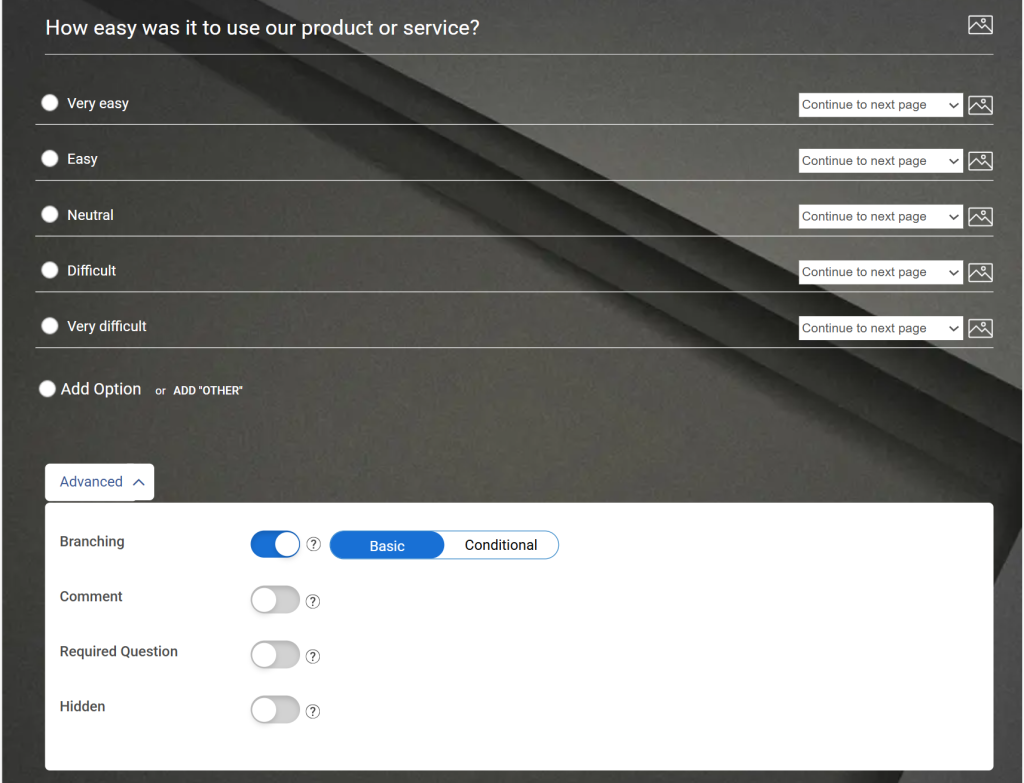
Sponsors get a different path than speakers. This keeps each survey short and each response set clean.
Step 4: Choose Your Distribution Channel
Send via email immediately after the event, embed the survey link in your post-event communication, or display a QR code on screen at the venue for in-person collection.
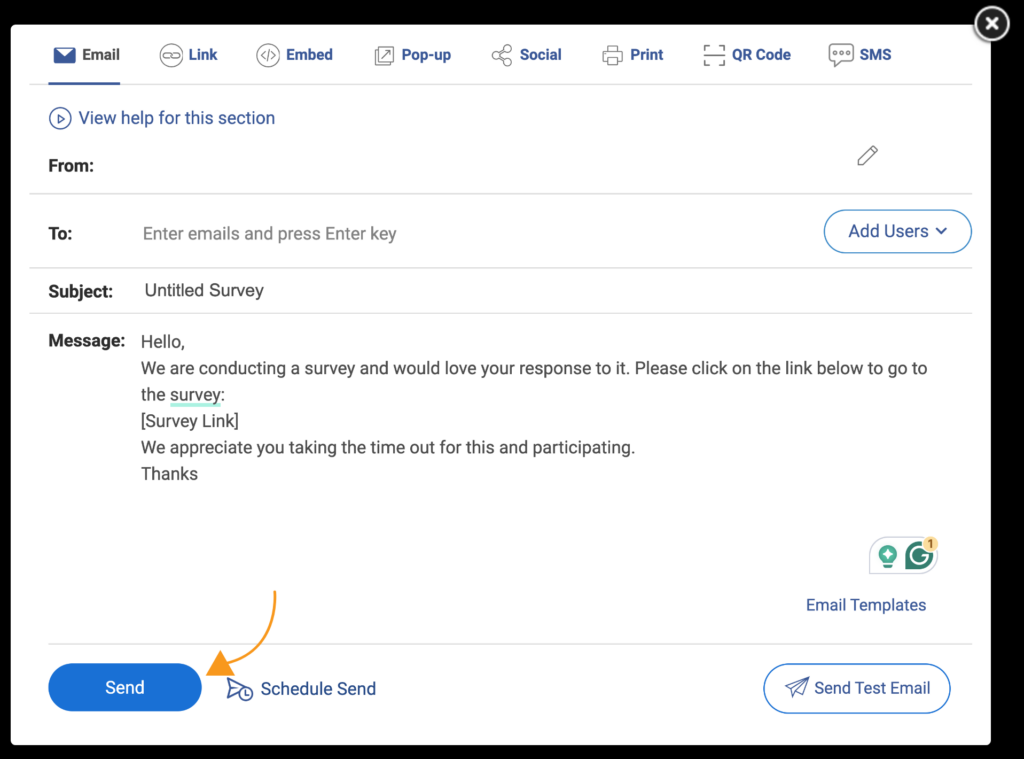
ProProfs Survey Maker supports all three from the same dashboard without switching tools.
Step 5: Analyze Results in Real Time
The reporting dashboard aggregates ratings, calculates your NPS score automatically, and surfaces open-ended responses in one view.
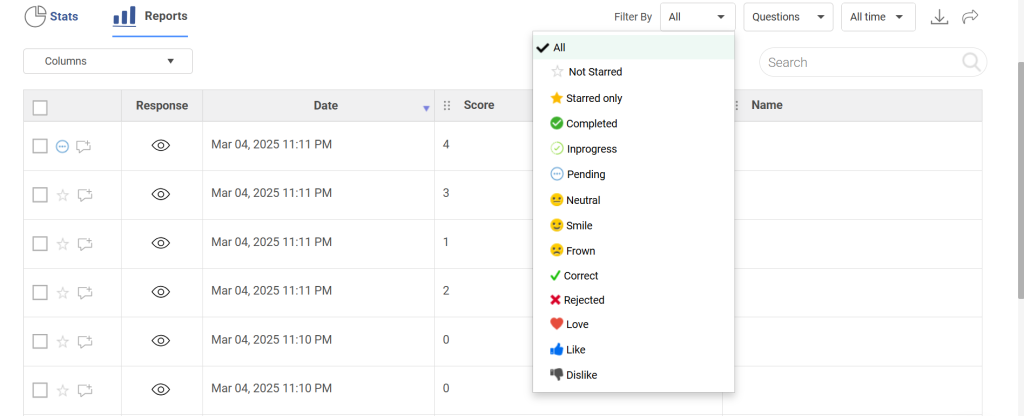
Export to Excel or connect to your CRM via Salesforce or HubSpot integration so your leadership brief is ready the next morning, not the next week.
Best Practices That Separate Effective Event Surveys From Ignored Ones
Most event surveys fail not because the questions are wrong but because the survey design is not properly structured, they are too long, arrive too late, or ask questions that the respondent cannot answer well.
For teams running recurring events, these are fixable problems.
1. Before You Build:
Set One Goal Per Survey, Not Five
Decide before you build whether this survey is measuring satisfaction, proving ROI, gathering content inputs, or evaluating logistics.
Trying to cover all four in one form produces a 15-question survey that nobody finishes. Each goal maps to a different question set.
Run Separate Surveys for Each Audience Type
Attendees, sponsors, and speakers have different experiences and different priorities. One survey sent to all three produces data that cannot be segmented.
Three short surveys, each under eight questions, produce three clean data sets you can actually act on.
Use Consistent Scales Across Every Event Cycle
If you use a 1-5 scale for satisfaction in Q1 and a 1-10 scale in Q2, you cannot show leadership a trend line. Pick one scale and use it every time. Consistency is what turns individual event surveys into an event program benchmark.
2. How You Structure the Event Survey:
Put Your Most Important Question on the First Screen
Overall satisfaction on page one means you capture it even from attendees who drop off after one question. You lose the nuance. You keep the benchmark.
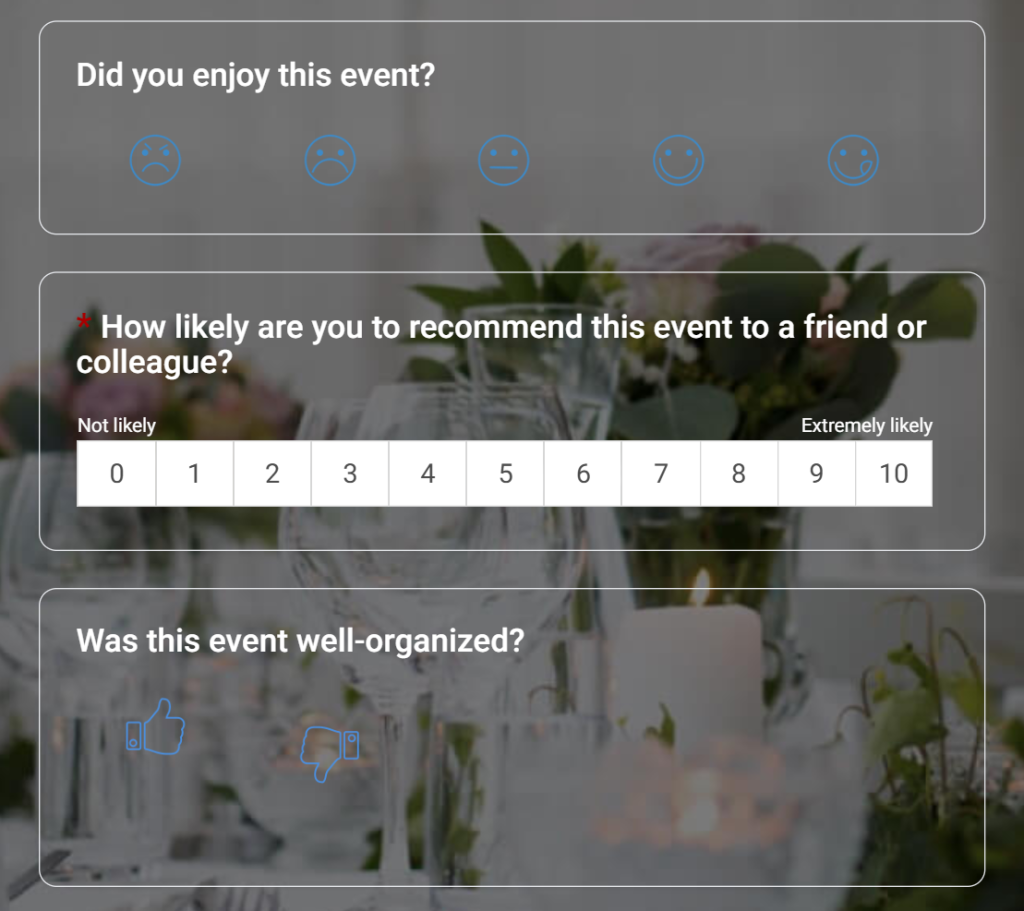
Put NPS Second, Not Last
NPS scores are more accurate when placed early.
Respondents who hit the NPS question after several others give lower scores because of fatigue, not genuine dissatisfaction. That artificially depressed score is what you then present to leadership.
Here’s an event NPS survey template:
Use Multiple Choice for the Middle Section
Three to four targeted questions on content, speakers, logistics, and networking give you structured data your team can segment without qualitative coding. Multiple choice is the format that produces decisions fastest.
Put Open-Ended Questions Last
One or two at the end, framed specifically: “What is one thing we should change for the next event?” Respondents who reach this question are self-selecting for higher engagement. Their answers are the ones worth reading carefully.
Write Neutral Questions
“How much did you enjoy our excellent keynote?” is not a question. It is asking for validation. Questions that allow for honest negative responses are the ones that surface the problems you need to know about before next quarter.
Test Your Survey Before It Goes Out
Send it to one person on your team first. If they find a question confusing or ambiguous, your attendees will too, and they will either skip it or give you an answer that does not mean what you think it does.
3. How and When You Send It:
Send Within 24-48 Hours
Within 24 hours of leaving a conference, attendees forget up to 70% of what they heard, according to event industry benchmark data cited by Upmetrics.
Waiting three days does not just reduce response rates; it also reduces the quality of responses.
Close the Feedback Loop Before the Next Event
A one-sentence note in your next event communication, “Based on your feedback last quarter, we shortened the morning sessions and added a structured networking block,” does more for response rates at the next event than any reminder email.
It signals that completing the survey is worth their two minutes because you actually use the data.
Leverage Event Survey Questions to Build a Feedback System That Sticks
The question bank, timing rules, and best practices in this guide give you everything you need to run a repeatable three-stage feedback system across every event cycle.
What determines whether you actually use it is how fast you can go from event end to survey live to leadership brief.
Try ProProfs Survey Maker and launch your first three-stage event survey in under 20 minutes using AI-generated templates built for pre-, during-, and post-event feedback.
Frequently Asked Questions
What are the most important post-event survey questions to ask?
For a recurring event program, the five you cannot skip are: overall satisfaction rating, NPS score, which session was most valuable and why, whether the event met pre-event expectations, and one specific change for next time. Together, they give you a satisfaction benchmark, an advocacy signal, a content direction, an alignment check, and an improvement input you can act on before the next planning cycle opens.
When should I send post-event survey questions to attendees?
According to Events.Studio data , within 24-48 hours. A 2015 study by Murre and Dros on the forgetting curve also shows human memory retention decreases logarithmically over time, dropping rapidly in the first 24 hours, so waiting means lower completion rates and less specific answers in your open-ended questions.
How many questions should an event survey have?
Five to eight for post-event surveys, three for mid-event pulse checks. Beyond ten questions, abandonment rates rise sharply. For small teams without a research function, fewer specific questions produce faster decisions than more questions that require qualitative coding to interpret.
What is the difference between pre-event and post-event survey questions?
Pre-event questions collect expectations, expertise level, logistical needs, and content priorities from registrants before anything is set. Post-event questions measure whether you delivered against those expectations and identify what to adjust for the next cycle. Pre-event surveys also improve attendance rates. Post-event surveys produce the data you use in leadership briefings and budget justifications.
How do I increase response rates for event surveys?
Send within 24 hours, keep the survey under five minutes, put the most important question first so you capture it even from partial completions, follow up within 48 hours with one reminder, and close the loop after the event by communicating what you changed. According to SuperCode’s 2026 data, in-person collection via QR code at the venue can reach 50% - 95% completion rates if scanning the code is woven natively into the live environment.
Can I use the same event survey questions for virtual events?
Partially. Overall satisfaction, NPS, and content quality questions carry over. But virtual events need additional questions that in-person surveys do not: platform usability, technical issues encountered, audio and video quality, and whether the virtual networking format was sufficient. Build a separate virtual event template rather than reusing your in-person version. The friction points are different enough that the combined data produces averages that are not useful for either format.
How do I measure event ROI using survey data?
Combine your NPS score with question 15 (repeat attendance intent), session quality scores, and sponsor satisfaction ratings to build the case. According to the Bizzabo 2026 State of Events report, 40% of event organizers still struggle to prove ROI to leadership because they measure satisfaction without connecting it to business outcomes. Pairing your survey data with attendance trends and sponsor renewal rates gives leadership the through-line they need.
FREE. All Features. FOREVER!
Try our Forever FREE account with all premium features!

 We'd love your feedback!
What did you like & how can we make it even better?

 Thanks for your feedback!
 Ask Your Question
Have a question? Get expert help to make your decision easier.