
You already know who your audience is. The problem is that most messaging strategies stop there.
Knowing a buyer is a 38-year-old operations director at a mid-size SaaS company tells you almost nothing about:
Whether they respond to ROI data or peer validation.
Whether they research for six weeks before deciding or move fast on gut instinct.
Or, whether your “easy to use” positioning lands as a benefit or an insult to their technical identity.
That is the gap psychographic variables fill. And closing that gap is what separates campaigns that convert from ones that reach the right person and still get ignored.
This guide covers the five core psychographic variables, how to collect the data using surveys, how to build segments from responses, and how to apply those segments to messaging, targeting, and positioning decisions that actually move the needle.
What Is Psychographic Segmentation?
Psychographic segmentation is the practice of dividing an audience into groups based on shared psychological characteristics: what they value, believe, prioritize, and how they make decisions. It goes one layer deeper than demographic or behavioral segmentation by answering not just who bought, or what they bought, but why.
It groups people by personality traits, lifestyle choices, social class, attitudes, and AIO variables (activities, interests, and opinions).
These psychological characteristics drive purchase behavior in ways that demographics cannot predict, and they are surfaced through surveys, interviews, social listening, and behavioral data analysis.
Where demographic segmentation tells you a buyer is a 40-year-old marketing director at a mid-size company, psychographic segmentation tells you she is risk-averse, values peer validation over vendor claims, and will not move forward without a case study from someone in her industry.
That second profile changes everything: the content you create, the proof points you lead with, and the sequence in which you build trust.
For B2B teams in particular, psychographic segmentation is rated the most effective segmentation method, ahead of demographic and behavioral approaches.
Yet, according to MarketingLTB (2026), only 19% of organizations run advanced segmentation with predictive modeling or multi-dimensional approaches.
The 5 Psychographic Variables and What Each One Unlocks
At a glance, here is what each variable captures and where it is most useful in practice:
| Psychographic Variable | What It Captures | Best Used For |
| Personality | How someone processes information and makes decisions | Matching message tone and format to buyer psychology |
| Lifestyle | How someone spends time and what they consistently prioritize | Predicting category interest before a lead enters your funnel |
| Social Class | Values and brand expectations shaped by economic identity | Differentiating positioning for multi-segment products |
| Attitudes | Overall evaluation of your product, category, or brand | Uncovering hidden resistance and objections in your pipeline |
| AIO (Activities, Interests, Opinions) | What they do, follow, and believe | Campaign targeting, channel selection, influencer alignment |
1. Personality: Predicting How a Buyer Will Respond to Your Message
Personality determines how someone processes information and makes decisions.
A risk-averse buyer will not respond to urgency-based messaging or “be the first to try” positioning, regardless of how well the product fits their needs.
An openness-driven buyer might find that same message compelling.
The five dimensions most useful in marketing segmentation:
- Openness: Willing to try new products, switch brands, and experiment. Responds to novelty and innovation framing.
- Conscientiousness: Researches thoroughly before deciding. Needs evidence, reviews, and structured comparison.
- Extraversion: Influenced by social proof and peer behavior. Responds to community and belonging signals.
- Agreeableness: Relationship-driven. Responds to trust, shared values, and collaborative language.
- Neuroticism: Risk-averse. Needs reassurance, guarantees, and low-friction onboarding to reduce perceived risk.
The practical use: if your survey data shows a high proportion of conscientious buyers in a segment, your conversion bottleneck is probably not awareness.
It is a lack of comparison content, detailed case studies, or third-party validation.
2. Lifestyle: Predicting Category Interest Before a Lead Enters Your Funnel
Lifestyle describes how someone spends their time and what they consistently prioritize. It is one of the most actionable psychographic variables because it predicts category interest before any purchase signal.
A person who describes themselves as health-conscious is pre-qualified for wellness, fitness, and nutrition products before they ever visit your site.
A professional who spends evenings on skill development is pre-qualified for learning tools, certification programs, and productivity software.
Lifestyle segmentation is particularly valuable for HR managers and consultants who need to understand employee or client profiles beyond job function.
Knowing that a segment of employees prioritizes autonomy and career development over recognition and stability changes the entire design of an engagement program.
3. Social Class: Understanding the Values That Come With Economic Identity
Social class is a psychographic variable, not just an economic one, because income level shapes values, self-perception, and brand expectations in ways that outlast the income itself.
A high-income buyer who grew up in a working-class household may still respond strongly to value-based messaging even when price is not a constraint.
A middle-income buyer who strongly identifies with an aspirational lifestyle may prioritize brand signals over functional specs.
| Segment | Core Motivation | Messaging That Converts |
| Upper class | Exclusivity, craftsmanship, premium experience | Quality signals, provenance, heritage, scarcity |
| Middle class | Quality-to-price ratio, reliability, and practicality | Proof of value, comparison data, total cost of ownership |
| Lower class | Affordability, core functionality, trust | Transparent pricing, simplicity, and no-risk entry points |
The mistake most teams make here is mapping their product to one class and running a single message. In reality, most products serve multiple segments and need differentiated positioning for each.
4. Attitudes: Uncovering the Hidden Resistance in Your Pipeline
Attitudes reflect a buyer’s overall evaluation of your product, category, or brand, including beliefs they may not volunteer unless you ask directly.
Attitude-based segmentation is valuable not just for identifying enthusiasm but also for identifying resistance. A segment that holds a skeptical attitude toward AI-powered tools will not be converted by a feature list, no matter how strong it is.
They need case studies from people like them, transparent explanations of how the technology works, and clear answers to the objections they have not yet raised.
Understanding attitudes also tells you which messaging actively damages your positioning with specific segments. Innovation language alienates buyers who value stability.
Disruptive language repels buyers who trust established processes.
If your pipeline has strong top-of-funnel numbers but weak conversion, attitude misalignment is often the cause.
5. AIO: The Most Actionable Variable for Campaign Targeting
AIO stands for Activities, Interests, and Opinions. It is the most directly applicable psychographic variable for campaign execution because each dimension maps to a specific targeting lever.
| AIO Dimension | What It Surfaces | How It Changes Your Campaign |
| Activities | What they do with their time regularly | Determines which channels, events, and formats to invest in |
| Interests | What topics and categories they follow closely | Identifies influencers, publications, and content categories to align with |
| Opinions | How they feel about your category, brand, or competitors | Shapes messaging tone, objection handling, and proof point selection |
A B2B SaaS team that discovers a core segment of decision-makers follows specific industry analysts, attends a particular annual conference, and holds a skeptical opinion about implementation complexity can build an entire campaign around those three data points: partner with the analyst, sponsor the conference, and lead the messaging with “live in 48 hours” proof.
How to Collect Psychographic Data That Is Actually Useful
The most common mistake in psychographic research is asking surface-level questions and expecting deep insights. “What is your job title?” is demographic. “When you evaluate a new tool, what concern do you always think about but rarely say out loud?” is psychographic.
The four collection methods that work in practice:
Surveys & Questionnaires
These are the most scalable. The key is using open-ended questions and Likert scales that reveal the degree of feeling, not just binary preference. A well-designed market research survey of 300 to 500 respondents gives you enough data to identify three to five distinct segments.
Focus Groups
These add depth where surveys add breadth. A group of eight to twelve participants who match your target profile, led by a skilled moderator, will surface language, objections, and attitudes that a survey cannot. The moderator’s job is to follow the unexpected answer, not to confirm what you already believe.
Social Listening
This gives you unprompted honesty. How your audience talks about your category on Reddit threads, LinkedIn comments, and community forums reveals psychographic data in its rawest form: the exact words they use to describe their frustrations, the comparisons they make, and the things they wish existed.
Website & Behavioral Analytics
These act as psychographic proxies. A user who reads three case studies before requesting a demo is behaviorally signaling conscientiousness.
A user who goes straight from the landing page to pricing is signaling decisiveness. These behavioral patterns map to psychographic traits and can inform segment design without a single survey question.
The Psychographic Survey Questions Worth Using
Copy these directly into your next survey:
- When you evaluate a new tool or service, what is the first concern that comes to mind?
- What matters most in your purchase decision? (Price / Quality / Ease of Use / Brand Reputation / Peer Recommendation)
- On a scale of 1 to 5, how much does a vendor’s values and mission influence your decision to buy?
- Have you ever stopped using a product you liked because of how the company handled a problem? What happened?
- When you need advice on a major purchase, where do you go first? (Colleague / Online Review / Industry Expert / Community Forum / Other)
- How would you describe your approach to adopting new tools? (Early Adopter / Wait and See / Only When Necessary / Reluctant)
- What would need to be true for you to feel fully confident recommending us to a colleague?
- Is there something you wish we offered that we currently do not?
Building this at scale requires a tool that handles branching logic, so a respondent who says they are a reluctant adopter gets different follow-up questions than an early adopter.
ProProfs Survey Maker’s skip logic handles that without manual configuration, and the AI survey generation removes the blank-page problem entirely. Also, there are ready-made templates you can choose from.
Here’s a psychographic segmentation survey template:
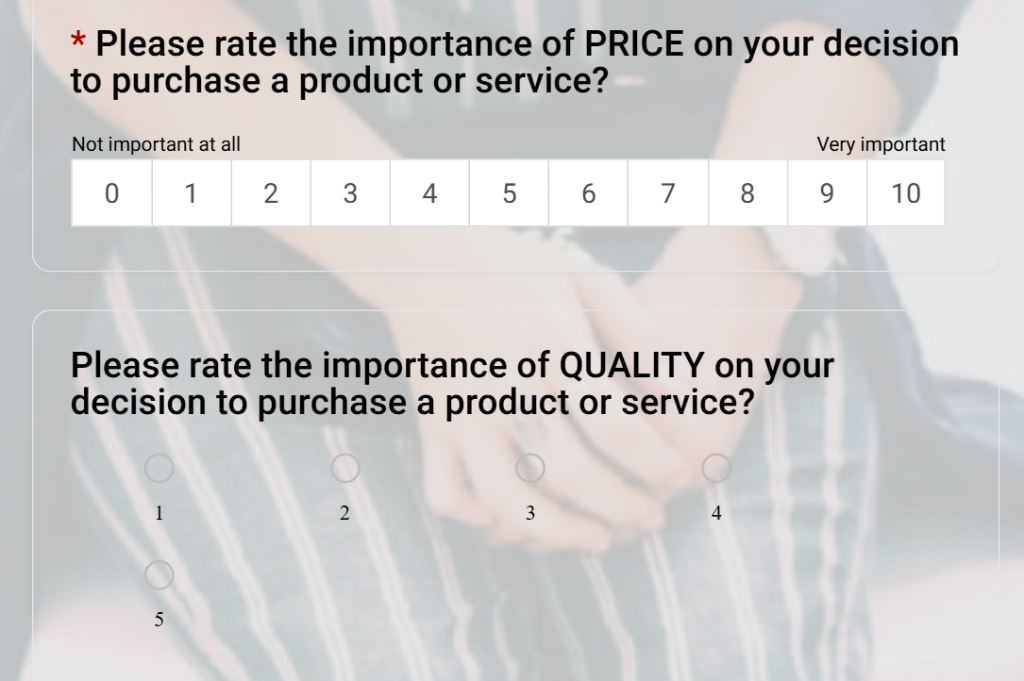
The forever-free plan includes all premium features, so you can build and run your first psychographic survey without a budget conversation.
FREE. All Features. FOREVER!
Try our Forever FREE account with all premium features!
How to Build a Psychographic Survey Using ProProfs AI Survey Maker
If you want to move faster than building your psychographic survey from scratch, here is exactly how to do it:
Here’s the detailed breakdown:
1. Log in and click “Create a Survey.” Select “Create with AI” from the options on the screen.
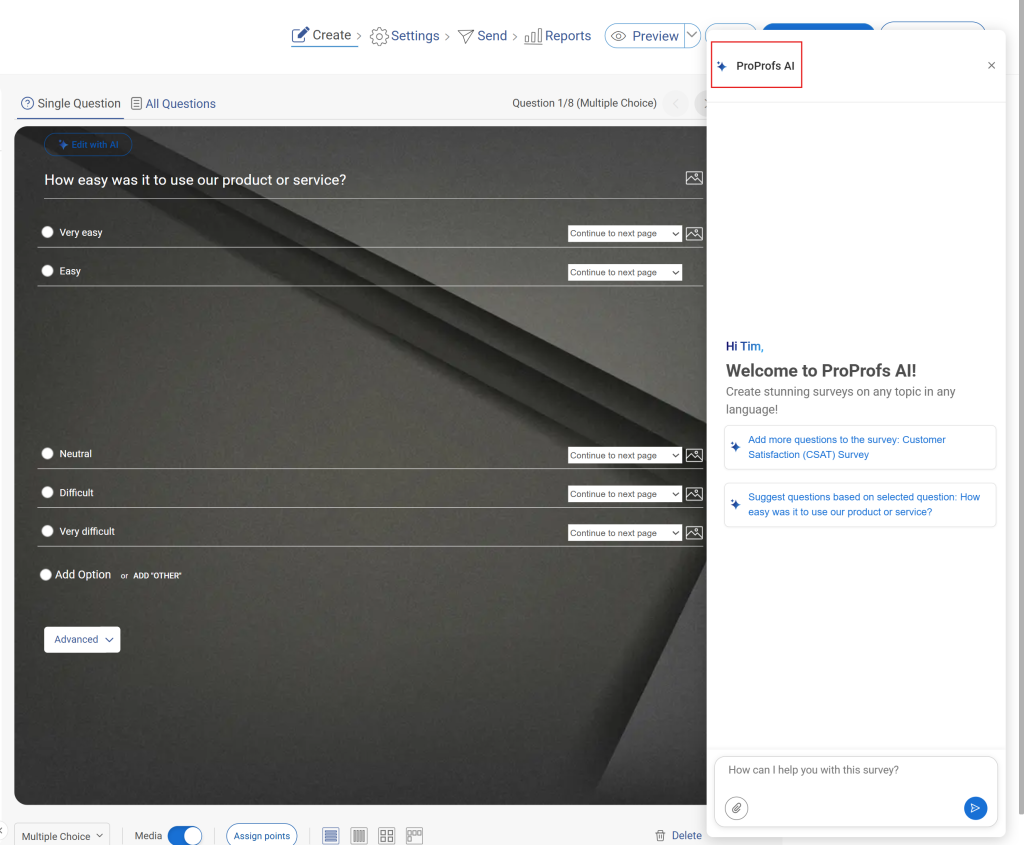
to understand what my B2B customers value most when evaluating a new SaaS tool, including their attitudes toward risk, adoption, and vendor trust”) or as a direct audience description (“mid-size B2B buyers who are skeptical about switching tools”).
The AI generates questions tuned to surface that specific psychographic profile. The more specific your input, the more targeted the output.
3. Review the AI-generated question set. ProProfs produces a complete survey with question types already matched to your goal: Likert scales for attitude questions, open-ended fields for motivation questions, and multiple choice for AIO variables.
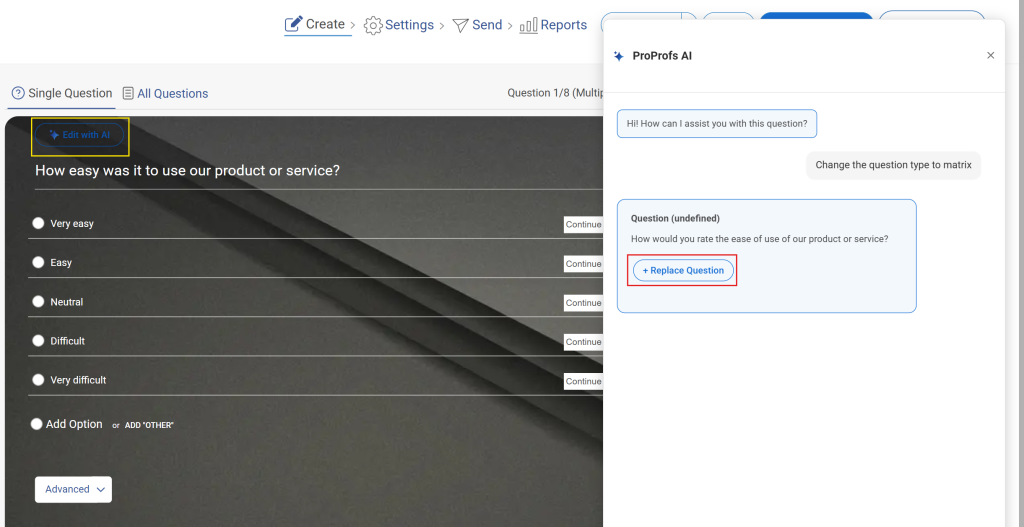
Edit any question that does not fit your specific audience.
4. Add skip logic to branching questions. For any question where different answers should lead to different follow-ups, set the skip logic rules directly in the question editor.
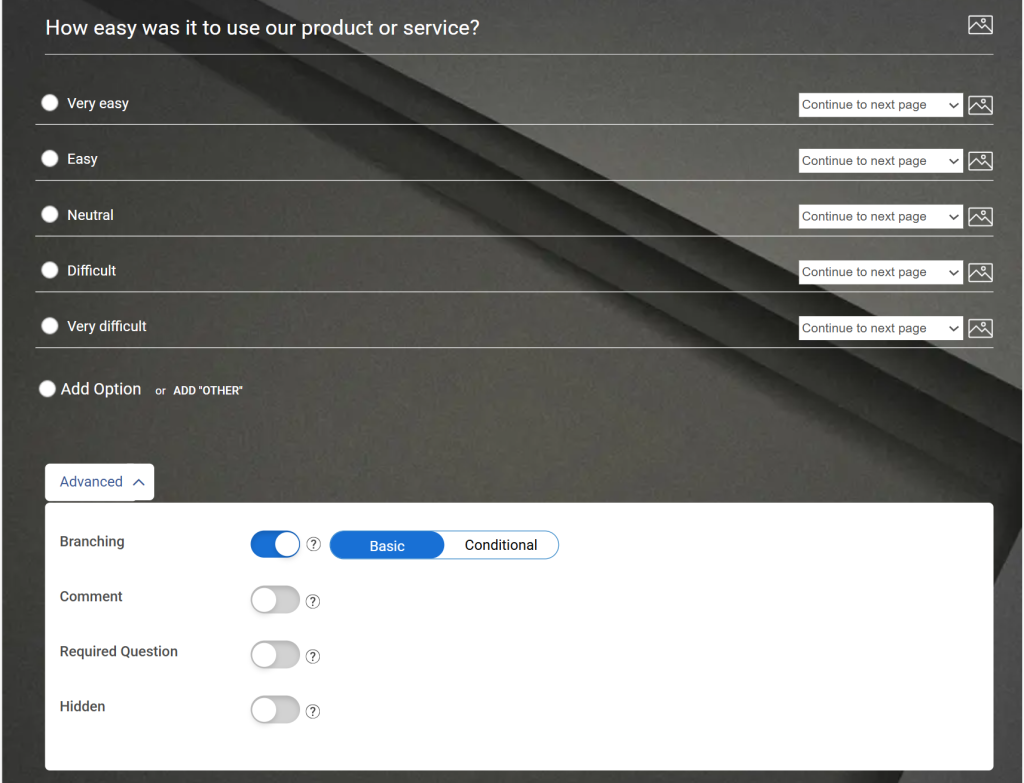
A respondent who identifies as a “reluctant adopter” should see different follow-up questions than one who identifies as an “early adopter.”
5. Set up scored responses if you are building segments. Assign point values to each answer option. Define score ranges that correspond to your psychographic profiles.
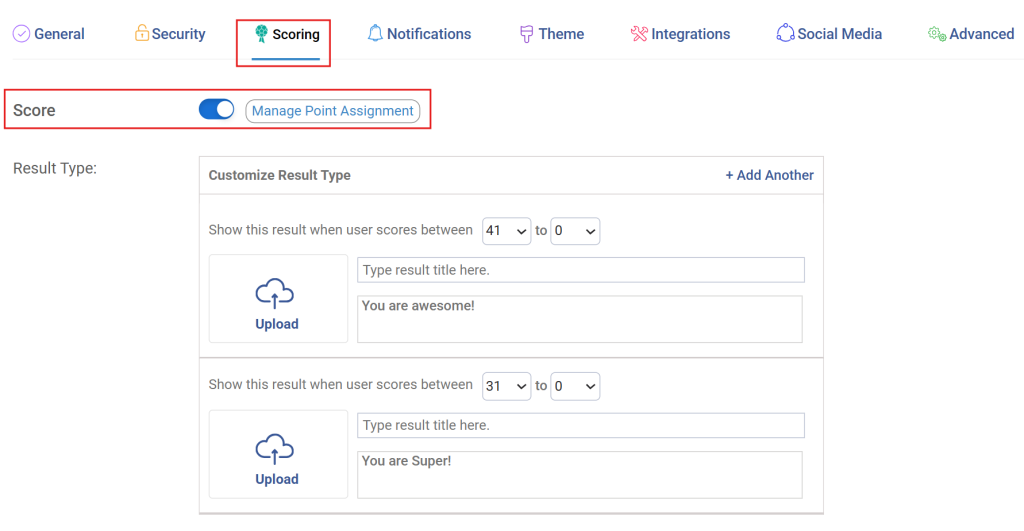
Set custom result pages for each range so respondents in different profiles receive different messaging or follow-up content immediately after completing the survey.
6. Choose your distribution channel. Send via email, embed on your website, share as a direct link, or distribute via QR code.
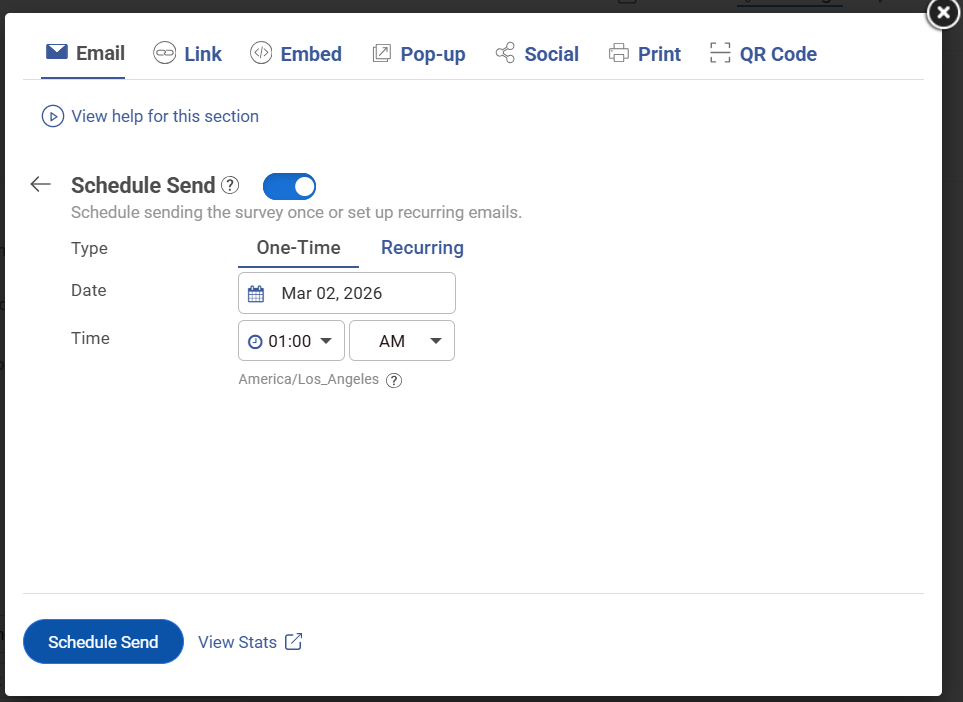
For employee psychographic surveys, email distribution with a custom sender name and subject line produces the highest open rates.
7. Monitor responses in real time. The reporting dashboard shows response breakdowns by question as answers come in.
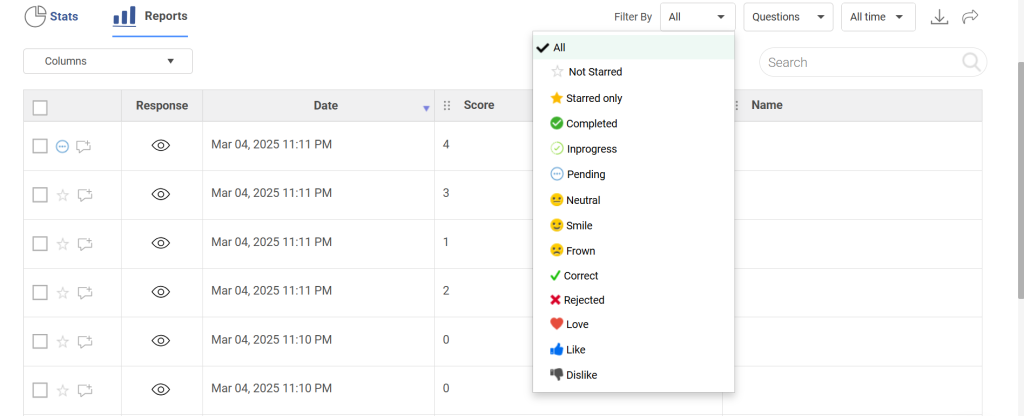
Once you hit 100 to 150 responses, you will start to see the clusters that define your segments.
The Collect-Segment-Apply Loop: Turning Data Into Decisions
Collecting psychographic data without a clear segmentation process produces a spreadsheet, not a strategy. Here is how to move from responses to actionable profiles.
Step 1: Filter to Your Primary Demographic
If you collected 800 responses, filter first to the demographic profile that represents your core buyer. Responses outside that profile will create noise in your segments.
Step 2: Find the Questions With Clustered Responses
Look for survey questions where 40% or more of respondents share a similar answer.
These clusters are the foundation of your psychographic segments. Two or three clustered questions together define a profile.
Step 3: Name Each Segment by Its Dominant Motivation, Not Its Demographic
A segment is not “marketing managers aged 30 to 45.” It is “ROI-driven buyers who need proof before they advocate internally” or “autonomy-first buyers who distrust tools that require vendor support.”
The name should tell you immediately what messaging will and will not work.
Step 4: Build a One-Page Profile for Each Segment
Each profile needs: the core motivation, the dominant attitude toward your category, the AIO signature (what they do, follow, and believe), and the single objection most likely to stall the sale.
Step 5: Map Each Segment to a Specific Message, Channel, and Content Type
This is where most teams stop short. A psychographic segment that never changes how you write an ad, design a landing page, or structure a sales conversation has not generated any value.
Each profile should produce at least one concrete change to how you communicate.
Applying Psychographic Profiles to Messaging and Campaigns
Once your segments exist, every touchpoint is an opportunity to use them.
Here is how each application area maps to a specific psychographic action:
| Application | Psychographic Action | What to Audit or Build |
| Brand Messaging | Match tone and values to your dominant segment profiles | Homepage copy, email sequences, sales collateral: does this reflect their values or yours? |
| Paid Campaigns | Translate AIO data into targeting parameters | Interest clusters, lookalike seed audiences, exclusion filters built around what your segment follows, attends, and believes in |
| Product Positioning | Identify the feature tied to a core segment value, not the feature your team is proudest of | Retention data, churn interviews, and psychographic survey responses were mapped against feature usage |
For brand messaging, the most common mistake is defaulting to internal priorities: efficiency, innovation, and growth.
Run every major asset against your two or three dominant profiles before publishing.
For paid campaigns, the payoff is not just better reach; it is reach with a message designed for the exact mindset of the person seeing it.
Pairing this with a well-timed NPS survey lets you validate whether that message is actually landing with each segment after they convert.
For product positioning, psychographic data often surfaces a mismatch: the feature your team leads with is not the one your best customers actually cite as the reason they stayed.
The retention driver is almost always tied to a core value or belief in a dominant psychographic segment, and it only shows up when you ask the right survey questions.
Stop Guessing What Your Audience Believes. Start Asking.
Demographics tell you who showed up. Psychographic variables tell you what it will actually take to earn their trust, match their values, and give them a reason to act.
The teams that close the gap between “right audience, wrong message” are not the ones with bigger budgets.
They are the ones who built a survey, identified the clusters in their data, and let those clusters change how they write, target, and position.
You already have the demographic layer. Build the psychographic one with ProProfs Survey Maker using AI-generated questions, skip logic, and real-time segment reporting. No per-user fees, no setup time, and a forever-free plan for teams getting started.
Frequently Asked Questions
What are the five psychographic variables used in segmentation?
The five psychographic variables are personality, lifestyle, social class, attitudes, and AIO (activities, interests, and opinions). Each one captures a different layer of what drives purchase behavior. Personality predicts how someone responds to messaging. Lifestyle predicts category interest. Attitudes reveal hidden resistance. AIO maps directly to campaign targeting. Together they explain the why behind every buying decision.
How is psychographic segmentation different from behavioral segmentation?
Behavioral segmentation tells you what a customer did: what they bought, how often, and how long they stayed. Psychographic segmentation tells you why they did it: the values, motivations, and attitudes that drove the behavior. Behavioral data surfaces patterns. Psychographic data explains the reasoning behind them. You need both to build audience profiles that are accurate enough to act on.
Why do campaigns that target the right demographic still underperform?
Demographics define who is in the audience, but psychographics determine whether the message resonates with them. Two buyers in the same demographic can hold entirely different values and respond to opposite messaging. Getting the demographic right and the psychographic wrong still produces low conversion. The targeting was correct. The message was built for a category, not a specific mindset.
What is the fastest way to collect psychographic data on an existing customer base?
Send a short survey of eight to twelve questions to active customers. Open-ended questions about decision-making, values, and attitudes yield more useful data than multiple-choice options alone. With ProProfs Survey Maker, you can build, distribute, and analyze that survey in a single session using AI-generated questions, skip logic, and a real-time reporting dashboard that shows segment clusters as responses come in.
Why is psychographic segmentation especially important for B2B marketing?
In B2B, decision-makers at companies with identical firmographic profiles can hold completely different beliefs about vendor relationships, implementation risk, and ROI timelines. Those differences determine which message converts them and which one alienates them. Demographics cannot surface that distinction. Psychographic surveys can. It is why psychographic segmentation is rated the most effective segmentation method specifically for B2B businesses.
How do you use scored surveys for psychographic segmentation?
Assign point values to each response option in your survey. Total the scores per respondent and define ranges that correspond to different psychographic profiles: for example, "change-ready," "cautiously interested," and "risk-averse." Each range then triggers a different follow-up sequence, proposal, or result page. ProProfs Survey Maker handles the scoring and custom result pages automatically, so segmentation happens without any manual bucketing after the fact.
How often should psychographic profiles be refreshed?
At least once a year, or whenever campaign performance shifts significantly without an obvious cause. Psychographic profiles change faster than demographics, particularly in response to economic shifts, industry disruption, or major life transitions in your audience. A profile that converted well eighteen months ago may no longer reflect how your best buyers think. Periodic resurveying keeps your segments accurate and your messaging aligned with current beliefs.
Can psychographic segmentation be used for employee research, not just customers?
Yes, and it is one of the most underused applications in HR and organizational development. Segmenting employees by motivational driver, whether that is autonomy, recognition, career growth, or security, lets you design engagement programs, development paths, and communications that match what each group actually needs. Applying a single message to all employees produces average results. Psychographic segmentation produces programs that land differently for each segment.
What is the difference between psychographic and demographic segmentation?
Demographics describe who the customer is: age, gender, income, location, job title. Psychographics describe why they buy: their values, beliefs, attitudes, and lifestyle priorities. Demographics define the audience and set the boundaries. Psychographics determine whether your message will actually resonate once it reaches them. The most effective segmentation strategies layer both: demographics to define the population, psychographics to understand the motivation behind their decisions.
What is the VALS framework and how does it apply to psychographic segmentation?
VALS (Values, Attitudes, and Lifestyles) is a proprietary psychographic framework developed by Strategic Business Insights. It divides consumers into eight types based on motivations and available resources: Innovators, Thinkers, Achievers, Experiencers, Believers, Strivers, Makers, and Survivors. Each type carries distinct purchasing patterns and responds to different messaging. It is most commonly used in B2C market research as a starting framework before building custom psychographic segments from your own survey data.
FREE. All Features. FOREVER!
Try our Forever FREE account with all premium features!

 We'd love your feedback!
What did you like & how can we make it even better?

 Thanks for your feedback!
 Ask Your Question
Have a question? Get expert help to make your decision easier.