
You’ve written “this survey is anonymous” at the top of a form more times than you can count.
But if your last engagement survey yielded vague, guarded answers, the problem probably wasn’t the questions. It was that people didn’t believe you.
Recent research backs that up.
According to Gallup’s 2026 Global Workplace Report, driven heavily by a lack of workplace connection and leadership distrust, global employee engagement has dropped to 20%.
That distrust shows up everywhere, from HR forums to viral social posts about surveys that turned out to be confidential rather than anonymous.
This guide gives you the exact wording that closes that gap.
You’ll get a plain-English definition, copy-paste examples for different survey types, and a fill-in-the-blank template you can adapt inside ProProfs Survey Maker in minutes.
What Is an Anonymous Survey Disclaimer?
An anonymous survey disclaimer is a short, upfront statement that informs respondents their answers cannot be linked to them personally. It covers what data is collected, what is deliberately left out (such as names, emails, or IP addresses), and how the responses will be used, so people can answer honestly without worrying about being identified.
It’s not a legal document in the way a contract is. It’s closer to a promise, one that only holds up if the survey is actually built to keep it.
Anonymous Is Not the Same as Confidential
This is the distinction most disclaimers get wrong, and it’s the one respondents have started calling out publicly.
An anonymous survey strips out anything that could identify a person before anyone sees the data.
A confidential survey keeps that identifying data on file, it’s just restricted to a small group who agree not to share it.
Both can be legitimate. But calling a confidential survey “anonymous” is where trust breaks down, and where you pick up legal risk, too.
| Question | Anonymous Survey | Confidential Survey |
| Is the response linked to an identity anywhere? | No, not even for administrators | Yes, but access is restricted |
| Who can see raw, identifiable answers? | No one | A small, named group, such as HR or the survey owner |
| Best used for | Sensitive feedback, engagement surveys, and exit surveys | Feedback where limited follow-up may be needed |
| How GDPR treats it | Outside GDPR’s scope if re-identification truly isn’t possible | Still counts as personal data, full GDPR rules apply |
If you can’t honestly say “no one, including us, can trace this back to you,” the accurate word is confidential, not anonymous. Say that instead.
What Should Every Anonymous Survey Disclaimer Include?
A disclaimer that actually earns trust does more than say the word “anonymous” and move on. Work through this list before you finalize any survey that makes an anonymity claim.
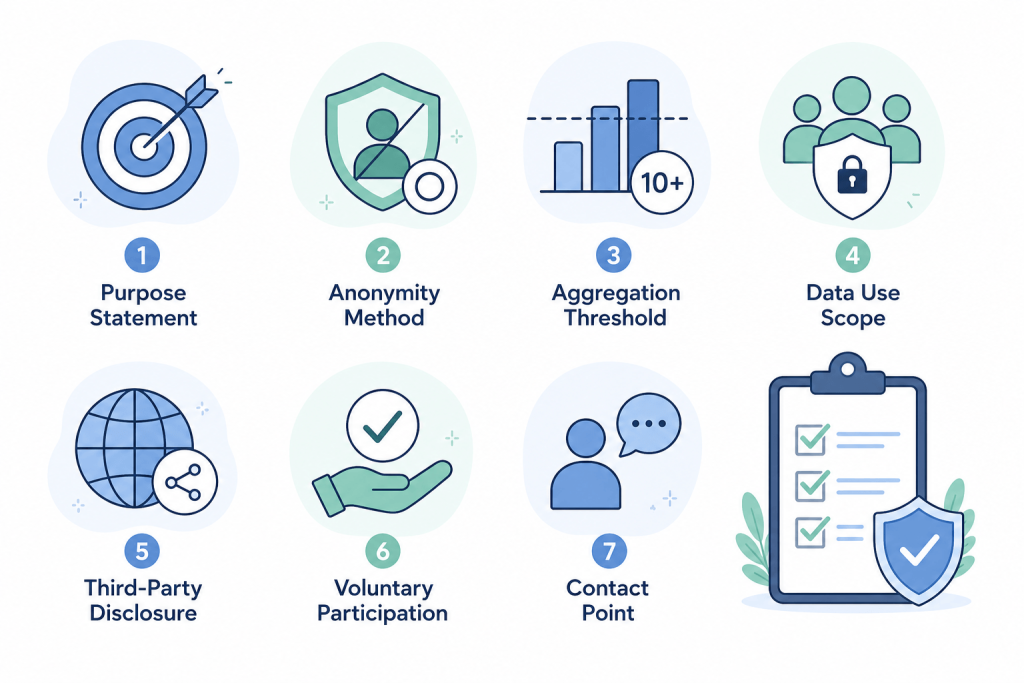
- Purpose Statement: Why you’re running the survey and what decisions the results will inform
- Anonymity Method: Exactly what is not collected, such as names, email addresses, IP addresses, or login credentials
- Aggregation Threshold: The minimum number of responses required before any segmented view, by department, role, or location, is shown to anyone
- Data Use Scope: Who sees the responses and how long they’re retained
- Third-Party Disclosure: Whether responses leave your organization or get shared with a vendor or partner
- Voluntary Participation: Confirmation that taking the survey is optional, and questions can be skipped
- Contact Point: Someone respondents can ask if they have questions about how their data is handled
Miss the aggregation threshold in particular, and you can label a survey anonymous while still letting someone view results broken down so narrowly that only one person could have given that answer.
That’s the exact scenario people are describing when they say anonymous surveys “aren’t really anonymous.”
What Are Some Anonymous Survey Disclaimer Examples You Can Copy?
Here are four ready-to-use examples, each written for a different survey context. Copy the one closest to your use case and adjust the bracketed details.
Employee Engagement Survey Disclaimer Example
| This survey is anonymous. We do not collect your name, email address, or IP address, and your login is not linked to your answers in any way. Results are only reviewed in groups of [minimum number] or more responses, so no individual answer can be traced back to a specific person. Your participation is voluntary, and you can skip any question you’d rather not answer. |
Customer Feedback Survey Disclaimer Example
| Your feedback is anonymous unless you choose to share your contact information at the end of this survey. We use your responses only to improve our product and service, and we do not connect your answers to your account unless you’ve opted in. Aggregated results may be shared internally, but individual responses are never shared outside our team. |
Event or Course Feedback Survey Disclaimer Example
| This feedback form is anonymous. Your responses help us improve future [events/courses] and are not linked to your registration, attendance record, or grade in any way. Only summarized results, not individual responses, are reviewed by organizers or instructors. |
Academic or Research Survey Disclaimer Example
| Participation in this survey is voluntary and anonymous. No identifying information, including your name, email, or IP address, is collected or stored with your responses. Data will be reported only in aggregate form and used solely for the purpose described in the survey introduction. You may stop at any time without penalty. |
Don’t Start From a Blank Survey
Choose from ready-made templates for every survey type
How Do You Build Your Own Anonymous Survey Disclaimer Template?
If none of the examples above fit exactly, build your own from this fill-in-the-blank version.
| This survey is anonymous. We do not collect [list of data points you exclude, such as names, email addresses, or IP addresses]. Responses are used only for [stated purpose]. Results are reviewed in groups of [minimum threshold] or more, so no individual answer can be identified. Participation is voluntary, and you may skip any question. Questions about this survey can be directed to [contact person or email]. |
Work through it in this order so nothing gets skipped:
- List What You’re Excluding: Write down every identifying data point your anonymous survey tool is capable of collecting, then confirm which ones you’ve turned off.
- State the Purpose in One Sentence: Vague purpose statements are one of the biggest reasons respondents disengage, so be specific about what the data will actually inform.
- Set Your Aggregation Threshold: Five is a common floor for small teams, but raise it if any single demographic slice, like a department of three people, could still identify someone.
- Confirm the Voluntary and Skip Language: This isn’t optional in most jurisdictions, and it also reads as more trustworthy to respondents.
- Add a Real Contact Point: A named role or shared inbox works better than a generic “contact support” line.
Decide Where the Disclaimer Appears
Placement changes whether people actually read it. The two spots that work best:
- Start of the Survey, Before Question One
This is the strongest option because respondents see it before they’ve committed to answering anything, which is when trust decisions actually get made.
- In the Invitation Email or Message
As a short line above the survey link, so people know what they’re opting into before they even click through.
A disclaimer placed only in a website footer or a linked privacy policy gets skipped almost every time.
If you use one of those as a legal backstop, still repeat the core anonymity promise directly on the survey’s first screen.
FREE. All Features. FOREVER!
Try our Forever FREE account with all premium features!
How Do You Make Sure the Survey Behind the Disclaimer Is Actually Anonymous?
This is where most anonymity claims quietly fail. The wording can be perfect and still be untrue if the survey tool itself is capturing and identifying data in the background.
Check for these settings before you publish:
- No login or account requirement to access the survey
- IP address collection is turned off or is not collected by default
- A minimum response threshold is enforced before any segmented report can be viewed
- Aggregate-only reporting for small groups, rather than raw response-by-response views
If your current tool makes any of these hard to configure or verify, that’s a gap between what your disclaimer says and what your platform actually does, and it’s exactly the gap respondents are learning to spot.
ProProfs Survey Maker’s anonymous response setting removes identifying data by design rather than as an optional add-on, so the disclaimer you write can actually be backed up by the platform underneath it.
Here’s how it works:
Build It in Minutes With AI Survey Maker
Once you know what your disclaimer needs to say, building the survey around it takes a few steps:
Here’s the step-by-step breakdown:
Describe Your Survey Goal to AI Survey Maker
Type a plain-language prompt, something like “anonymous employee engagement survey for a 40-person remote team.”
Try it here:
Describe your survey and we'll create it for you
The AI Survey Maker returns a complete draft in seconds, already matched to the right mix of question types, such as Likert scale, rating, and open-ended, so you’re editing a finished survey instead of staring at a blank page.
Already have questions sitting in a document? Upload a PDF, DOCX, or TXT file instead, and AI Survey Maker converts it into a ready-to-edit survey, so you’re never rebuilding from scratch.
Turn on Anonymous Response Settings Before You Send Anything
This is the setting that actually stops names, emails, and IP addresses from being captured with each submission.
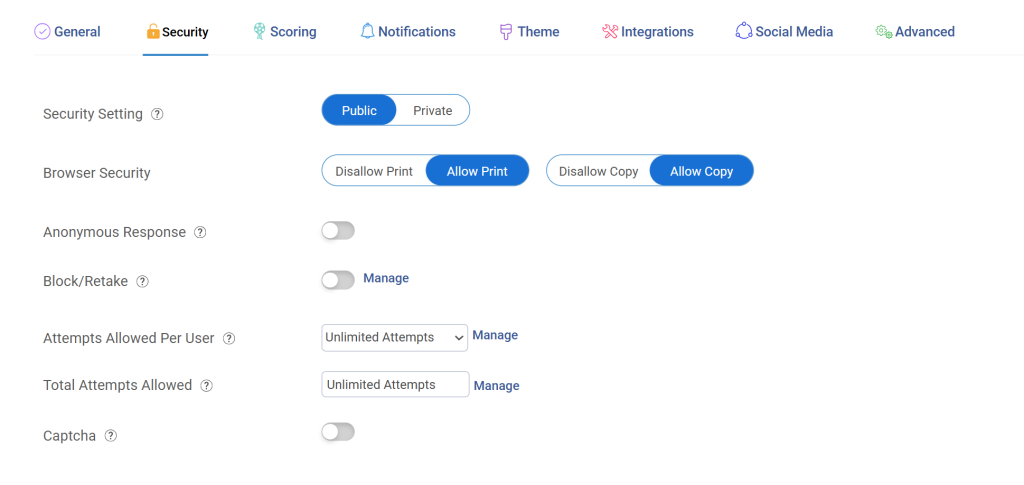
Turn it on before your first response comes in. Anonymity can’t be applied retroactively once identifying data has already been collected.
Paste Your Disclaimer Into the Survey’s Opening Screen
The screen respondents see before question one, and fill in the real numbers.
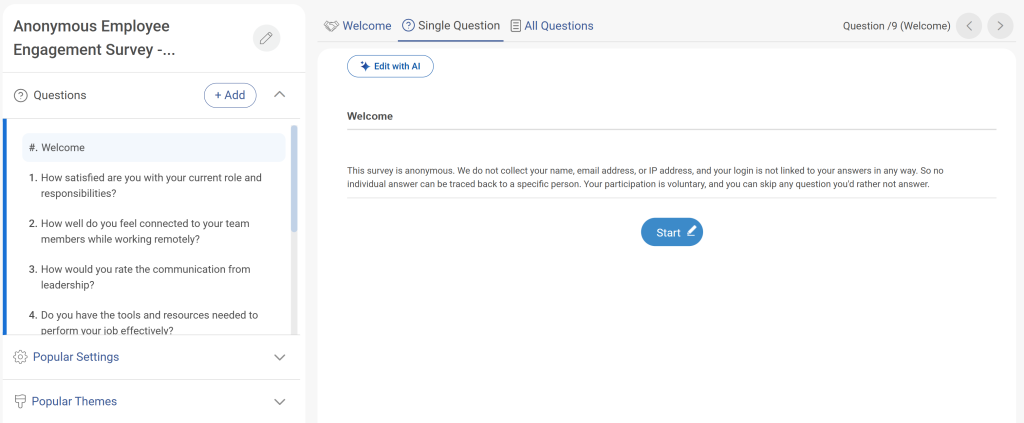
Swap in your actual minimum response threshold and a working contact detail so the disclaimer reads as specific, not like boilerplate.
Send It Out However Works Best for Your Audience
Send via email invite, QR code for in-person events, or an embedded link on your site.
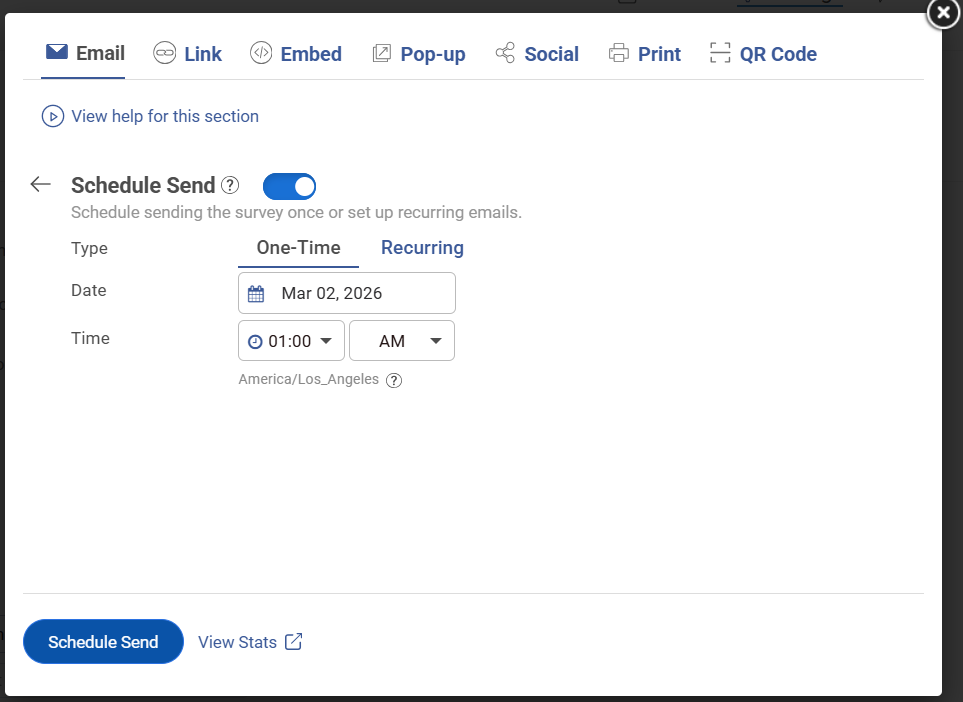
None of these requires respondents to log in, which means the “no login” line in your disclaimer holds up in practice, not just on paper.
Prefer to start with a proven structure rather than a prompt or an upload?
ProProfs Survey Maker’s template library also includes ready-made employee engagement survey templates you can adapt with your own disclaimer and question set.
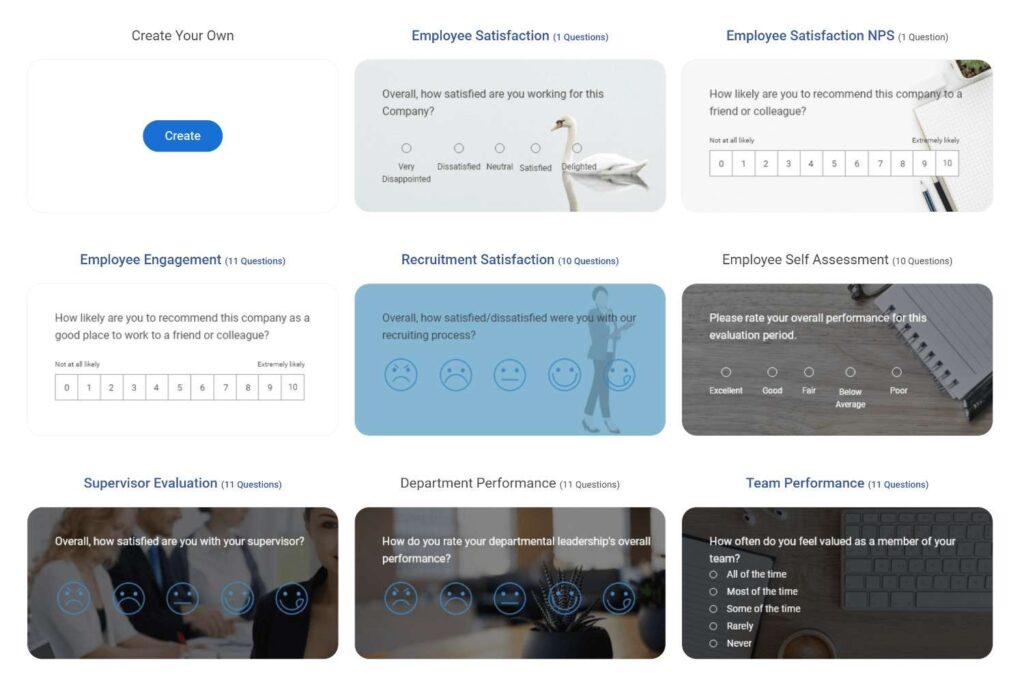
The free plan covers all of this for up to 50 responses, so you can test the disclaimer wording and the anonymous settings together before rolling it out company-wide. Larger response volumes start at $19.99/month.
What Changes Once Your Disclaimer Matches Your Settings?
Once the wording and the platform align, the shift shows up quickly. Answers get longer.
Feedback becomes more specific rather than remaining safely neutral. Fewer people leave sensitive questions blank out of caution.
That’s the real return on getting this right. Not a compliance checkbox, but data you can actually act on, from people who believed you the first time you said: “anonymous.”
Try ProProfs Survey Maker and build your first anonymous survey with the disclaimer template above already in place.
Frequently Asked Questions
Is an anonymous survey disclaimer legally required?
Not universally, but it's expected practice and often required indirectly. If you're subject to GDPR or similar data protection law, you must disclose data handling regardless of anonymity, and a disclaimer is the simplest way to meet that expectation while also building respondent trust.
What is the difference between an anonymous survey disclaimer and a consent form?
A consent form typically asks for explicit agreement to participate and to specific data uses, often required for research or medical surveys. An anonymous survey disclaimer is usually a simpler notice, informing rather than requesting a signature, though the two can overlap in formal research settings.
Can my employer see my answers even if the survey says it's anonymous?
If the survey is genuinely anonymous, no, because no identifying data is collected in the first place. If it's actually confidential rather than anonymous, someone with administrative access likely can, which is exactly why accurate labeling matters so much.
How long should an anonymous survey disclaimer be?
Two to four sentences are usually enough. Cover the purpose, what's excluded, the aggregation threshold, and voluntary participation. Longer disclaimers tend to get skipped entirely, which defeats the point of having one.
Do GDPR and other privacy laws require different disclaimer wording?
The core content, purpose, data handling, and rights stay similar across regulations, but specific requirements like retention periods or contact details for data requests vary. If you collect responses from regulated regions, have someone familiar with the applicable law review your wording.
What if my team is too small for the survey to feel anonymous?
Raise your aggregation threshold and avoid granular demographic breakdowns like department or tenure if any single slice could only describe one or two people. In very small teams, consider running the survey as confidential instead and saying so plainly.
Should the disclaimer be translated for multilingual teams?
Yes. A disclaimer that respondents can't fully read doesn't meet its purpose. ProProfs Survey Maker supports surveys in 90-plus languages, so the disclaimer and survey questions can both be localized for the audience taking the survey.
Do internal-only surveys still need a disclaimer?
Yes. Internal audiences are often the most skeptical of anonymity claims, since they know exactly who has access to company systems. An internal survey without a disclaimer tends to get the same guarded responses as one with a disclaimer nobody believes.
FREE. All Features. FOREVER!
Try our Forever FREE account with all premium features!

 We'd love your feedback!
What did you like & how can we make it even better?

 Thanks for your feedback!
 Ask Your Question
Have a question? Get expert help to make your decision easier.