

If you’ve ever sent a survey and worried the results didn’t actually reflect your audience, the problem probably wasn’t your questions. It was your sample.
Survey sampling is the process of choosing who gets surveyed, and getting it wrong quietly undermines every insight that follows.
Most teams don’t have a statistician on staff, and they shouldn’t need one to get this right.
This guide walks through the main survey sampling methods, how to pick the right one for your specific survey, how to size your sample, and how to avoid the mistakes that keep showing up in survey software reviews.
Along the way, we’ll point out where a tool like ProProfs Survey Maker’s AI Survey Maker and built-in segmentation actually remove the guesswork, rather than just automating it.
What Is Survey Sampling?
Survey sampling is the process of selecting a smaller subset of people, called a sample, from a larger group, called a population, so you can draw conclusions about the whole population without surveying every single member of it. A good sample reflects the population’s makeup closely enough that your results generalize.
That’s also the working definition of survey sampling in most research and market research contexts.
If you’re trying to define sampling survey work for a team that’s never done it formally, think of it this way:
Instead of asking all 3,000 employees at your company how they feel about a new benefits plan, you ask a carefully chosen 350 and use their answers to estimate what the other 2,650 would likely say.
Population, Sample, and Sampling Frame Explained:
Three terms come up constantly, and mixing them up is where most confusion starts.
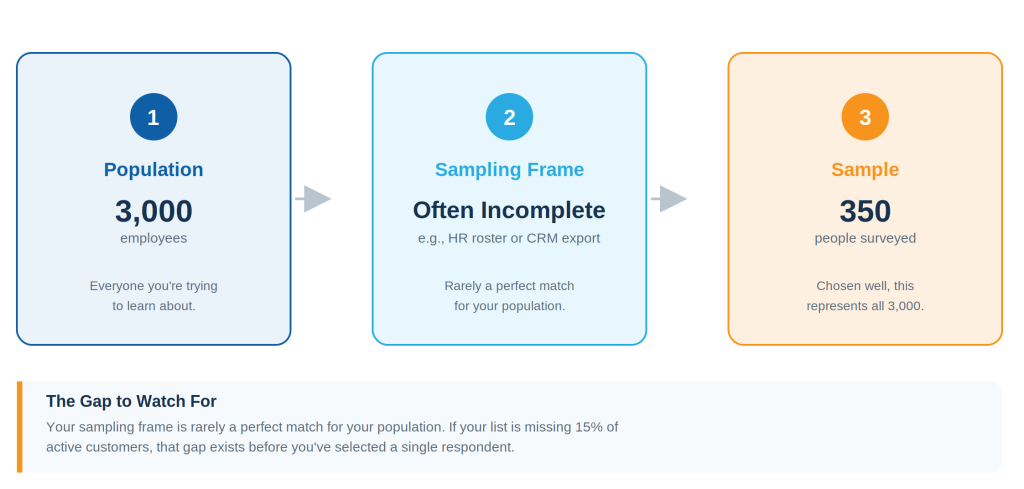
- Your population is everyone you’re trying to learn about. All employees, all customers, all students in a district.
- Your sample is the subset you actually survey.
- Your sampling frame is the actual list you draw that sample from, like an HR roster or a CRM export.
Here’s the part that trips people up: your sampling frame is rarely a perfect match for your population.
If your CRM is missing 15% of active customers, your sampling frame already has a gap before you’ve selected a single respondent.
Always check your frame against your population before you pick a method.
Why Does Your Sampling Method Matter More Than Your Sample Size?
There’s a persistent idea that a bigger sample automatically means better data collection. It doesn’t.
A sample of 2,000 people pulled entirely from one region, one age group, or one customer segment can be far less useful than a well-structured sample of 400.
Small, Diverse Samples Often Beat Large, Skewed Ones
Picture two employee engagement surveys.
- Survey A collects 1,500 responses, but 1,200 of them come from a single large office.
- Survey B collects 400 responses, deliberately spread across every department, region, and tenure band in the company.
Survey B will almost always give you a more accurate read on company-wide sentiment, even with a fraction of the responses.
This is exactly why the method you choose to build your sample matters more than the number you’re chasing.
What Are the Main Survey Sampling Methods?
Sampling methods fall into two broad families.
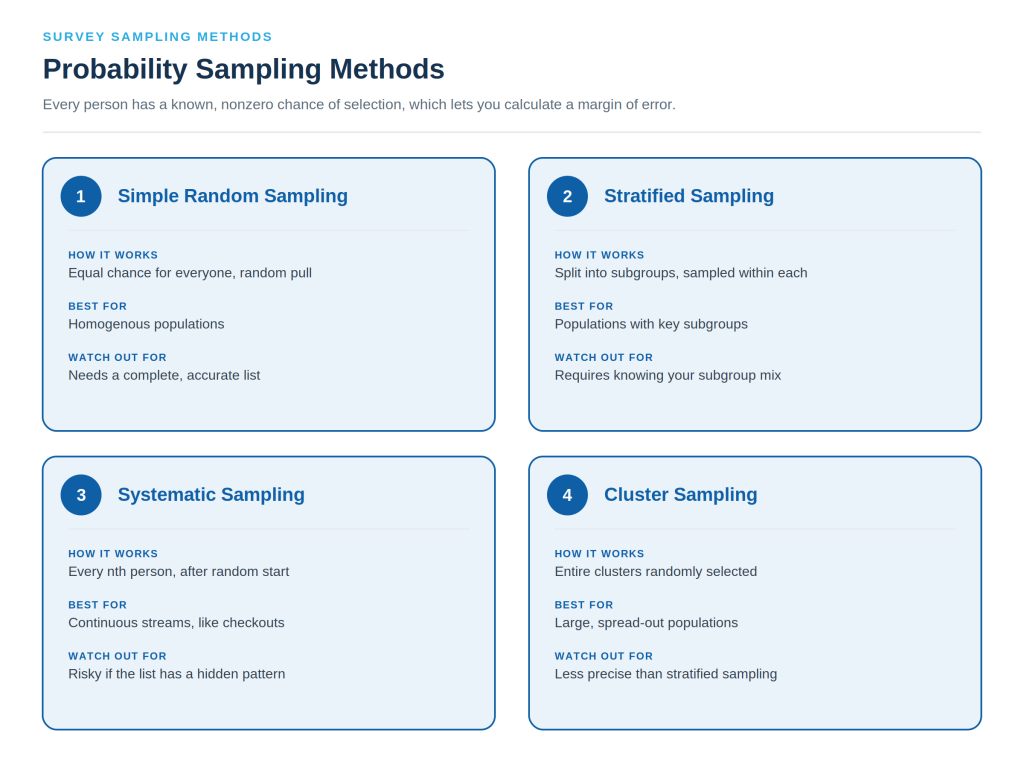
- Probability sampling gives every member of the population a known, nonzero chance of being selected, which allows you to calculate a margin of error and generalize your findings.
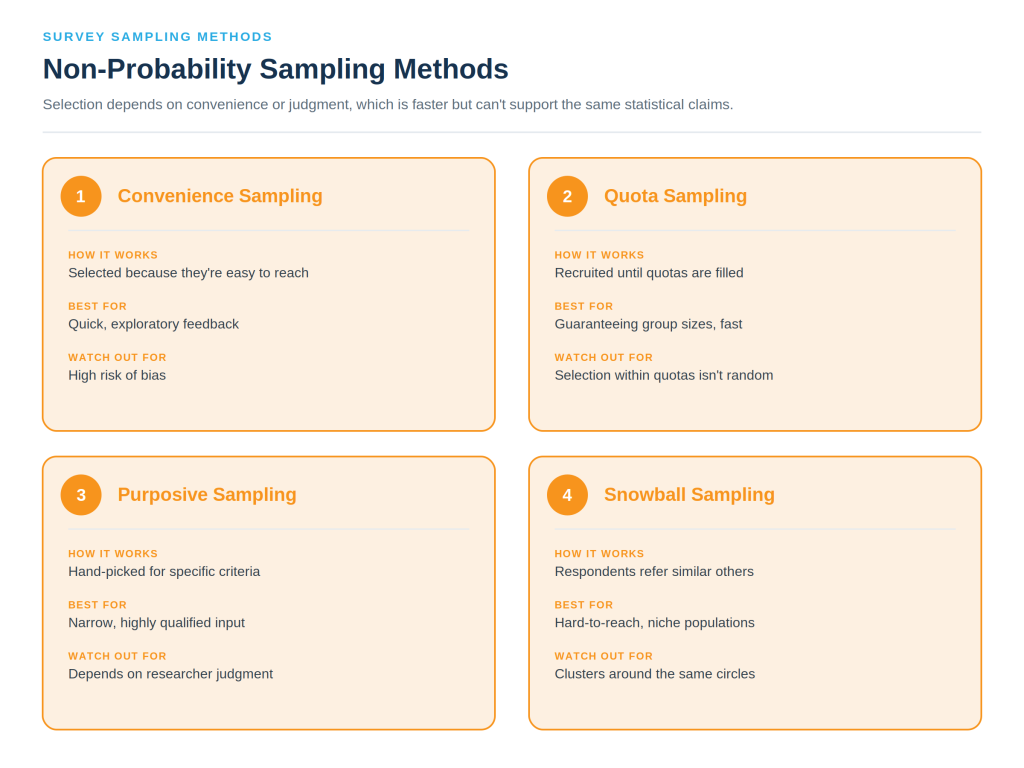
- Non-probability sampling selects people based on convenience or judgment, which is faster but cannot support the same statistical claims.
Neither family is inherently better. The right choice depends on how your population is structured and what you’re trying to prove.
Probability Sampling Methods
| Method | How It Works | Best For | Watch Out For |
| Simple Random Sampling | Every member of the population has an equal chance of selection, typically pulled from a complete list | Homogeneous populations where subgroups don’t matter much | Needs a complete, accurate list to start from |
| Stratified Sampling | The population is split into subgroups, or strata, such as department or region, then randomly sampled within each | Populations with meaningful subgroups you need represented proportionally | Requires knowing your subgroup breakdown ahead of time |
| Systematic Sampling | Every nth person on an ordered list is selected after a random starting point | Continuous streams, like customers as they check out or renew | Risky if the list has a hidden pattern that lines up with your interval |
| Cluster Sampling | The population is divided into natural clusters, like schools or offices, and entire clusters are randomly selected | Large, spread-out populations where surveying individuals one by one is impractical | Less precise than stratified sampling if clusters aren’t similar to each other |
Non-Probability Sampling Methods
| Method | How It Works | Best For | Watch Out For |
| Convenience Sampling | Respondents are selected simply because they’re easy to reach | Quick, exploratory feedback with no generalization needed | High risk of survey bias since it skews toward whoever is most available |
| Quota Sampling | Respondents are recruited until fixed quotas for key traits are filled | Fast studies where certain group sizes need to be guaranteed | Selection within each quota still isn’t random |
| Purposive Sampling | Respondents are hand-picked because they match specific, relevant criteria | Studies where only a narrow, qualified group’s input is useful | Depends heavily on the researcher’s judgment |
| Snowball Sampling | Existing respondents refer other respondents who fit the same profile | Hard-to-reach or niche populations with no public list | The sample tends to cluster around the same social or professional circles |
Probability Sampling vs. Non-Probability Sampling: The Core Trade-Off
Probability sampling is what lets you say “we’re 95% confident the true number falls within plus or minus 5%.”
Non-probability sampling can’t make that claim, no matter how many responses you collect, because selection wasn’t random.
That doesn’t make non-probability sampling useless. A quick quota sample for a product concept test is often exactly the right amount of rigor.
The mistake is presenting non-probability results with the same confidence as a properly randomized sample.
Which Sampling Techniques Work Best for Your Type of Survey?
The right sampling technique depends entirely on how your specific population is structured and how your survey gets triggered. These sampling techniques in survey research show up constantly across HR, product, education, and consulting use cases, so here’s how they map in practice.
| Survey Type | Typical Population Structure | Recommended Method | Why It Fits |
| Employee Engagement Survey (Global Company) | Multiple departments, regions, and tenure levels | Stratified Random Sampling | Ensures every department and region is proportionally represented, not just the loudest teams |
| Post-Purchase NPS Survey | A continuous stream of customers over time | Systematic Sampling | Captures a consistent, unbiased slice of customers as they arrive, without manual selection |
| Scored Discovery Assessment (Coaching or Consulting) | A defined list of prospects or leads | Purposive or Quota Sampling | Targets people who match specific qualifying criteria instead of surveying everyone |
| Large-Scale Education Survey (Students, Teachers, Families) | Whole schools or districts | Cluster Sampling | Surveys entire classrooms or schools instead of individually selecting students, which is faster and more practical |
| Event Feedback Survey | A fixed, known attendee list | Census (Full Population) | A small, finite population makes surveying everyone more accurate than sampling a portion of it |
Here’s a vast library of survey templates you can use for survey sampling:
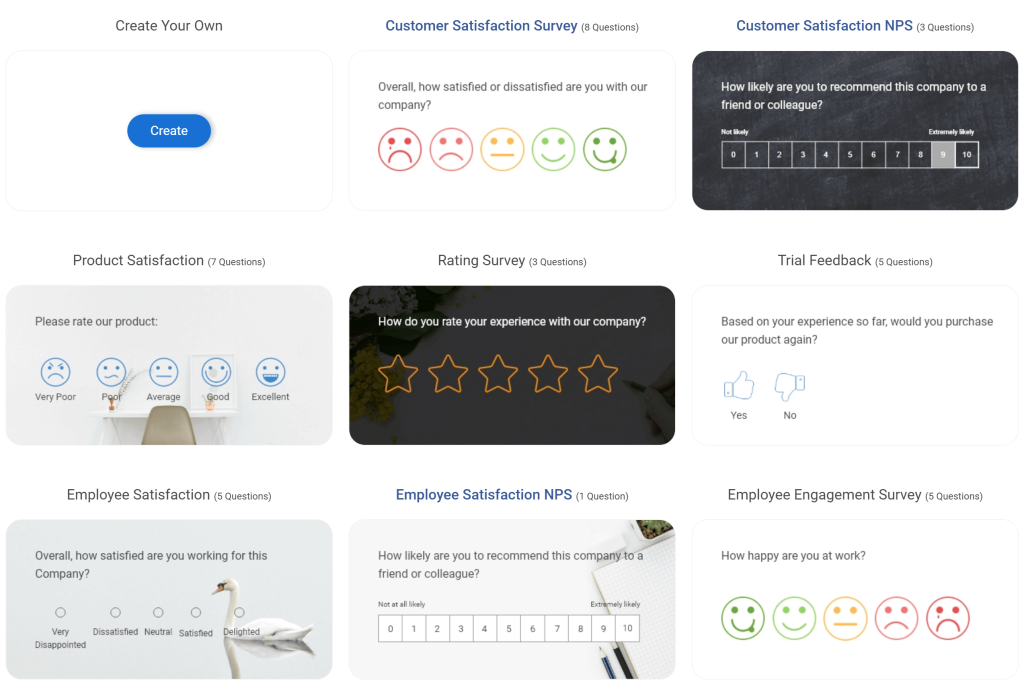
If you’re running a global employee engagement survey and need to guarantee every region and department shows up proportionally, this is where segmentation tools do the heavy lifting.
ProProfs Survey Maker’s Groups and Classrooms feature lets you organize respondents into the exact strata your sampling plan calls for, then report on each segment separately instead of untangling it after the fact.
FREE. All Features. FOREVER!
Try our Forever FREE account with all premium features!
How Do You Calculate the Right Sample Size for Your Survey?
Sample size comes down to three inputs: your population size, your desired confidence level, and your acceptable margin of error.
A 95% confidence level with a 5% margin of error means that if you repeated the survey 100 times, 95 of those times your results would land within 5 percentage points of the true figure.
You don’t need to run the formula by hand. Here’s a reference table for the 95% confidence, 5% margin combination that covers most business surveys.
| Population Size | Responses Needed (95% Confidence, ±5% Margin) |
| 50 | 44 |
| 500 | 217 |
| 1,000 | 278 |
| 10,000 | 370 |
| 100,000 or more | 384 |
Notice how the required sample flattens out past a certain population size.
Once your population crosses roughly 20,000, the number of responses you need barely changes, whether your population is 50,000 or 5 million.
A Quick Example: Sizing a 500-Person Employee Survey
Say your company has 500 employees and you want a 95% confidence level with a 5% margin of error. The table above tells you that you need 217 completed responses.
If you expect a 40% response rate, a common benchmark for internal employee surveys, you should invite all 500 employees rather than a subset, since 40% of 500 lands you right around 200, close to your 217 target.
This is also exactly the kind of math that determines whether you need to send reminder waves or widen your invite list.
What Survey Sampling Mistakes Should You Watch Out For?
Most sampling problems trace back to one of these five issues, all of which show up repeatedly in survey software reviews and forum threads.
Non-Representative Panels: A sample that doesn’t match your population across geography, demographics, or department will produce results that look precise but mean very little.
Over-Narrow Targeting: Filtering too aggressively on niche criteria can leave you with too few qualifying respondents to draw any real conclusion, even if your invite list was large.
Ignoring Non-Response Bias: People who don’t respond often differ systematically from those who do. A 15% response rate skewed toward your happiest customers will overstate satisfaction.
Straightlining and Fatigue: Long, repetitive surveys sent to the same panel repeatedly lead to rushed, low-effort answers that quietly corrupt your data.
Skipping Segment Weighting: A common rule of thumb in UX and market research is that if more than 1 percent of your responses come from a single company or group, confidence in the results drops, since that group is now over-represented relative to the true population. If you don’t weight for that, your overall numbers will lean in that group’s direction without anyone noticing.
The over-narrow targeting problem is especially common when teams try to build precise screening without the right tools.
This is where skip logic and branching in ProProfs Survey Maker help.
You can route respondents to qualifying questions dynamically instead of relying on a single blunt filter, which keeps your qualifying pool larger without loosening your criteria.
Here’s how it works:
How Do You Build a Properly Sampled Survey Step by Step?
Once you know your survey method and your target sample size, here’s how the actual build happens inside ProProfs Survey Maker, from the first draft to the final report.
Look at the detailed steps below:
Step 1: Draft Your Survey and Screening Questions Using AI Survey Maker
Describe your population and goal in plain language, such as “employee engagement survey for a 500-person company across three regions,” and it generates a complete starting survey so you’re not building your sampling plan and your questionnaire from scratch at the same time.
Try here:
Let ProProfs AI Build a Survey
Describe your survey and we'll create it for you
Step 2: Segment Your Audience
Set up your strata, whether that’s department, region, tenure, or customer tier, so every group you need represented is tracked as its own bucket from the start, not reconstructed later in a spreadsheet.
Here’s how to administer large groups:
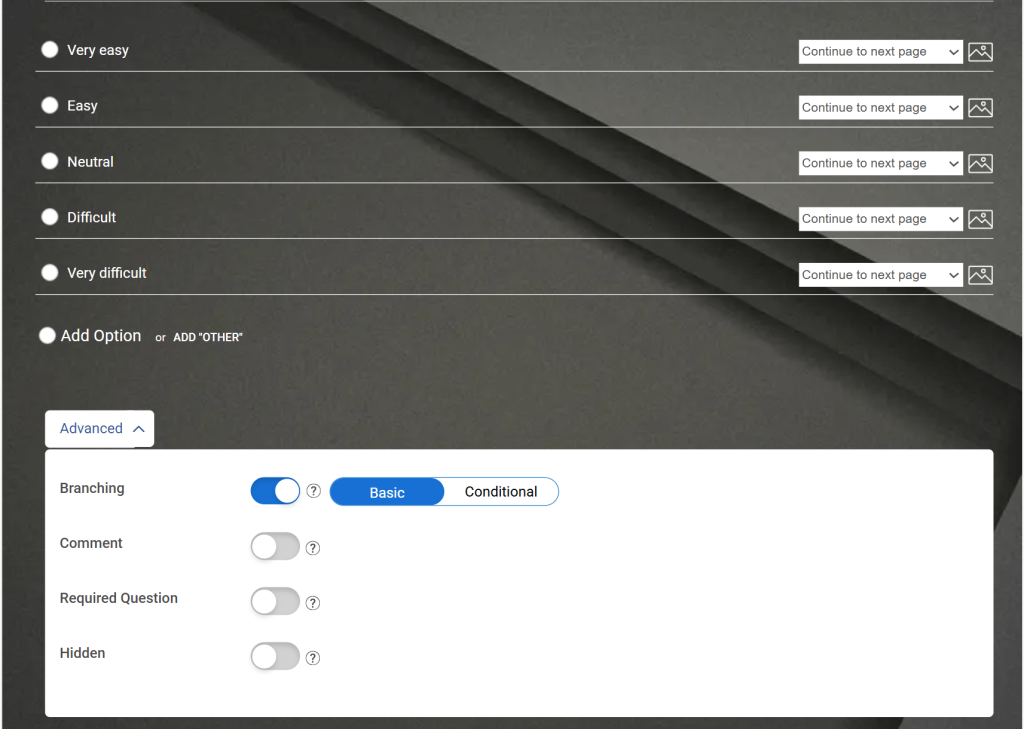
Step 3: Add Skip Logic and Branching to Handle Your Screening Criteria
Instead of one blunt qualifying question that filters people out, branching routes respondents to the right follow-up questions based on their answers, which keeps your qualifying pool larger without loosening your criteria.
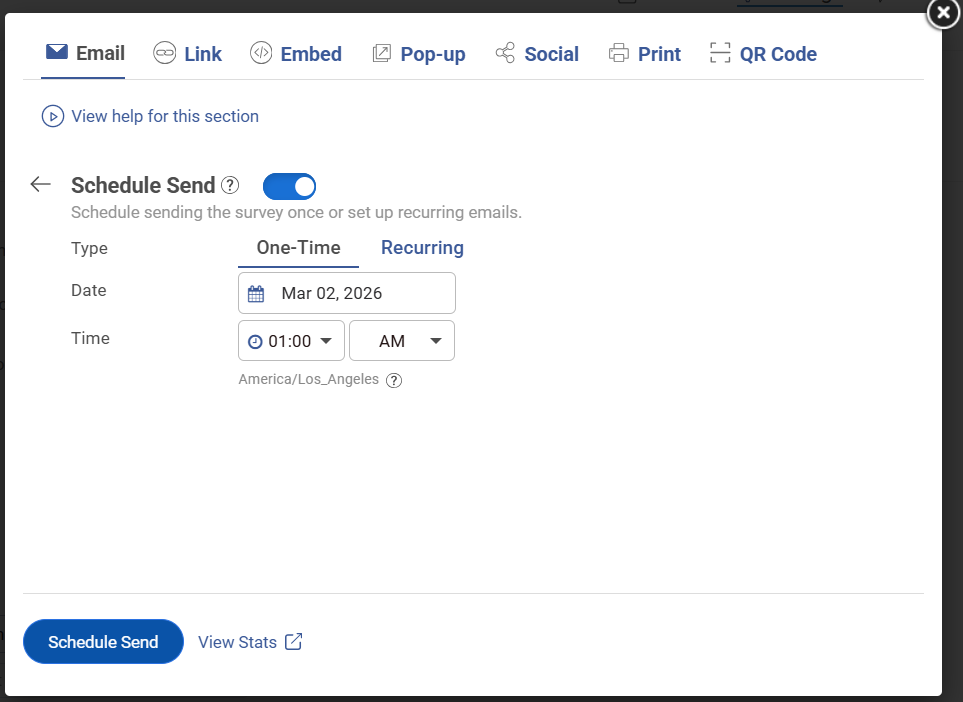
Step 4: Distribute Across the Channels That Actually Reach Your Full Sampling Frame
Send via email, direct link, QR code, website embed, or in-app placement.
Turn on multilingual surveys if your population spans multiple countries or language groups, since an English-only survey quietly excludes part of your sample before anyone responds.
Step 5: Track Incoming Responses Against Your Population’s Known Profile
Do this using the real-time reporting dashboard. If one region or department is falling behind, you’ll see the gap while there’s still time to send a reminder or widen your invite list.
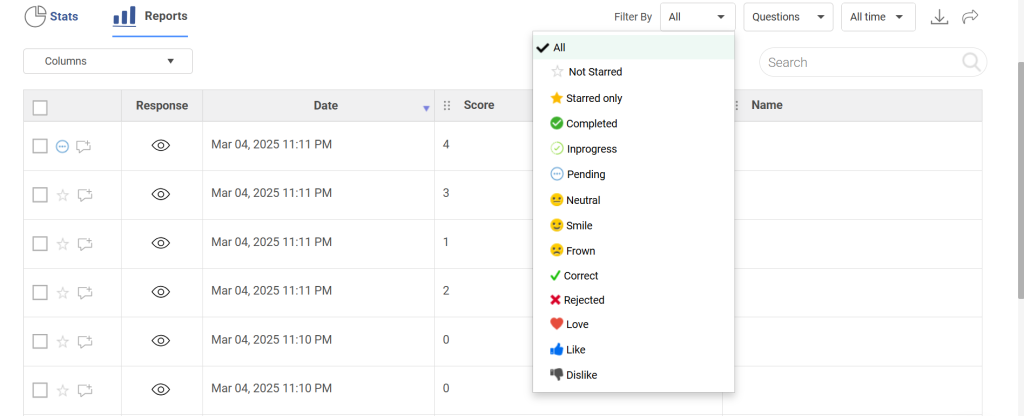
Step 6: Export Segmented Reports
Help stakeholders see representativeness broken out by group, not just a single topline number that hides which segments are under- or over-represented.
Survey Sampling Is a Design Decision, Not an Afterthought
Most teams don’t lose credibility because of a bad question.
They lose it because the people who answered never represented the people they actually needed to understand, and that gap only shows up months later, when a decision gets made on data nobody double-checked.
Treat your sampling plan as part of the survey design itself, not a step you handle after the questions are written.
Whether you’re stratifying a global workforce, clustering an entire school district, or sizing a 500-person pulse check, the method comes first, and the tool just needs to keep up with it.
ProProfs Survey Maker gives you the segmentation, skip logic, and reporting to put that plan into action without hiring a statistician.
Frequently Asked Questions
What is the definition of survey sampling in research?
Survey sampling is the practice of selecting a smaller, defined group from a larger population so you can study that smaller group and reasonably generalize the findings back to the whole population. It's used because surveying an entire population is usually too slow, too expensive, or simply impossible.
What is the difference between a sample and a census?
A sample surveys a portion of your population, while a census attempts to survey every single member of it. Censuses make sense for small, finite populations, like a 40-person team or a fixed event attendee list. For anything larger, a well-designed sample is faster and often just as accurate.
What is sampling error, and how is it different from bias?
Sampling error is the natural, expected gap between your sample's results and the true population value, and it shrinks as your sample size grows. Bias is a systematic distortion, caused by a flawed method or a non-representative panel, that doesn't shrink no matter how many more people you survey.
How many people should a small team survey?
It depends on your population size and how much precision you need, but as a starting point, a population of 500 typically needs around 217 responses for 95% confidence at a 5% margin of error. Smaller populations need a higher proportion of the group surveyed to hit the same confidence level.
What is quota sampling, and how is it different from stratified sampling?
Quota sampling recruits respondents until fixed group sizes are filled, without randomizing selection within each group. Stratified sampling also divides the population into groups, but then randomly samples within each one, which is what allows it to support statistical generalization, while quota sampling cannot.
Can you use more than one sampling method in the same survey?
Yes, and it's common in practice. A large education survey might use cluster sampling to select schools, then stratified sampling within each school to balance grade levels. Combining methods usually produces a more practical and more representative result than forcing one method to do everything.
Does AI change how you should approach survey sampling?
AI tools can speed up how you draft screening questions and segment respondents, but they don't change the underlying statistics. You still need to define your population, pick a method that matches its structure, and calculate a proper sample size. What AI removes is the manual setup time, not the planning step itself.
FREE. All Features. FOREVER!
Try our Forever FREE account with all premium features!

 We'd love your feedback!
What did you like & how can we make it even better?

 Thanks for your feedback!
 Ask Your Question
Have a question? Get expert help to make your decision easier.