
You don’t need six weeks and a research agency retainer to know whether a market is worth entering.
You need a market assessment analysis: a structured way to combine what already exists, industry data, competitor moves, published trends, with what you don’t have yet, real answers from the people you’d be selling to.
Most founders and consultants get stuck at the same point.
They know research matters, but they don’t have a repeatable process, so every assessment starts from a blank page and drags on for weeks.
This guide gives you that process: the steps, the exact questions to ask, the tools to use, including ProProfs Survey Maker for the primary research and scoring layer, and the mistakes that quietly wreck an otherwise solid assessment.
What Is a Market Assessment Analysis?
Market research is the data-gathering activity that includes surveys, interviews, and secondary reports. Market assessment analysis is the judgment layer built on top of that data. Think of research as the raw material and assessment as the decision it produces.
You’ll see this process referred to under a few different names: market assessment and analysis, market assessment and situation analysis, or simply market analysis.
The label varies by industry and consultant, but the goal stays the same: turn external data and direct customer input into a decision you can defend.
This distinction matters because most failed launches don’t fail on execution.
According to CB Insights research (2026) on startup failures, nearly 43% of failed venture-backed companies cite weak product-market fit as the leading cause, ahead of running out of cash or having the wrong team.
A market assessment analysis is how you catch that risk before you build, price, or pitch anything.
What Tools Do You Need for Market Assessment and Analysis?
Choosing the right tools for market assessment and analysis comes down to three layers working together:
- Sources for secondary data
- A way to run primary research
- A way to turn that research into a number you can act on
Most assessments fail not from a lack of tools, but from trying to force one tool to do all three jobs.
For secondary data, free and low-cost sources go a long way:
- Government labor and census statistics
- Industry association reports
- Search trend tools to gauge rising or falling interest in your category
None of this requires a paid subscription.
| Tool Category | What It’s For | Example Sources |
| Secondary Data | Market size, growth, and trend direction | Government labor statistics, census data, trade association reports, search trend tools |
| Primary Research | Direct survey data from your target segment | A survey platform with AI-assisted question drafting and skip logic |
| Scoring and Segmentation | Turning responses into a fit score | Scored surveys with point-based logic and custom result pages |
| Distribution | Reaching your segment where they already are | Email, website embed, QR code, and social link distribution |
The gap most small teams and consultants hit is the second and third layers.
Enterprise market research suites are built for research departments running dozens of studies a year and priced accordingly, with monthly minimums that don’t make sense for a single go-or-no-go decision.
That pricing model prices out exactly the founders and consultants who need to run this analysis the most.
This is where ProProfs Survey Maker fits the job.
It’s priced by response volume rather than per seat or per monthly research minimum, and every plan, including the free one, includes AI-assisted survey creation and scored surveys.
This way, you’re not paying extra to get the scoring layer that step six of the process depends on.
What Are the Steps to Conduct a Market Assessment Analysis?
Here’s the sequence that keeps an assessment from turning into an open-ended research project.
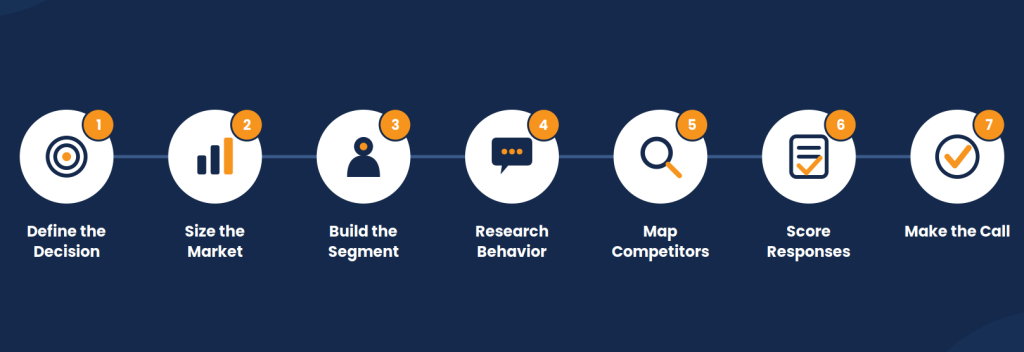
Each step builds on the one before it, and each one ends with something concrete you can hand to a stakeholder or a client.
1. Define the Decision the Assessment Needs to Support
Before you gather a single data point, write down the actual decision this assessment needs to inform.
Are you deciding whether to launch a new product line, enter a new geography, or greenlight a client’s expansion plan?
Get specific about the threshold that would justify a “go.” If you skip this step, you’ll end up with a pile of interesting data and no clear way to act on it.
Consultants running this for clients should get the client to sign off on the decision and threshold in writing before research starts.
What This Gives You: A single, agreed-upon question the rest of the assessment has to answer, instead of a vague mandate to “learn more about the market.”
2. Size the Market With Secondary Data First
Start with what already exists before spending time or money on primary research.
Government sources like the Bureau of Labor Statistics or your country’s equivalent, trade association reports, and tools like Google Trends will tell you whether the category is growing, flat, or shrinking, and roughly how large it is.
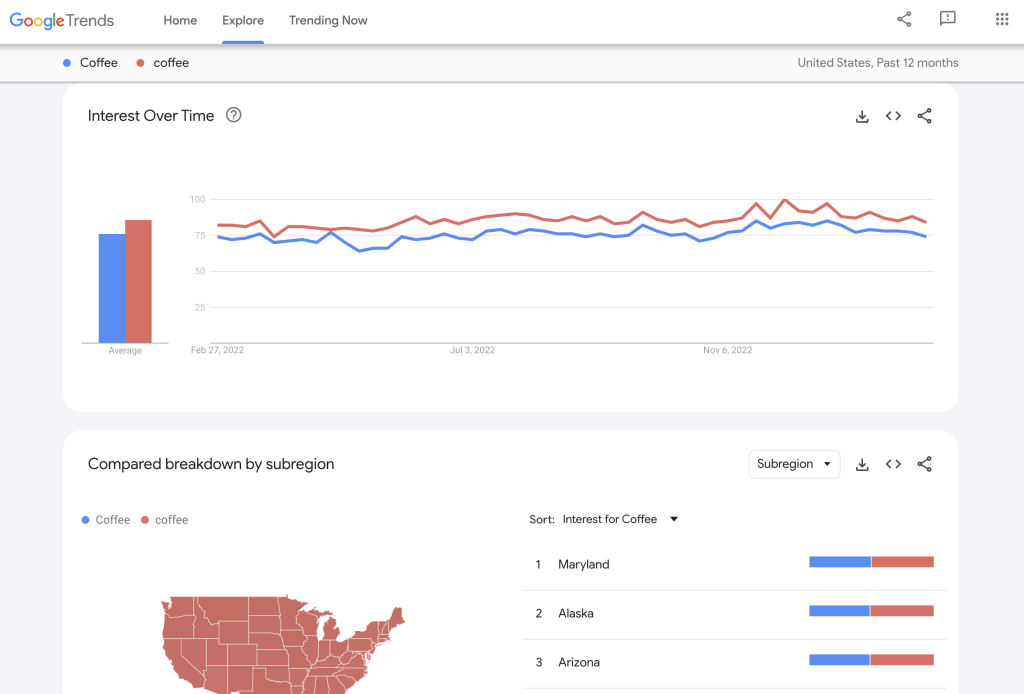
This is where you estimate your total addressable market: the full revenue opportunity if every reachable buyer in the category bought from you.
You’re not trying to get this number perfectly precise. You’re trying to confirm the pond is big enough to justify the next steps.
What This Gives You: A rough but defensible size and growth trajectory for the market, built without spending a dollar on primary research.
3. Build the Persona and Segment You Are Assessing
You cannot survey “everyone who might buy this.” Narrow down to a specific buyer: their role, company size, industry, and the pain point that would make them look for a solution like yours.
This step is really a target market analysis assessment in miniature: narrowing a broad market down to the specific segment you can actually reach, survey, and convert.
If you’re assessing a B2B market, a segment defined by company size and revenue range (for example, 26 to 50 employees, $1 million to $5 million in revenue) behaves very differently from one defined by industry alone.
Tight segmentation is what makes every later step, especially the survey questions, actually answerable. A guide to customer segmentation surveys covers this in more depth if you need to split a broad market into distinct buyer groups first.
What This Gives You: A specific enough persona that your primary research targets real decision-makers instead of a diluted mix of tire-kickers and buyers.
4. Design Primary Research Around Behavior, Not Opinions
This is where most assessments quietly go wrong. Customers cannot reliably tell you whether your product has product-market fit.
They can tell you what they currently do, what they currently pay, and what frustrates them about it.
Write every question to surface behavior and spend, not opinions about your idea. Avoid leading questions that assume the answer you want to hear.
Have someone outside the project read every question before you send it, specifically looking for hidden assumptions.
What This Gives You: Survey data grounded in what people actually do, which is far more predictive than what they say they’d probably do.
5. Map the Competitive Landscape Alongside Your Own Data
Cross-reference what you’re hearing from respondents against what’s publicly knowable about competitors: market share, pricing, feature gaps, and how customers describe them in reviews.
Look for barriers to entry and how much of the market is already spoken for.
This step tells you whether the demand you’re seeing in your survey data is demand for something new, or demand that’s already being served reasonably well by someone else.
What This Gives You: Context for your survey findings, so a positive demand signal doesn’t get mistaken for an open lane if the market is already crowded.
6. Score and Segment the Responses
Reading hundreds of open-text survey answers one at a time doesn’t scale, and it invites bias into how you interpret them.
Assign point values to the answers that matter most: demand frequency, current spend, and switching intent, and let respondents fall into clear buckets, such as high-fit, moderate-fit, and low-fit.
This is the step where a scored survey tool earns its place in the process.
Manually tagging and bucketing hundreds of rows in a spreadsheet is exactly the kind of task that turns a two-week assessment into a six-week one.
What This Gives You: A quantified view of demand instead of a subjective read of “most people seemed pretty interested.”
7. Turn the Findings Into a Go or No-Go Recommendation
Bring the assessment back to the decision you defined in step one. Write the recommendation in plain terms: go, go with specific conditions, or no-go, and back it with the two or three data points that drove the call.
Resist the urge to keep researching past this point. A market assessment is meant to produce a decision, not an indefinitely growing research file.
What This Gives You: A clear, defensible recommendation that a stakeholder or client can act on immediately, instead of a report that raises more questions than it answers.
How Do You Run a Market Assessment Survey Using ProProfs Survey Maker?
Here’s how the process from earlier in this guide translates into an actual survey build, from a blank dashboard to a scored report.
Step 1: Draft the Survey With AI Survey Maker
Describe your assessment goal in plain language.
For example, “gauge demand for a mid-market invoicing tool among finance managers at 50 to 200-person companies,” and AI Survey Maker generates a complete, ready-to-edit question set in seconds.
Try here:
Let ProProfs AI Build a Survey
Describe your survey and we'll create it for you
This removes the blank-page problem that stalls most DIY assessments before they start.
You get a complete survey draft in minutes, ready for you to tighten around the behavior-based questions from step four of the process.
Or skip the blank page entirely and start from a market research survey template (confirm slug) and adjust it to your segment.
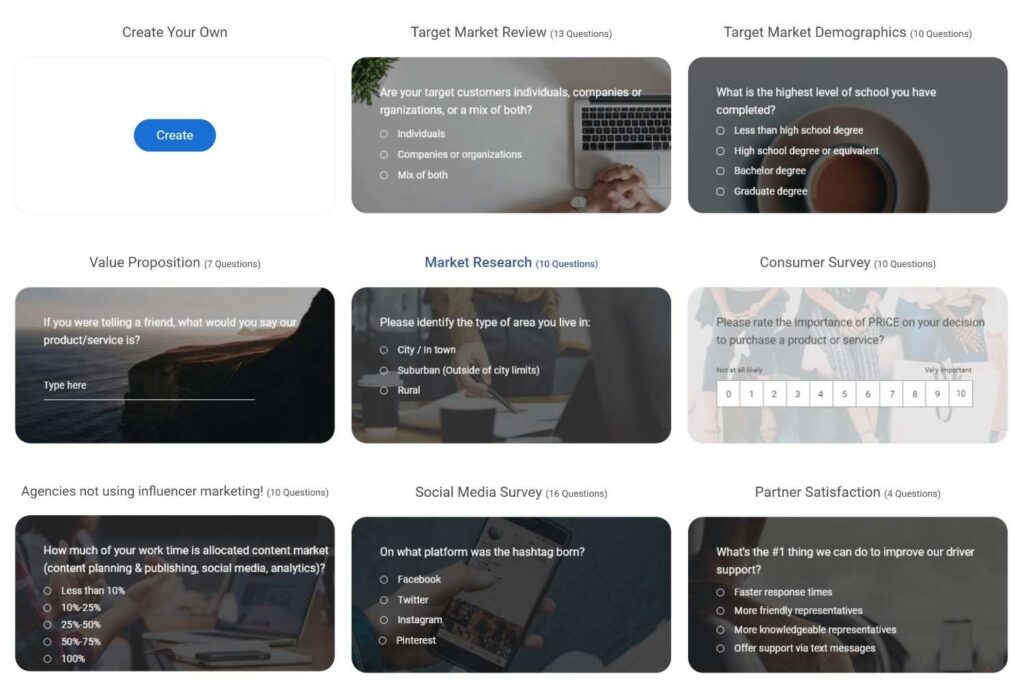
Step 2: Add Scored Logic to Bucket Respondents by Fit
Assign point values to the answers that signal real demand: frequency of the problem, current spend, and switching intent.
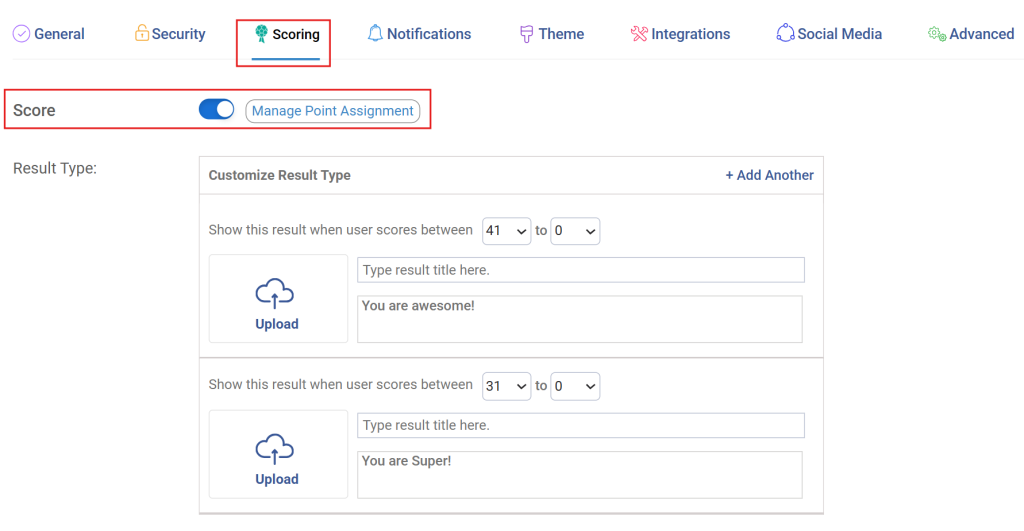
Respondents are automatically bucketed, for example, into high-fit, moderate-fit, and low-fit segments, and you can route each bucket to a custom result page.
This is the step that replaces manually tagging spreadsheet rows with a system that scores every response as soon as it comes in.
It becomes a live, quantified demand signal instead of a folder of open-text answers waiting to be read one at a time.
Step 3: Distribute Across the Channels Your Segment Actually Uses
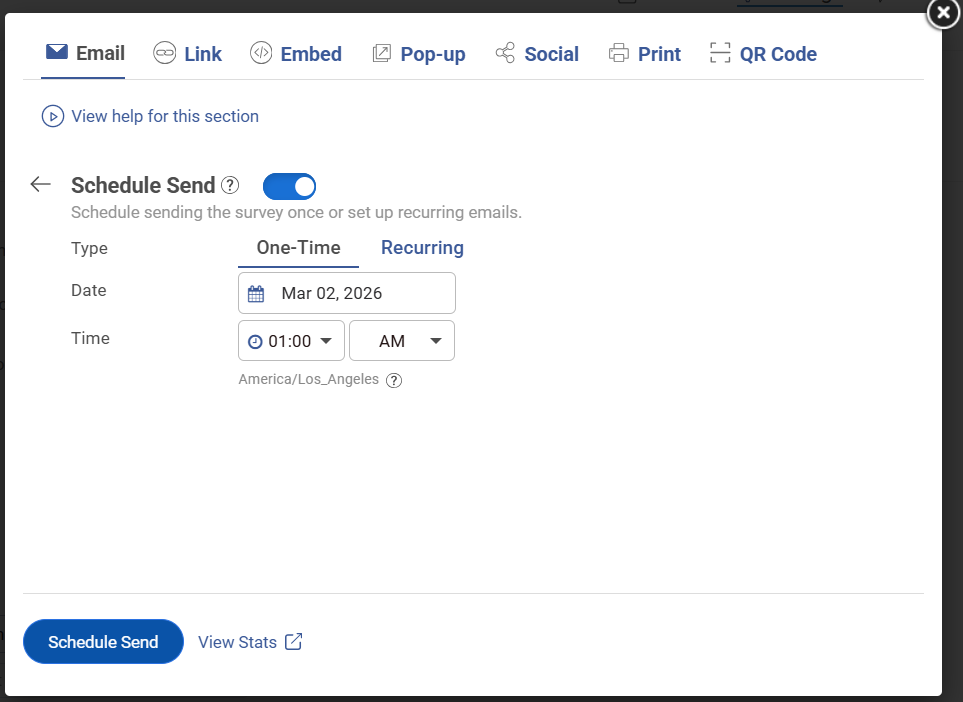
Send the survey through email, embed it on a landing page, or share it as a direct link or QR code, depending on where your defined segment actually spends time.
If you’re assessing a market across regions, multilingual support covers over 70 languages without needing separate survey builds.
You will get response volume from the right people, not just whoever happened to see a generic social post.
Step 4: Read the Score-Based Report and Make the Call
The real-time dashboard shows your fit buckets as they fill, and reports export cleanly for a stakeholder or client deck without requiring a data analyst to translate them first.
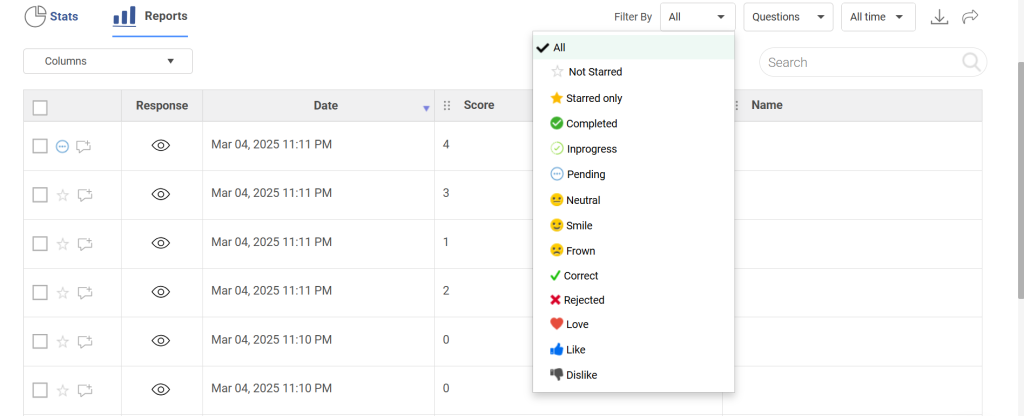
Bring this report back to the decision you defined in step one of the process, and write your go, go-with-conditions, or no-go recommendation directly from the scored data.
And you will get a reporting layer that a non-technical stakeholder can read and act on the same day the survey closes.
FREE. All Features. FOREVER!
Try our Forever FREE account with all premium features!
What Questions Should You Ask in a Market Assessment Survey?
Good market assessment questions are built to surface behavior, spend, and switching triggers, not abstract opinions about your idea.
Here’s a ready-to-use set organized by what each question is actually trying to teach.
| Category | Example Question | What It Reveals |
| Screening | Which of the following best describes your role in purchasing decisions for [category]? | Confirms you’re talking to an actual decision-maker, not just an interested bystander. |
| Current Behavior | What do you currently use to handle [problem]? | Surfaces real substitutes, including manual workarounds you’d be competing against. |
| Demand Frequency | How often does [problem] come up for your team? | Frequency signals urgency better than a hypothetical interest question ever will. |
| Willingness to Pay | What are you currently spending, in time or budget, to deal with [problem]? | Anchors any future pricing conversation in real spend instead of a guess. |
| Switching Trigger | What would need to change about your current approach for you to consider switching? | Surfaces the real trigger for change, not just a surface-level complaint. |
| Buying Channel | Where do you typically look when evaluating a new [category] solution? | Tells you where to focus the distribution and marketing effort later. |
| Open-Ended | What’s the one thing your current approach to [problem] gets wrong? | Gives you the exact language prospects use, which is useful for messaging down the line. |
Callout: Swap in your category and problem in brackets, and this seven-question set is enough to run a first-pass market assessment survey without writing a single question from scratch.
What Mistakes Should You Avoid in a Market Assessment Analysis?
A handful of avoidable mistakes account for most assessments that produce a confident conclusion built on shaky data. Here’s what to watch for and how to fix each one.
| Mistake | Fix |
| Skipping the decision definition and jumping straight to data collection | Write down the specific decision and the threshold that justifies a “go” before sending a single survey. |
| Asking customers to evaluate abstract concepts like product-market fit | Ask about current behavior and spend instead, and let the pattern across responses tell you the fit. |
| Writing leading questions that confirm what you already believe | Have someone outside the project review every question for hidden assumptions before launch. |
| Relying only on secondary data or only on primary data | Cross-reference both. Secondary data tells you the market exists. Primary data tells you if it exists for you. |
| Surveying too broad a group just to inflate response counts | Screen respondents down to the exact persona you defined before analyzing any results. |
| Treating the assessment as a one-time report instead of a repeatable check | Re-run the same scored survey each planning cycle to track shifts, not just capture a single snapshot. |
Turn Market Guesswork Into a Go or No-Go Decision
A market you’re about to enter doesn’t care how confident you feel about it.
It cares whether enough of the right people have a problem you can solve, at a price they’ll actually pay, and that’s the exact question a market assessment analysis is built to answer.
You now have the sequence, the survey questions, and the scoring method to get that answer without guessing and without a six-week research contract.
What’s left is the part that separates a real assessment from a gut feeling, with a slide deck built around it: running it.
If you’re a founder, that means the next new market or product line gets validated before the budget goes into it.
If you’re a consultant, it means walking into your client’s next planning meeting with a scored, defensible number instead of an opinion.
Try ProProfs Survey Maker and build your first scored market assessment survey in minutes using AI, or start from a library of 100+ ready-to-use templates.
Frequently Asked Questions
What is the difference between market assessment and market research?
Market research is the activity of gathering data through surveys, interviews, or secondary reports. Market assessment is the broader judgment built from that data, evaluating whether a market is viable and worth entering. Research is the input. Assessment is the decision it produces.
How long should a market assessment analysis take?
A focused assessment for a single decision typically takes one to three weeks: a few days for secondary research and segment definition, a week for the survey to collect enough responses, and a few days to score and write the recommendation. Scope creep, not the process itself, is what stretches this timeline.
How many people should you survey for a market assessment?
There's no universal number, but 50 to 150 responses from a tightly screened segment is usually enough to spot a clear demand pattern for an early-stage decision. A smaller sample of the right people beats a larger sample of the wrong ones every time.
What is a rapid market assessment?
A rapid market assessment is a compressed version of the process, often run in a single day or over a single event, using short surveys and quick counts instead of a multi-week research cycle. It trades depth for speed and works best for directional decisions rather than major investments.
Can you run a market assessment without a big budget?
Yes. Secondary data from government and trade sources is largely free, and per-response survey pricing means you only pay for the responses you actually collect. A founder or small team can run a credible assessment for a fraction of the cost of an agency retainer or an enterprise research platform.
Is a market assessment the same as a feasibility study?
No. A market assessment focuses specifically on demand, competition, and buying behavior. A feasibility study is broader and also weighs operational, financial, technical, and legal factors. Many feasibility studies include a market assessment as one input among several.
Do you need a market assessment before writing a business plan?
Yes, ideally. A business plan's revenue projections and go-to-market strategy are only as credible as the market data behind them. Investors and lenders will ask where your demand numbers came from, and a documented assessment gives you a defensible answer instead of an assumption.
What makes a market assessment analysis credible to investors or leadership?
Credibility comes from a clear decision framework, a well-defined respondent segment, and primary data that reflects behavior rather than opinions. A scored, quantified result carries more weight than a summary of impressions, because it shows exactly how the recommendation was reached.
FREE. All Features. FOREVER!
Try our Forever FREE account with all premium features!

 We'd love your feedback!
What did you like & how can we make it even better?

 Thanks for your feedback!
 Ask Your Question
Have a question? Get expert help to make your decision easier.