


HR survey questions are structured prompts designed to collect employee feedback on specific workplace aspects, including engagement, culture, management, onboarding, and satisfaction.
Effective HR survey questions are tied to a single objective, phrased in plain language, and paired with a response format that produces data you can act on.
Running surveys without a question framework is one of the most common reasons HR feedback programs lose employee trust. You send a 20-question form that mixes compensation, culture, and manager feedback.
Completion rates drop. Results are too scattered to prioritize. Nothing changes. Employees stop filling out the next one.
This article gives you 75 HR survey questions organized by objective, a framework for when and how to use each category, and a step-by-step guide to building your next survey using AI so you never start from a blank page again.
Each question was evaluated against one criterion: does it produce data you can act on, or does it only tell you something is wrong without pointing to what?
Categories were validated against Gallup’s 2025 Employee Engagement benchmarks, HR.com’s 2025 State of Employee Productivity and Engagement study, and SHRM’s ongoing workforce benchmarking research.
75 Most Important HR Survey Questions for Each Employee Feedback Goal
Before you pick a single question, match your survey to one of these six HR objectives. Each maps to a distinct employee moment and a distinct data need.
Using questions from multiple categories in one survey produces noise, not insight.
| HR Objective | When to Run It | Ideal Length |
| Employee Engagement | Quarterly or after major changes | 8 to 12 questions |
| Workplace Culture | Twice a year or after leadership changes | 6 to 8 questions |
| Manager Effectiveness | Tied to performance review cycles | 7 to 10 questions |
| Employee Satisfaction | Quarterly alongside engagement | 6 to 8 questions |
| Onboarding Experience | Week 2 and Day 90 of a new hire’s tenure | 5 to 8 questions |
| Pulse Check | Monthly or biweekly | 3 to 5 questions |
The sections below follow this structure. Questions are numbered consecutively across every category, so you can reference them by number when discussing results with your team.
What Questions Should You Ask in an Employee Engagement Survey?
Employee engagement survey questions measure how emotionally invested your employees are in their work, their team, and the organization. They assess motivation, commitment, sense of purpose, and whether employees feel their contributions matter.
Gallup’s 2025 data shows that only 31% of US employees were actively engaged at work, unchanged from 2024 and significantly below the 2020 peak of 36%.
Each one-point drop represents approximately 1.6 million fewer engaged workers.
The questions that move the needle are not broad satisfaction items. They focus on clarity, recognition, and growth.
| # | Question | What It Gauges |
| 1 | Do you feel valued by this organization? | Sense of belonging and emotional recognition |
| 2 | Does the company maintain regular, transparent communication with all employees? | Trust in leadership and organizational transparency |
| 3 | To what extent do you feel your individual contributions make a real difference here? | Sense of purpose and impact |
| 4 | Do you have access to the learning and development opportunities you need to grow in your role? | Growth mindset support and L&D investment perception |
| 5 | On a scale of 0 to 10, how likely are you to recommend this company as a great place to work? | Employee Net Promoter Score (eNPS) and overall advocacy |
| 6 | Do you understand how your day-to-day work connects to the company’s overall goals? | Role clarity and strategic alignment |
| 7 | Has someone at work specifically acknowledged your contributions in the past two weeks? | Frequency and quality of recognition |
| 8 | Do you feel motivated to put in your best effort most days? | Intrinsic motivation and discretionary effort |
| 9 | Do you see a clear path to advance your career at this company? | Career growth confidence and retention risk |
| 10 | Are the company’s goals and priorities clearly communicated to you on a regular basis? | Internal communication effectiveness and leadership clarity |
Here’s an employee engagement survey template you can use:
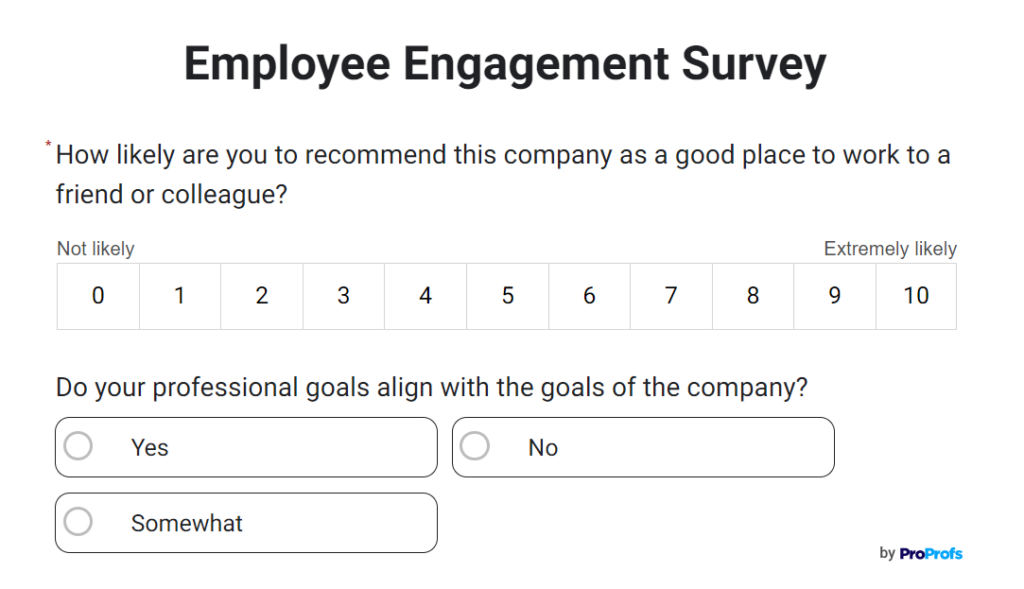
If you need a fast engagement read, use questions 5, 7, and 8 together.
They capture loyalty (eNPS), recognition, and discretionary effort in three questions and take under 90 seconds to complete.
Question 5 is your eNPS (Employee Net Promoter Score). Responses between 0 and 6 are detractors, 7 to 8 are passives, and 9 to 10 are promoters.
Track this number monthly, and you will see engagement trends before they appear in turnover data.
What Questions Reveal the Truth About Your Workplace Culture?
Workplace culture survey questions assess whether employees feel respected, psychologically safe, and aligned with the organization’s stated values. They surface the gap between the culture you describe in your handbook and the culture employees experience every day.
Culture is the top driver of both retention (61%) and organizational performance, according to HR.com’s 2025 State of Employee Productivity and Engagement report.
It is also where the biggest gap between leadership perception and employee reality tends to live.
| # | Question | What It Gauges |
| 11 | Do you feel respected by both your coworkers and leadership? | Mutual respect across hierarchies and peer relationships |
| 12 | Do the company’s stated values reflect how decisions are actually made here? | Alignment between stated culture and lived reality |
| 13 | Does this organization encourage an open exchange of ideas across all levels? | Psychological safety and inclusivity of voice |
| 14 | Do you feel comfortable raising a concern or disagreeing with your manager without fear of repercussions? | Psychological safety and speak-up culture |
| 15 | Are employees treated consistently and fairly regardless of their background or role? | Perceived equity and inclusion |
| 16 | What motivates you most to stay at this company? (Open-ended) | Retention drivers and intrinsic motivators |
| 17 | Have you witnessed or experienced any behavior that conflicts with our stated values? (Yes/No, with optional comment) | Culture integrity and values violations awareness |
| 18 | Do you feel your ideas are heard and taken seriously in team decisions? | Inclusion in decision-making and sense of influence |
Here’s a quick workplace culture survey template for you:
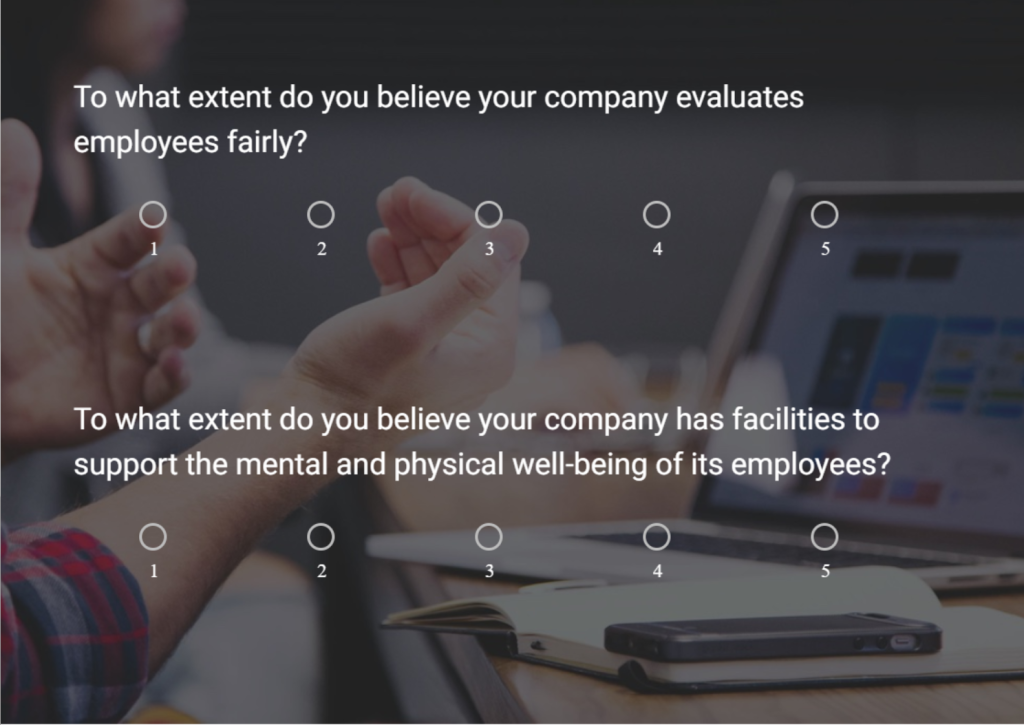
One finding that surfaces consistently in HR community discussions: culture surveys fail when employees do not trust that responses are truly anonymous.
Before sending, explicitly tell employees who will see the results, how data will be aggregated, and what your anonymity setup is.
In teams of fewer than 15 people, consider combining departments before sharing results with leadership.
Here’s how you can make your surveys absolutely anonymous:
Which Questions Help You Evaluate Manager Effectiveness?
Manager effectiveness survey questions give employees a structured outlet for upward feedback and give HR data on which leaders are developing their teams versus contributing to disengagement or attrition.
Managers account for 70% of the variance in team engagement scores, according to Gallup (2025). That is not a management platitude.
It means that if your company-wide engagement score is low, the fastest place to look is manager quality, not compensation or culture programs. You cannot see that without direct upward feedback.
| # | Question | What It Gauges |
| 19 | Does your manager clearly communicate what is expected of you? | Clarity of expectations and role definition |
| 20 | Does your manager give you feedback that actually helps you improve? | Feedback quality and developmental value |
| 21 | Does your manager acknowledge your effort and contributions? | Manager-led recognition and appreciation |
| 22 | Do you feel comfortable raising a concern directly with your manager? | Psychological safety within the manager relationship |
| 23 | Does your manager actively support your professional development? | Manager investment in employee growth |
| 24 | How well does your manager handle conflict within the team? | Conflict resolution effectiveness and team health |
| 25 | Does your manager treat all team members equitably and consistently? | Perceived fairness and managerial consistency |
| 26 | Has your manager given you specific, useful feedback in the past two weeks? | Recency and specificity of actionable feedback |
| 27 | Does your manager set a clear direction for the team’s priorities? | Strategic clarity and team alignment |
| 28 | Overall, how would you rate your manager’s effectiveness on a scale of 1 to 5? | Overall manager performance and satisfaction rating |
Here’s a managerial feedback HR survey template for you:
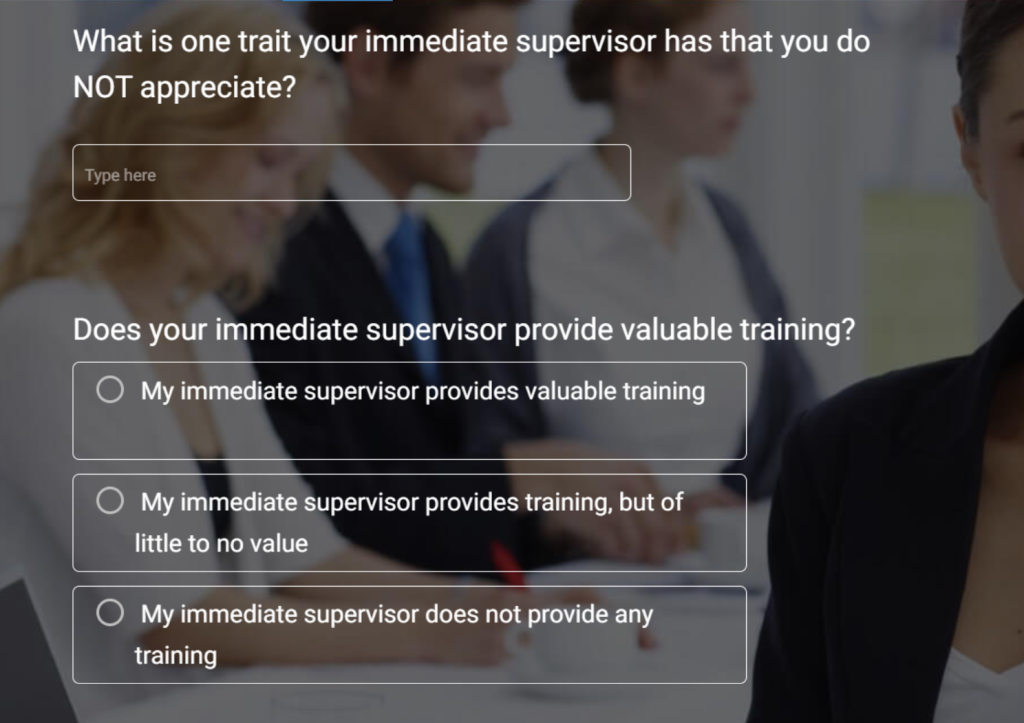
In teams of fewer than 15 people, manager surveys can feel identifying even when they are anonymous.
Aggregate results across at least two teams before sharing with any individual manager.
What Employee Satisfaction Survey Questions Give You Actionable Data?
Employee satisfaction survey questions measure how content employees are with the practical elements of their job: compensation, benefits, workload, tools, and working conditions. Satisfaction and engagement are closely related but distinct. An employee can be satisfied but disengaged, and vice versa.
Understanding which one you have changes how you respond.
High satisfaction with low engagement usually signals a meaning or growth problem, not a compensation problem.
If you conflate the two, you will spend the budget on the wrong fix.
| # | Question | What It Gauges |
| 29 | How likely are you to recommend this company to a friend or colleague on a scale of 0 to 10? | Employee Net Promoter Score (eNPS) and overall advocacy |
| 30 | Are you satisfied with your current compensation relative to your responsibilities and experience? | Pay equity perception and compensation satisfaction |
| 31 | Do you have the tools and resources you need to do your job effectively? | Operational enablement and resource adequacy |
| 32 | Does the company support a healthy work-life balance? | Burnout risk and work-life balance perception |
| 33 | Are the benefits offered by this organization meeting your needs? | Benefits relevance and overall satisfaction |
| 34 | How often do you feel stressed at work to the point that it affects your performance? | Stress levels and wellbeing impact on productivity |
| 35 | Do you feel the workload across your team is distributed fairly? | Workload equity and team fairness perception |
| 36 | Are you satisfied with how HR responds when you raise a concern? | HR responsiveness and employee trust in HR |
| 37 | Do you find the company’s healthcare or wellness coverage adequate for your needs? | Wellness benefit adequacy and employee wellbeing support |
| 38 | Do you have a clear understanding of the compensation policy and how your pay is determined? | Compensation transparency and pay process clarity |
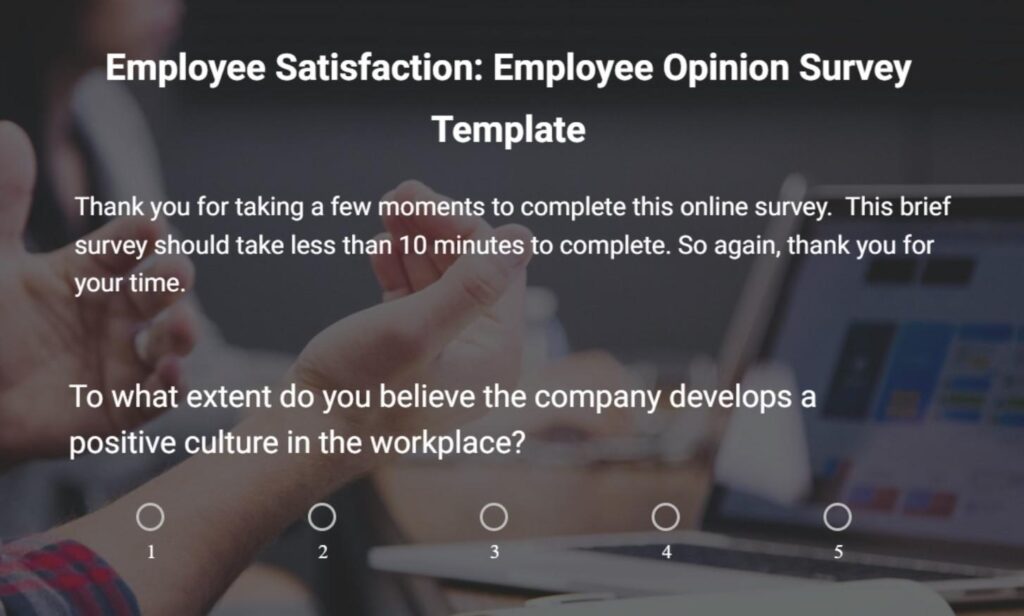
Here’s an employee satisfaction survey template for you:
What Onboarding Survey Questions Should You Ask New Hires?
Employee onboarding survey questions collect feedback from new hires on whether they received the clarity, training, and support they needed to be effective in their role. They are most valuable when sent twice: within the first two weeks and again at the 90-day mark.
Onboarding surveys are one of the highest-return investments in HR because the cost of early attrition is high and the feedback window is short.
If a new hire’s experience is not what they expected, you have roughly 30 to 60 days to correct it before disengagement becomes a pattern.
| # | Question | What It Gauges |
| 39 | Have your job responsibilities been clearly explained to you since you joined? | Role clarity and onboarding communication effectiveness |
| 40 | How satisfied are you with the training you received for your specific role? | Role-specific training adequacy and satisfaction |
| 41 | On a scale of 1 to 10, how welcome do you feel on your team right now? | Early belonging and team integration |
| 42 | Do you feel confident in your ability to do your job at this point in your tenure? | New hire confidence and readiness to perform |
| 43 | Did the role match what was described during the interview and recruitment process? | Recruitment accuracy and expectation alignment |
| 44 | If you could change one thing about the onboarding experience, what would it be? (Open-ended) | Onboarding gaps and qualitative improvement areas |
| 45 | Did you receive adequate training on the tools and systems you are required to use? | Technical onboarding completeness and tool readiness |
| 46 | Do you know who to go to if you have a question or concern in your first 30 days? | Support structure clarity and early navigation confidence |
| 47 | Do you feel your manager has been available and supportive since you started? | Manager accessibility and early relationship quality |
| 48 | How would you rate the overall onboarding experience on a scale of 1 to 5? | Overall onboarding satisfaction and experience rating |
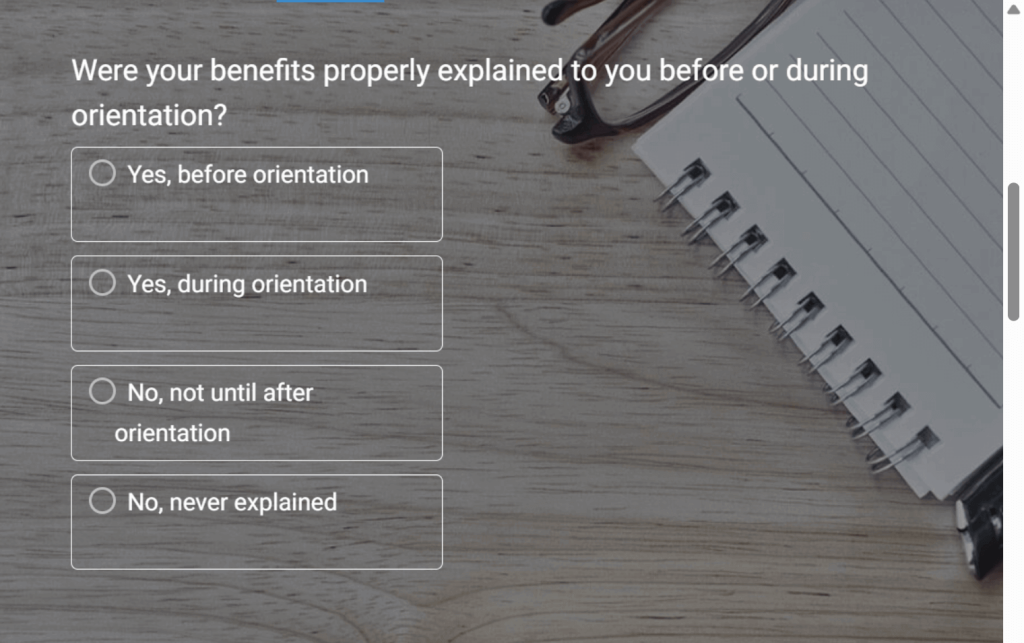
Here’s an onboarding HR survey template for you:
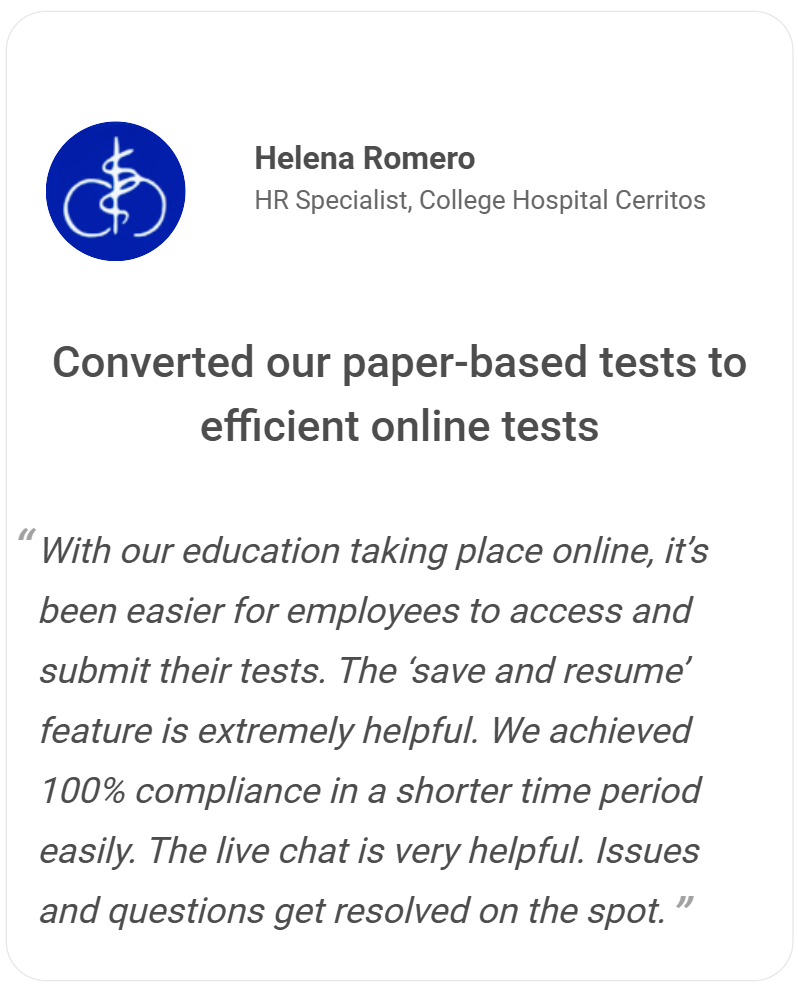
Helena Romero, HR Specialist at College Hospital Cerritos, used ProProfs Survey Maker to run onboarding compliance surveys and reported achieving 100% completion in a shorter time period than their previous process.
In onboarding, especially, survey logistics (timing, mobile accessibility, single-click access) directly determine whether you get data or radio silence.
What Are the Most Effective Pulse Survey Questions for Monthly Check-Ins?
Pulse surveys are short, high-frequency surveys sent monthly or biweekly, focused on a single topic. They capture real-time employee sentiment between longer engagement surveys and are the fastest mechanism HR teams have to detect issues before they escalate.
Pulse surveys only work if they are genuinely short. Three to five questions, one topic, under two minutes to complete.
The moment a pulse survey starts feeling like a full engagement survey, completion rates fall off.
| # | Question | What It Gauges |
| 49 | How would you rate your overall mood at work this week on a scale of 1 to 5? | Current emotional state and weekly sentiment |
| 50 | Do you have everything you need to complete your priorities this week? | Immediate resource availability and operational readiness |
| 51 | Did anything block your progress in the past week? (Yes/No, with optional comment) | Recent blockers and friction points in workflow |
| 52 | Do you feel supported by your team right now? | Real-time peer support and team cohesion |
| 53 | How clear are your priorities for the next two weeks on a scale of 1 to 5? | Short-term clarity and near-term directional alignment |
| 54 | Is there anything your manager could do differently to better support you right now? | Immediate manager support gaps and coaching needs |
| 55 | How confident do you feel about the company’s direction at this moment? | Current leadership trust and organizational confidence |
| 56 | On a scale of 1 to 5, how productive did you feel this week? | Self-assessed weekly productivity and output satisfaction |
The most common mistake with pulse surveys is sending the same eight questions every month.
Rotate topic focus each cycle: workload clarity one month, team communication the next, manager support the month after.
Rotation keeps responses honest and prevents the survey fatigue that tanks participation rates by month four.
You can use tools like Qualaroo, integrated with your communication platforms, for these pulses and real-time sentiment analysis.
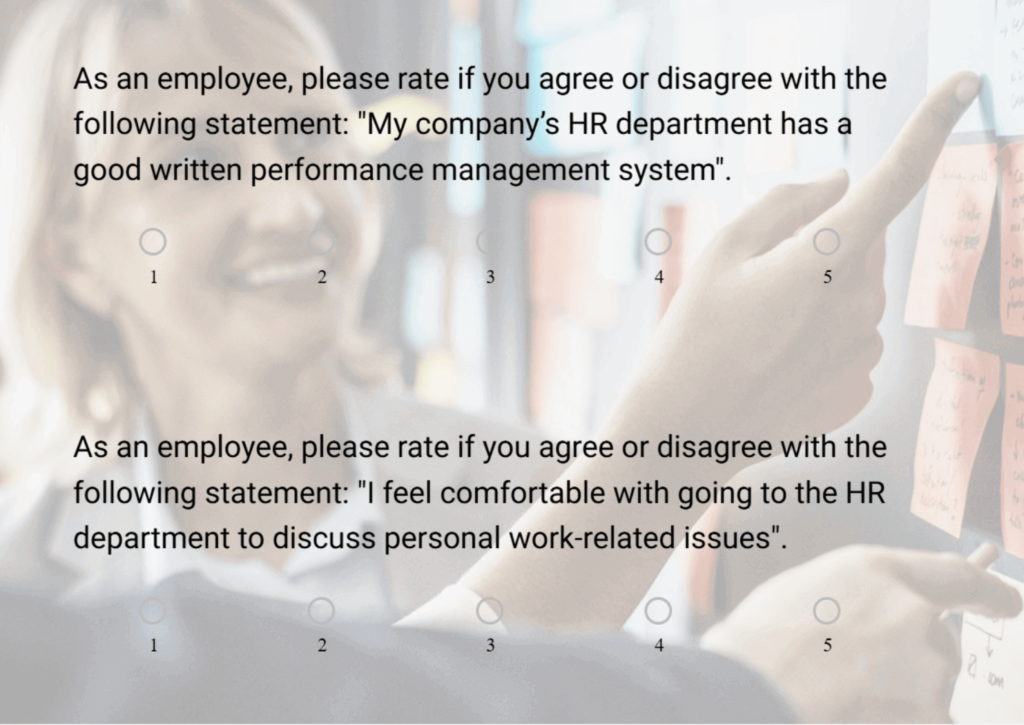
What Questions Belong in an HR Effectiveness Survey?
HR effectiveness survey questions measure how well the HR department itself is performing, from responsiveness and policy clarity to how well HR initiatives and events are landing with employees.
Most HR teams measure employee satisfaction, but not satisfaction with HR.
That blind spot means you can have solid engagement scores while HR processes, communication, and service quality are silently eroding trust.
This is the category that closes the loop on your own function.
| # | Question | What It Gauges |
| 57 | How responsive has the HR department been when you have raised a concern or question? | HR responsiveness and issue resolution timeliness |
| 58 | Do you feel you have easy access to HR staff when you need support? | HR accessibility and approachability |
| 59 | Are changes in company policies communicated to you in a timely and clear way? | Policy communication effectiveness and transparency |
| 60 | Do you feel HR policies are applied consistently and fairly across all employees? | Perceived HR fairness and policy consistency |
| 61 | Based on your experience with the HR team, would you recommend this company to someone you know? | HR-influenced advocacy and overall employer brand perception |
| 62 | How satisfied are you with how HR handled your most recent concern or request? | HR service quality and employee satisfaction with outcomes |
| 63 | What is one thing the HR team could do to better support you in your role? (Open-ended) | Qualitative HR improvement areas and unmet support needs |
Here’s an HR effectiveness survey template for you:
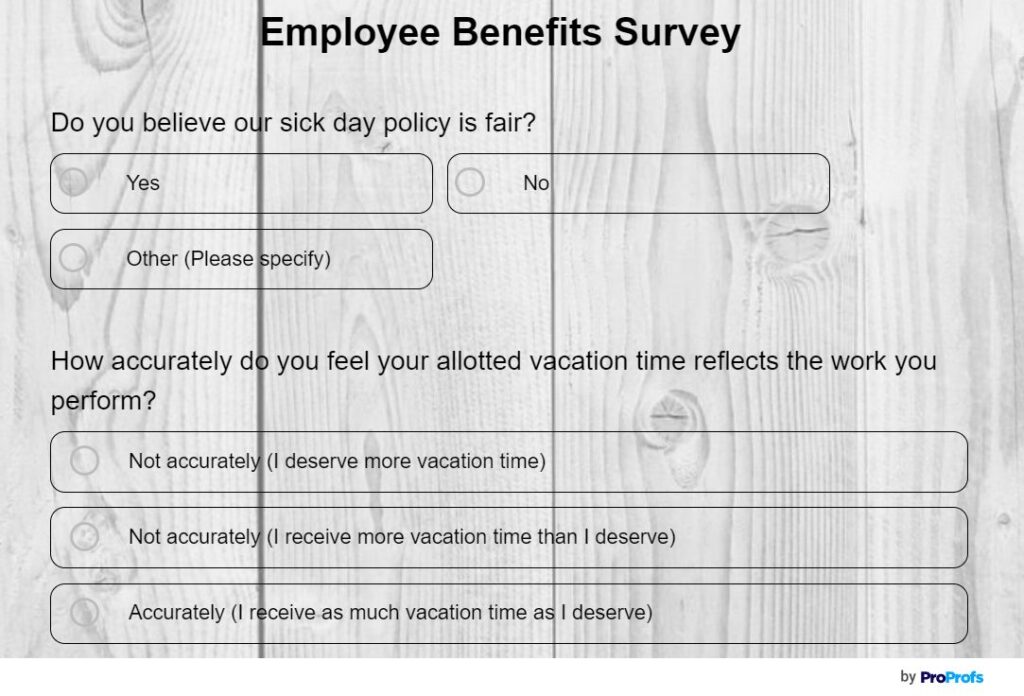
What Questions Should an Employee Benefits Survey Include?
Employee benefits survey questions capture whether employees understand, value, and feel satisfied with the compensation and non-compensation benefits the organization provides.
Benefits questions are worth separating from general satisfaction surveys because they produce data with a direct budget implication.
If 60% of employees do not find the healthcare plan adequate, that is a benefits strategy conversation, not a culture conversation.
Running it in a combined survey means leadership cannot act on it cleanly.
| # | Question | What It Gauges |
| 64 | Are you satisfied with the overall compensation you currently receive for your role? | Overall compensation satisfaction and pay adequacy |
| 65 | Do you find the healthcare coverage offered by the company adequate for your needs? | Healthcare benefit adequacy and employee wellbeing support |
| 66 | Which employee benefits do you value the most? (Multi-select) | Benefits prioritization and relative perceived value |
| 67 | Do you have a clear understanding of all the benefits available to you? | Benefits awareness and communication effectiveness |
| 68 | Are there any benefits currently not offered that would meaningfully improve your experience here? (Open-ended) | Unmet benefits needs and qualitative gaps |
| 69 | How fairly do you feel the company handles pay increases and promotions? | Perceived fairness in compensation advancement decisions |
| 70 | Does your total compensation reflect the value you bring to the organization? | Pay-for-performance perception and self-worth alignment |
Here’s a employee benefits HR survey template for you:
What Questions Should You Include in an Employee Recruitment Feedback Survey?
Recruitment feedback survey questions capture a new hire’s experience of the hiring process itself, from how they found the role to whether the interview accurately represented the position.
This category helps HR identify where the candidate experience breaks down and where misalignment between the job description and the actual role is creating early attrition.
According to the 2025 SHRM State of the Workplace report, only 41% of employees believe their company’s recruiting process is effective.
| # | Question | What It Gauges |
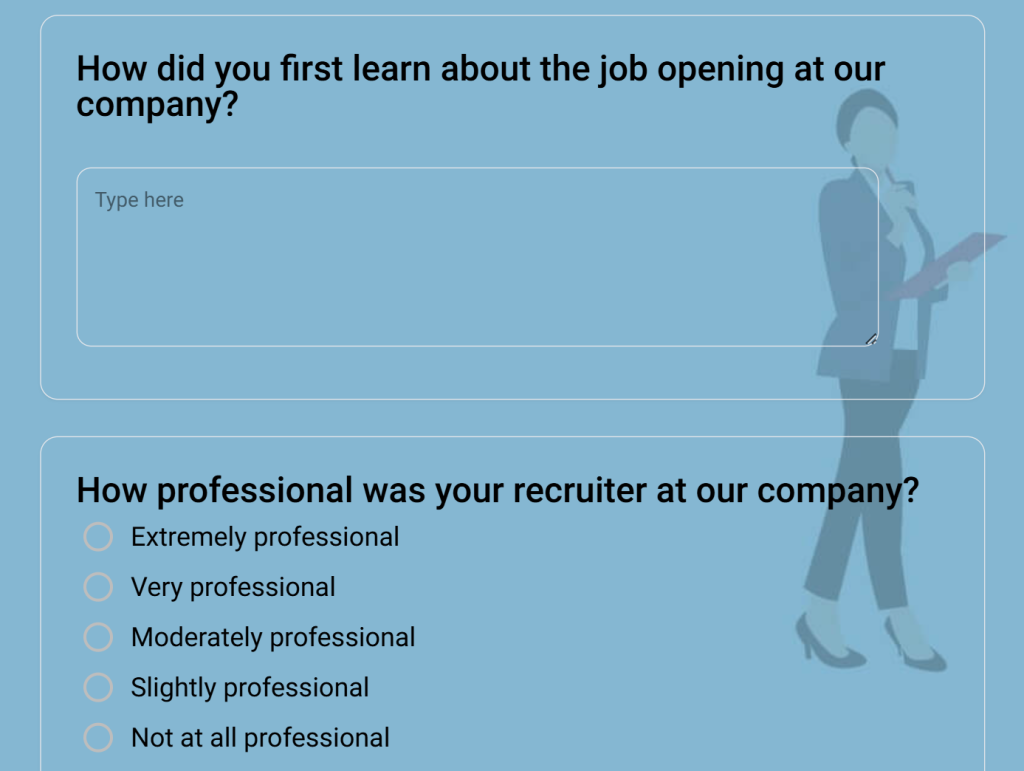
| 71 | How did you first learn about this job opening? | Recruitment channel effectiveness and sourcing reach |
| 72 | Overall, how satisfied were you with the recruitment process on a scale of 1 to 5? | Candidate experience quality and recruitment satisfaction |
| 73 | Did the interview process give you an accurate picture of the role and the company? | Interview accuracy and expectation setting effectiveness |
| 74 | Were all company policies and expectations clearly communicated during onboarding? | Onboarding communication completeness and policy clarity |
| 75 | What is one thing we could improve about our hiring or onboarding process? (Open-ended) | Qualitative gaps in recruitment and onboarding experience |
Here’s a recruitement HR survey template for you:
How Do You Build an HR Survey in Minutes Using AI?
HR teams running surveys across multiple departments often hit the same wall: building surveys from scratch takes time they do not have, and reusing the same generic template every quarter produces stale data that nobody acts on.
If you don’t want to use the templates, start by telling the AI what you are actually trying to solve, not just the topic.
The more specific you are upfront, the less editing you will need to do.
Here is the full process using ProProfs AI Survey Maker:
Step 1: State Your Objective in Plain Language
Instead of typing “employee engagement survey,” try: “I need a 10-question engagement survey for a remote team of 40, focused on manager communication and clarity of expectations.”
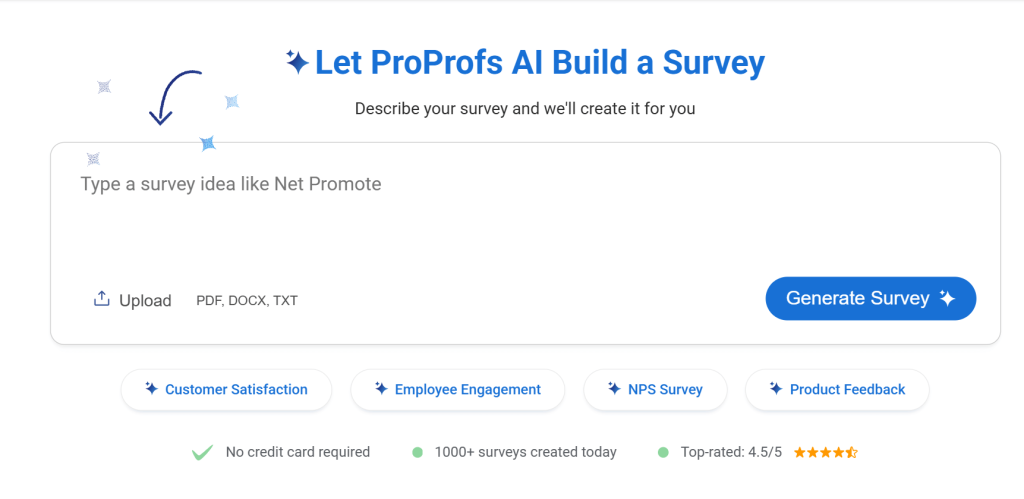
That level of specificity changes every question the AI generates. The tool pulls from a library of over 1,000,000 ready-to-use questions and builds a complete, ordered survey in seconds.
Step 2: Review and Adapt the Generated Questions
Read each AI-generated question against your specific context. Adjust wording for your industry, team size, or any recent event that makes certain questions more or less relevant right now.
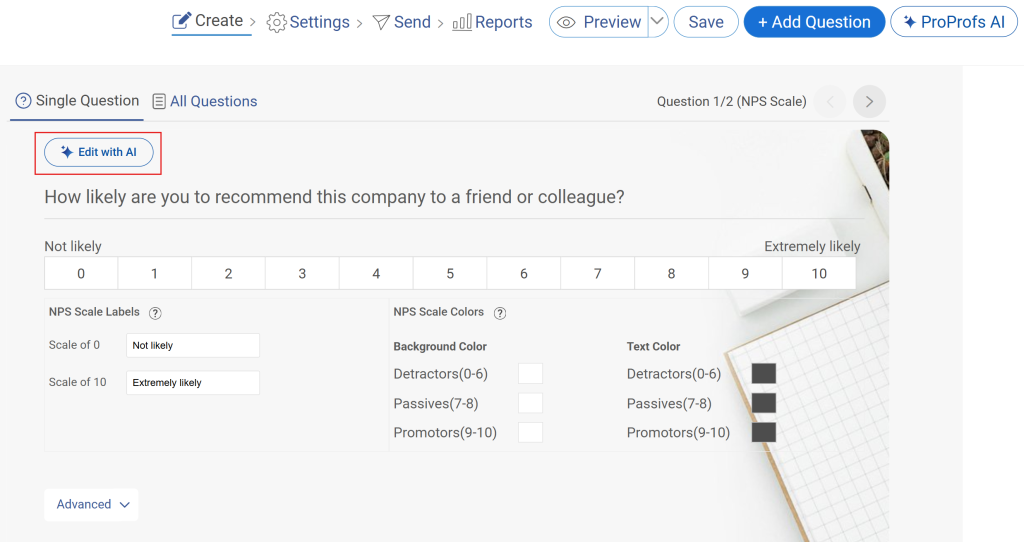
If you are running an HR maturity assessment or a coaching program intake, switch the survey mode to a scored survey so each answer carries a point value.
And, so respondents are automatically bucketed by result range, eliminating manual scoring.
Step 3: Set Response Formats for Each Question
Assign Likert scales (1 to 5) for sentiment tracking, Yes/No for clear pattern detection, and open-ended questions where you need context behind the scores.
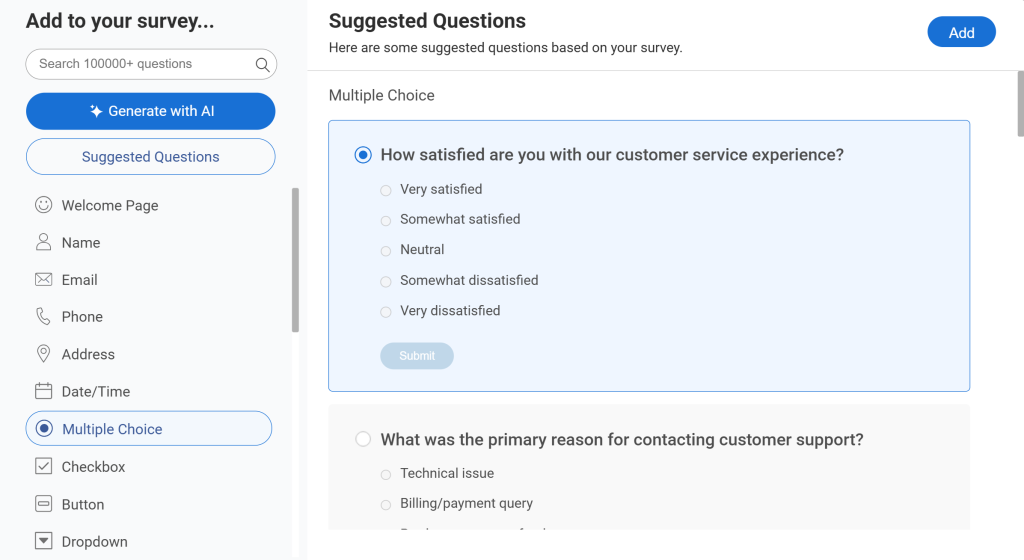
For complex surveys serving different employee types, use skip logic and branching so a frontline employee and a remote manager see different follow-up questions based on their initial answers.
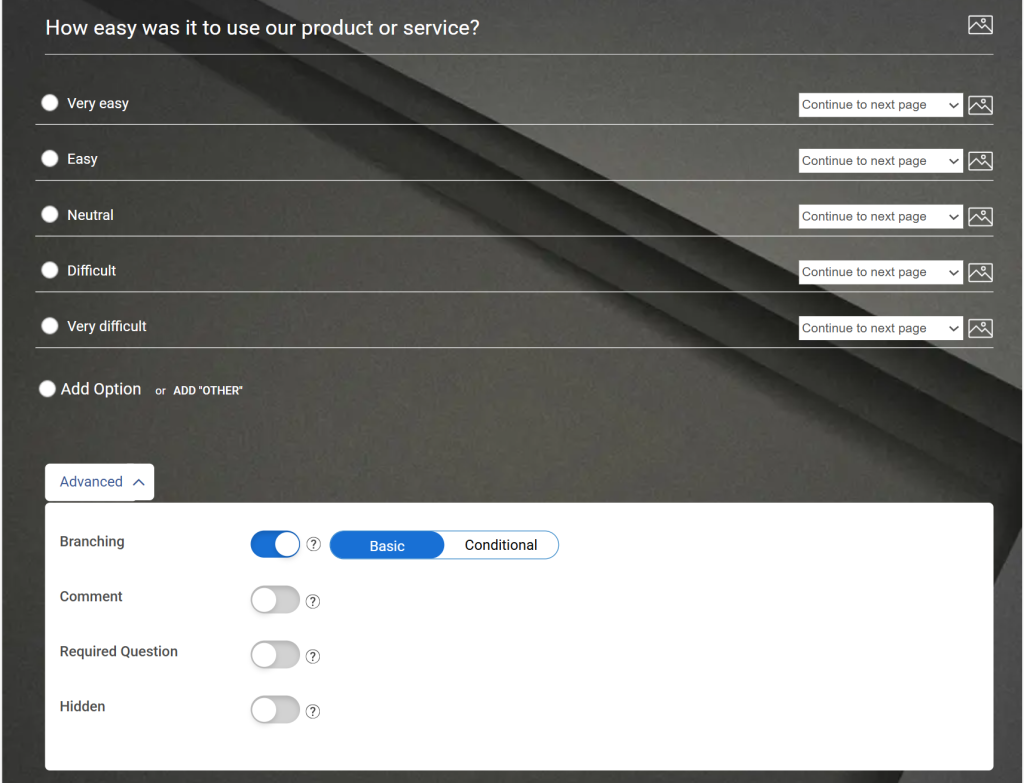
ProProfs Survey Maker supports 20+ question types.
Step 4: Configure Anonymity Before You Distribute
Enable anonymous responses. Set single-response restrictions per user. If your organization uses SSO, connect it here so employees do not need a separate login.
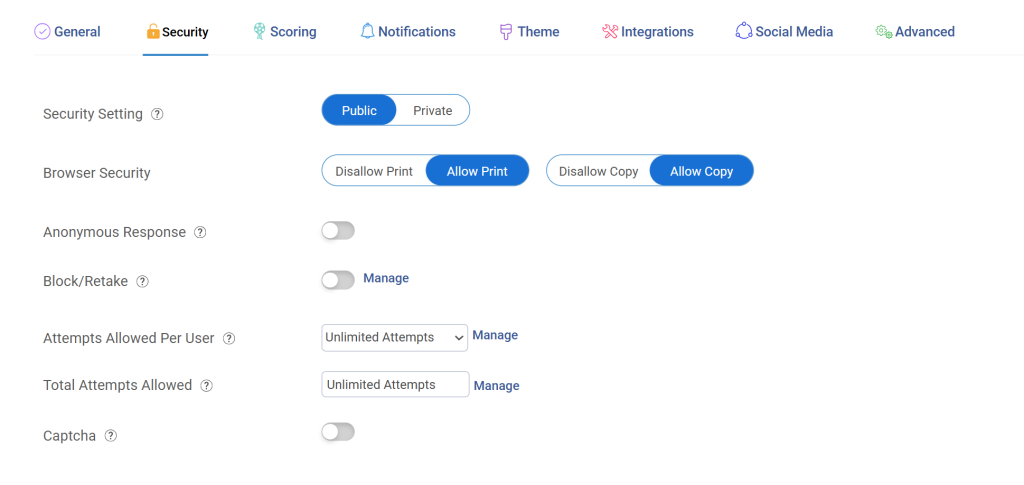
These settings directly affect whether employees trust the process enough to answer honestly. Skipping this step is the single fastest way to get useless data.
Step 5: Choose Your Distribution Channel
Send via email, embed on your intranet, share as a direct link in Slack, or generate a QR code for in-person events.
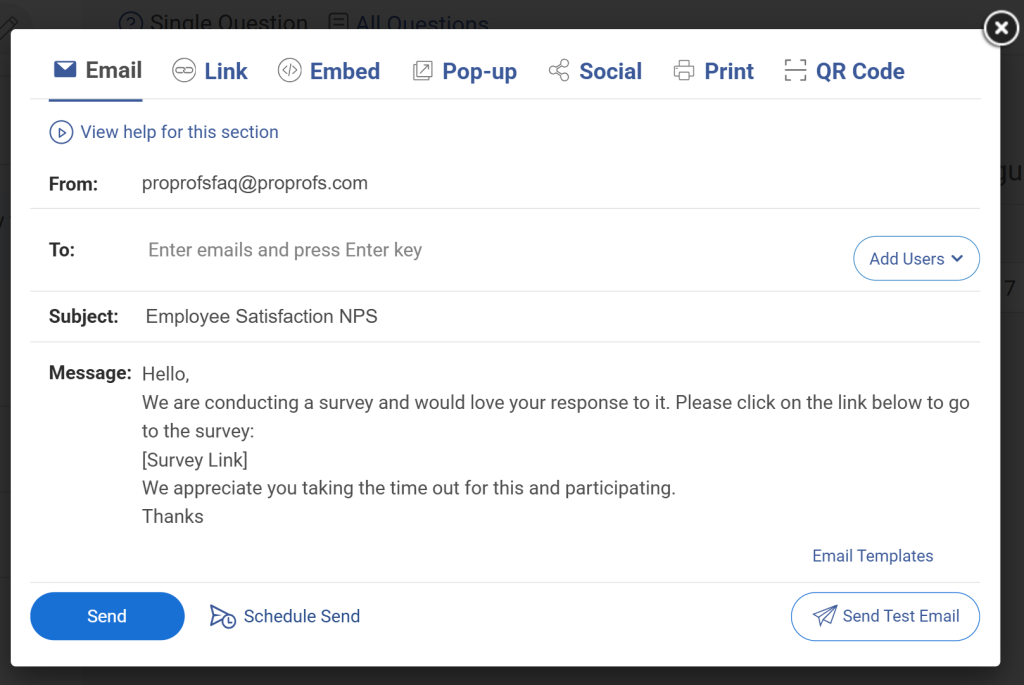
For mobile-first or distributed teams, ProProfs surveys are fully responsive and require no app download. The survey opens in a browser with one click.
Step 6: Read Results as They Come In
The reporting dashboard shows response rates, score distributions, and open-ended comment themes in real time.
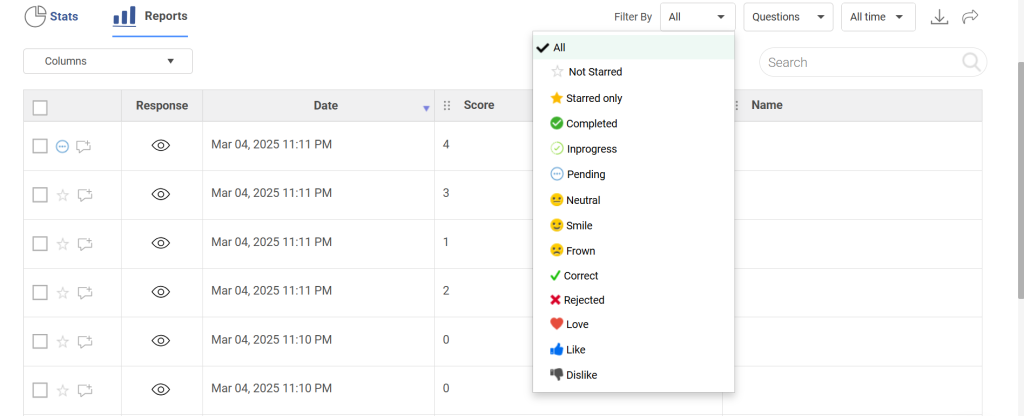
Filter by department, date range, or demographic segment before you write your action plan, not after.
That speed from survey to insight is what lets HR teams share a meaningful update with employees within the two-week window that keeps participation trust intact.
ProProfs Survey Maker’s free plan includes all premium features with no credit card required. You get the full tool, not a limited trial.
How Do You Turn HR Survey Results Into a Real Action Plan?
Collecting responses is the easy part. Most HR teams have more data than capacity to act on it.
Here is a six-step process that moves from a full results dashboard to a prioritized action plan without getting buried in charts.
| Step | What to Do | Why It Matters |
| Find Patterns Before You React to Outliers | Count how many employees flagged the same issue, not how loudly one person flagged it. Anything surfacing across 30%+ of respondents warrants priority attention. | Single-response outliers need individual follow-up, not policy changes. Acting on noise wastes leadership credibility. |
| Segment by Team and Tenure | Break results down by department first, then by tenure band if your sample allows it without identifying individuals. | A company-wide score of 3.8/5 can hide one team at 2.1 and another at 4.9. Aggregated data masks the real story. |
| Read Every Open-Ended Comment | Read all qualitative responses before writing your action plan, not after. | Scale questions tell you what changed. Open-ended responses tell you why. A four-point drop in manager support scores means nothing without the comments explaining whether it is workload, communication, or one specific team. |
| Pick 2–3 Priorities, Not 10 | Identify issues that are both high-impact (affecting a significant share of the workforce) and actionable within the current quarter. | Trying to fix everything in one cycle signals to employees that you did not actually prioritize their feedback. Focus earns trust. |
| Communicate Within Two Weeks | Share a short update (even a two-slide deck) that says: “You told us X. We are doing Y by Z date.” | Employees who see feedback acted on respond honestly next time. Employees who see no change stop responding entirely. No incentive program replaces this. |
| Send a Follow-Up Pulse Survey | Four to six weeks after acting, send a short pulse focused on the specific issue you addressed. | If scores improve, that is your proof point for sustained leadership investment. If they do not, you have an early signal to adjust before the next full survey cycle. |
When Response Rates Are Low: If a survey closes with under 30% participation, the data gap is telling you something before the results do.
The three most common causes are: employees do not trust anonymity, they have not seen previous feedback lead to change, or the survey went out too soon after the last one.
Address the trust gap with a brief all-team communication before the next send, not by redesigning the questions.
Stop Guessing What Your Employees Need: Start Asking the Right Questions
The organizations with the healthiest workplaces right now are not the ones running the most surveys.
They are the ones asking precise questions at the right moments, taking visible action within two weeks, and closing the feedback loop before employees stop believing their input matters.
You now have 75 questions organized by objective, a framework for when to use each type, and a six-step process for building and acting on results.
The only thing left is to pick one objective, build one short survey, send it, and do something visible with what you learn.
Build your first HR survey using ProProfs Survey Maker AI in under five minutes. All premium features included, no credit card required.
Frequently Asked Questions
How many questions should an HR survey include?
Six to ten questions per survey is the optimal range for most HR objectives. Pulse surveys should stay at three to five. Anything beyond fifteen questions sees a meaningful drop-off in both completion rate and response honesty. If you have more than ten things you want to know, run two separate surveys on two separate topics rather than combining them into one form.
How do you ensure employees answer HR surveys honestly?
Explicitly communicate anonymity before the survey opens, not just in the survey itself. Tell employees who will see the results, how data will be aggregated, and whether individual responses can be traced. Then act on the feedback visibly. The single biggest driver of honest participation in future surveys is employees seeing that their previous feedback changed something. No incentive program replaces that.
What is an eNPS question, and why does it belong in an HR survey?
The Employee Net Promoter Score asks employees to rate on a scale of 0 to 10 how likely they are to recommend the company as a great place to work. Responses from 0 to 6 are detractors, 7 to 8 are passives, and 9 to 10 are promoters. It produces a single benchmarkable number that tracks workforce loyalty over time and is one of the fastest metrics to present to leadership in a format they immediately understand.
What HR survey questions work best for diversity, inclusion, and belonging?
Focus on belonging and fairness rather than representation metrics alone. Ask "Do you feel you can be your authentic self at work?" and "Do you believe the internal promotion process is free from bias?" Pair Yes/No items for pattern data with at least one open-ended question for context. In small teams, always aggregate results across departments before sharing to prevent individual identification.
What questions belong in a 360-degree employee feedback survey?
360-degree questions should assess observable behaviors, not personality traits. Ask whether the employee delivers on commitments, communicates constructively, takes ownership of mistakes, and demonstrates company values in practice. Keep the question set to seven to ten items and make responses anonymous. Share results with the employee being reviewed in an aggregated form only. Attributed individual responses will reduce honesty in every future round.
What should you do with HR survey results after collecting them?
Segment results by department before drawing conclusions. Identify two or three issues that are both high-impact and actionable within the current quarter. Share a summary with employees within two weeks of closing the survey, including what you heard and what you will do about it. Then send a short pulse survey four to six weeks later to measure whether the action made a measurable difference.
How do exit survey questions differ from engagement survey questions?
Exit surveys are retrospective, not diagnostic. They focus on reasons for leaving, unresolved challenges, and whether the employee would return or refer others. Use them consistently and segment by team and tenure every quarter. If the same manager or department appears repeatedly in exit data, that is an actionable signal that your active-employee engagement surveys are not surfacing the problem early enough.
FREE. All Features. FOREVER!
Try our Forever FREE account with all premium features!

 We'd love your feedback!
What did you like & how can we make it even better?

 Thanks for your feedback!
 Ask Your Question
Have a question? Get expert help to make your decision easier.