

You ran the post-training evaluation. Participants filled it out. You got a 4.1 out of 5, with a few comments saying “good session” and “could use more examples.”
You filed the report. Three months later, the same performance gaps your training was meant to close are still open.
That is the problem with most course evaluation surveys. They measure how people felt in the room, not whether anything changed when they got back to their desks.
When your evaluation asks, “Was the facilitator effective?”, you get a rating.
When it asks, “Can you apply what you learned in this training to your current role within the next 30 days?”, you get something you can actually act on.
The right course evaluation questions tell you whether your program delivered, where it fell short, and what to rebuild before the next cohort runs.
This guide gives you 40+ course evaluation questions organized by category, a step-by-step process for building the survey in ProProfs Survey Maker, and the design decisions that determine whether your evaluation drives program improvement or produces a number nobody acts on.
What Is a Course Evaluation Survey?
A course evaluation survey is a structured questionnaire that collects participant feedback on facilitator effectiveness, program design, content quality, and learning outcomes at one or more points during or after a training program. Organizations use the results to improve course content, refine delivery methods, demonstrate training ROI, and decide whether to continue or redesign a program.
What separates a useful evaluation from a box-ticking exercise is whether the questions are specific enough to produce a decision.
“The facilitator was engaging” measures sentiment.
“The facilitator connected the content to challenges I face in my role” measures whether the training was relevant and worth acting on.
The three dimensions every corporate evaluation needs to cover are facilitator delivery, program structure and content, and participant learning outcomes.
Best Course Evaluation Questions to Ask
Before copying the questions below, match the format to the purpose. The format of a question determines what kind of data you get, and the wrong format on the right question produces noise.
| Format | Best For | Example |
| Rating Scale (1–5 or 1–10) | Quantitative benchmarking across cohorts and programs | “Rate the relevance of this training to your current role on a scale of 1 to 5.” |
| Likert Scale (Strongly Agree to Strongly Disagree) | Attitude and perception data on specific behaviors or outcomes | “The facilitator connected the content to real workplace challenges.” |
| Multiple Choice | Category-based insight on which elements landed or did not | “Which part of the program was most useful: content, activities, or discussions?” |
| Short Open-Ended | Targeted qualitative feedback on a specific element | “What one change would make this program more relevant to your role?” |
| Long Open-Ended | Deep qualitative insight at the close of the evaluation | “How do you plan to apply what you learned in the next 30 days?” |
Most training evaluations work best with a 70/30 split: structured questions for trend data and open-ended questions for root cause analysis.
A score of 3.8 out of 5 on “content relevance” tells you something is underperforming.
The open-ended follow-up tells you whether the gap is in the content itself, the examples used, or the mismatch between program level and participant experience.
One rule most L&D teams overlook: define your scale explicitly in the survey introduction and next to every rating question. When one participant’s “4” means “met expectations” and another’s means “exceeded them,” your aggregate score is unreliable across cohorts.
Here are the questions, organized by category. Each table shows what the question gauges, so you can swap or customize with the same intent in mind.
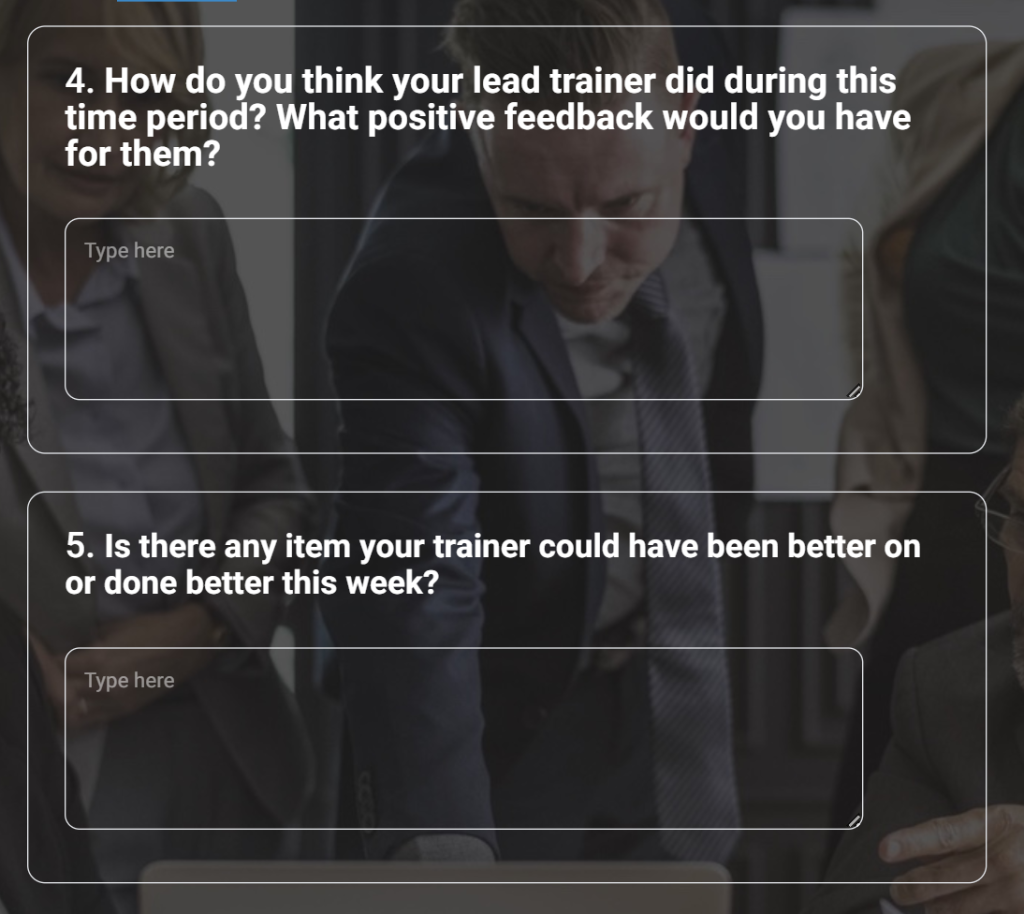
Facilitator Effectiveness Questions
These measures are specific to delivery behaviors: clarity of explanation, ability to connect content to participant context, responsiveness to confusion, and quality of feedback.
Keep them tied to observable behaviors, not overall impressions.
| # | Question | What It Gauges |
| 1 | The facilitator explained concepts clearly enough for me to apply them in my role. | Clarity of instruction relative to role context |
| 2 | The facilitator responded to questions in a way that deepened understanding. | Responsiveness to confusion |
| 3 | The facilitator adjusted the pace when participants needed more time on a concept. | Adaptability and pacing |
| 4 | The facilitator created an environment where I felt comfortable asking questions. | Psychological safety in the training room |
| 5 | The facilitator gave feedback that helped me understand where my thinking needed to develop. | Quality and usefulness of facilitator feedback |
| 6 | The facilitator demonstrated strong knowledge of the subject matter. | Subject matter credibility |
| 7 | The facilitator used examples and scenarios that connected theory to real workplace situations. | Practical relevance of delivery |
Open-Ended Add-On: What is one specific thing the facilitator did that helped you learn the most?
Here’s a template you can use to evaluate the course facilitator:
Program Design and Content Questions
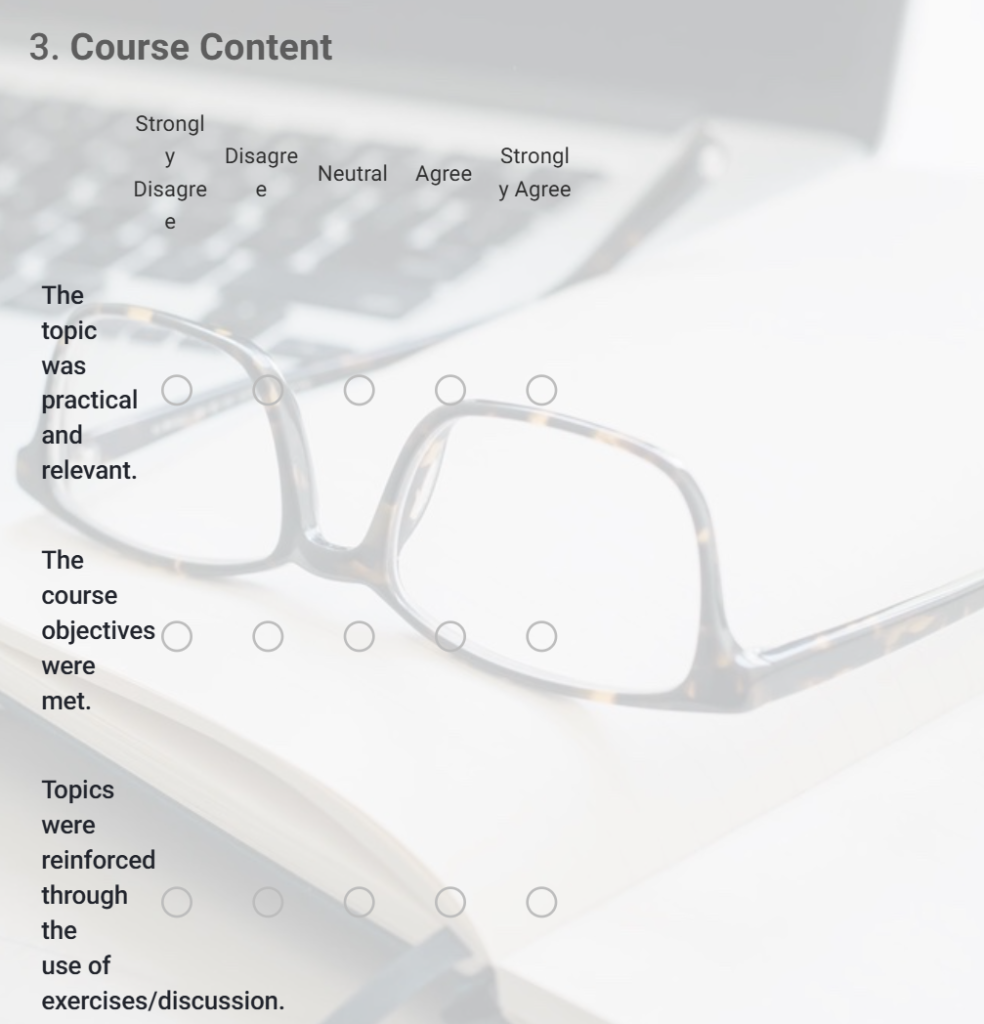
According to Levinsson et al. (2024) in Higher Education (Springer), course design is at least as strong a predictor of participant satisfaction as facilitator performance.
If your evaluation only covers the facilitator, you are missing the structural and content factors that are equally responsible for whether the program lands.
| # | Question | What It Gauges |
| 8 | The program objectives were clearly communicated before the training began. | Clarity of expectations and scope |
| 9 | The content was directly relevant to the challenges I face in my current role. | Role relevance of content |
| 10 | The program workload and pace were appropriate for the time available. | Workload and pacing calibration |
| 11 | The program followed a logical sequence that made it easy to build on earlier concepts. | Structural scaffolding |
| 12 | The materials and resources provided were current and applicable to my work context. | Currency and practical quality of resources |
| 13 | The assessments or activities reflected what was covered in the program. | Alignment between content and evaluation |
| 14 | The program covered the right depth for my experience level. | Calibration to participant level |
Open-Ended Add-On: Which part of the program structure helped your learning most, and which was least useful?
Here’s a program design feedback template you can use:
Learning Outcome Questions
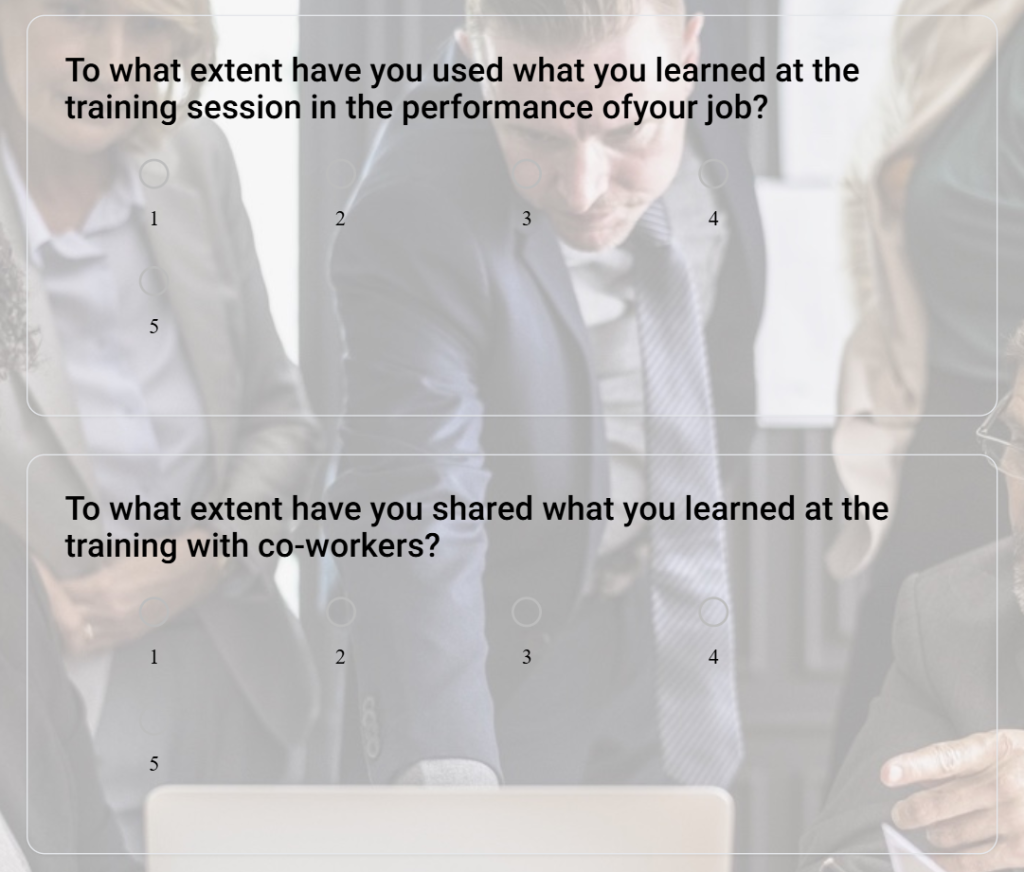
These measure what actually changed for the participant. This is the category that matters most for demonstrating training ROI to leadership.
Satisfaction scores show how people felt. Learning outcome questions show whether the program produced the capability it was designed to develop.
| # | Question | What It Gauges |
| 15 | This program improved my ability to handle the situations it was designed to address. | Core capability development |
| 16 | I can apply the skills or knowledge from this program to real situations I face at work. | Transfer of learning to practice |
| 17 | This program challenged me to think differently about problems in my role. | Depth of learning and mindset shift |
| 18 | The program helped me achieve the learning goals that were outlined at the start. | Alignment between stated objectives and outcomes |
| 19 | I leave this program with skills I can use immediately, without additional support. | Immediate practical applicability |
| 20 | I feel more confident handling the situations this program covered. | Confidence and readiness to apply learning |
Open-Ended Add-On: Describe one thing you learned in this program that you plan to apply within the next 30 days.
Here’s a template you can use to gauge learning outcomes of the course:
If you need to measure learning outcomes at scale across cohorts, not just collect qualitative responses, ProProfs Survey Maker’s scored surveys assign point values to answers and bucket participants by score.
HR managers and L&D directors use this to track capability development across cohorts and present measurable program outcomes to leadership, without building a separate assessment tool.
Overall Program Evaluation Survey Sample Questions
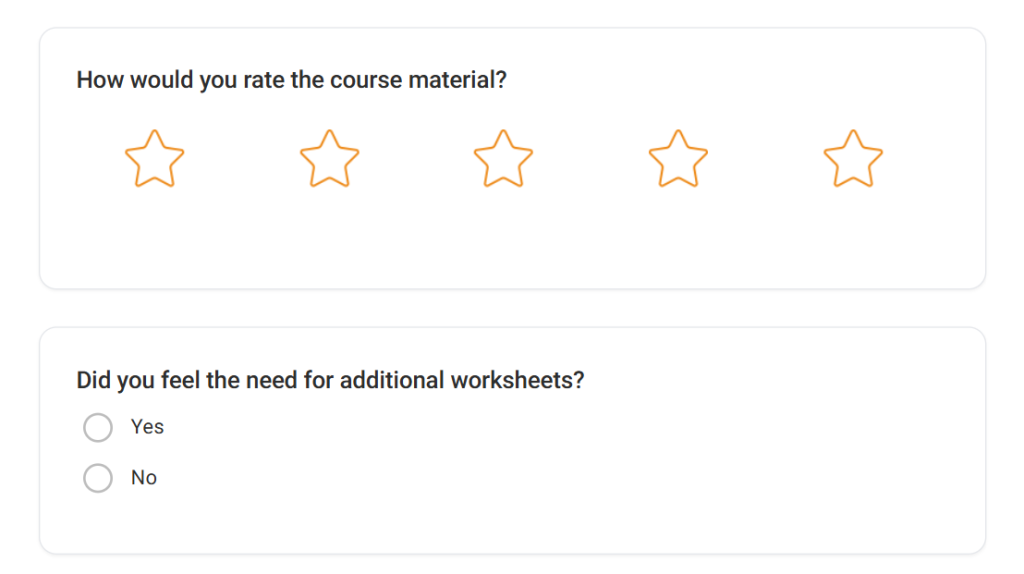
These give you the headline metric that program managers and L&D leaders use to benchmark course quality over time and across delivery formats. Include at least one net-level question alongside the category-specific ones.
| # | Question | What It Gauges |
| 21 | Overall, this was a valuable use of my time. | Net program value |
| 22 | I would recommend this program to colleagues in similar roles. | Net promoter intent |
| 23 | This program met the expectations I had going in. | Expectation vs. delivery gap |
| 24 | Compared to other training I have attended, this program prepared me better for my role. | Relative quality and readiness |
Here’s a template for overall course satisfaction feedback:
Open-Ended Questions for Qualitative Insight
Place these at the end of the evaluation, after the structured sections. Limit this block to two or three questions. Participants who have already worked through the rating sections are primed to reflect. Open-ended fields positioned too early get skipped; positioned last, they capture the most considered and honest responses.
| # | Question | What It Gauges |
| 25 | What did you find most valuable about this program? | Top strengths to preserve in the next iteration |
| 26 | What one change would improve this program most for the next group of participants? | Highest-priority redesign signal |
| 27 | Was there anything you expected from this program that you did not receive? | Unmet expectations and content gaps |
| 28 | What advice would you give to a colleague starting this program? | Participant-level signal on fit, difficulty, and preparation |
Practical Note: Cap open-ended answers at 300 to 500 characters if you need responses to stay analyzable at scale. Unlimited fields tend to produce either one-word answers or multi-paragraph essays, both of which are harder to act on when you are reviewing 50 or 100 submissions.
Course Evaluation Questions for Different Program Types
The 28 core questions above apply to almost any training program.
But different program formats need additional questions that reflect their specific delivery context. Use the core set and layer in the relevant program-type questions below.
| # | Question | What It Gauges |
| 29 | The onboarding program gave me a clear understanding of my role and responsibilities. | Role clarity at program close |
| 30 | I know where to find the resources and support I need to do my job effectively. | Resource and support accessibility |
| 31 | The program helped me understand how my role connects to the organization’s goals. | Strategic alignment and context |
| 32 | I feel prepared to contribute meaningfully within my first 30 days. | Readiness and confidence to perform |
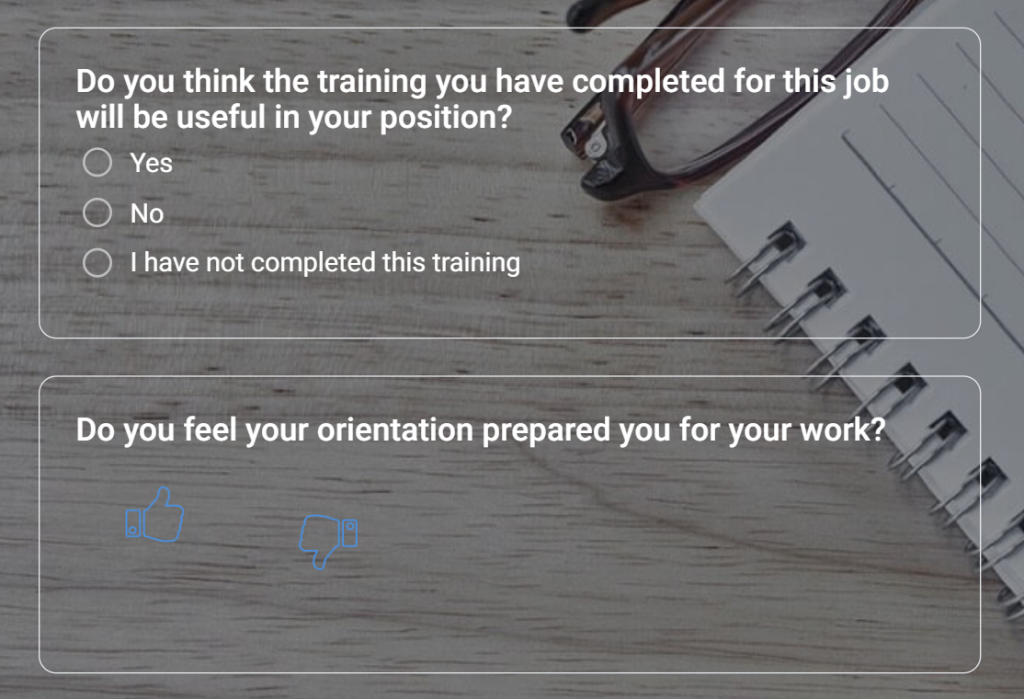
Here’s an onboarding program survey template:
Leadership and Management Development Programs
| # | Question | What It Gauges |
| 33 | This program gave me practical tools I can use to manage my team more effectively. | Practical leadership applicability |
| 34 | The program helped me understand how to handle situations I currently face as a manager. | Situational relevance |
| 35 | I am more confident in having difficult conversations with my team after this program. | Confidence in high-stakes interactions |
| 36 | The program challenged my assumptions about how I lead. | Mindset shift and self-awareness development |
Compliance and Certification Programs
| # | Question | What It Gauges |
| 37 | The compliance requirements covered in this program were explained clearly. | Clarity of regulatory content |
| 38 | I understand the consequences of non-compliance in my role. | Risk awareness |
| 39 | The program content was relevant to the compliance situations I encounter in my work. | Contextual relevance of compliance training |
| 40 | I feel confident applying what I learned to meet compliance requirements in my role. | Compliance readiness |
Skills and Technical Training Programs
| # | Question | What It Gauges |
| 41 | The hands-on activities gave me enough practice to use this skill independently. | Practice-to-independence transfer |
| 42 | The program covered the right level of technical depth for my current role. | Calibration to participant skill level |
| 43 | I know how to troubleshoot the most common problems I will encounter using this skill. | Problem-solving readiness |
| 44 | I have access to the tools and resources I need to apply what I learned. | Post-program support and enablement |
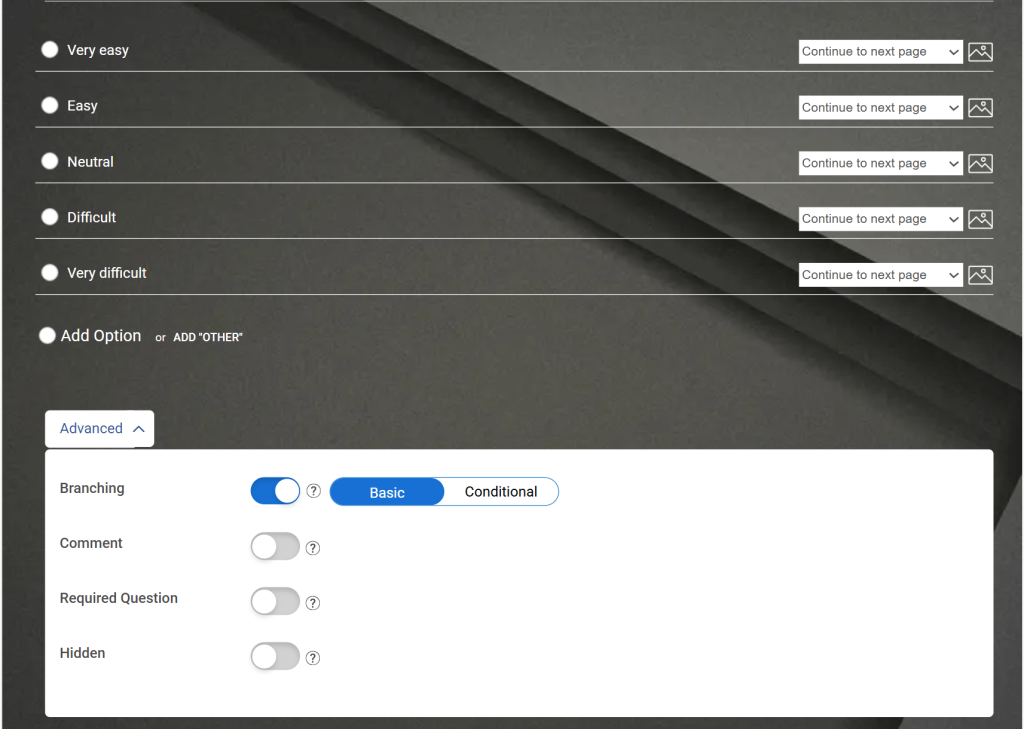
If your organization runs multiple program types and needs to evaluate them without rebuilding from scratch each time, ProProfs Survey Maker’s skip-logic routes participants to the right program-type questions automatically, so a single survey adapts to every context.
Here’s how skip logic works:
How to Create a Course Evaluation Survey Using ProProfs Survey Maker
Building a complete evaluation survey from scratch takes time; most instructors and program managers do not have between terms.
The blank-page problem is the most common reason evaluations get recycled from the previous cycle, questions and all, even when the course has changed significantly.
ProProfs Survey Maker solves this with a library of pre-built course evaluation templates, an AI survey maker that generates a full draft from a plain-language description of your goal, and 20+ question types that cover every format in the table above.
Here is how to go from blank page to live survey in under 15 minutes:
Step 1: Start With a Template or Use AI Generation
Open ProProfs Survey Maker and select “Create a Survey.”
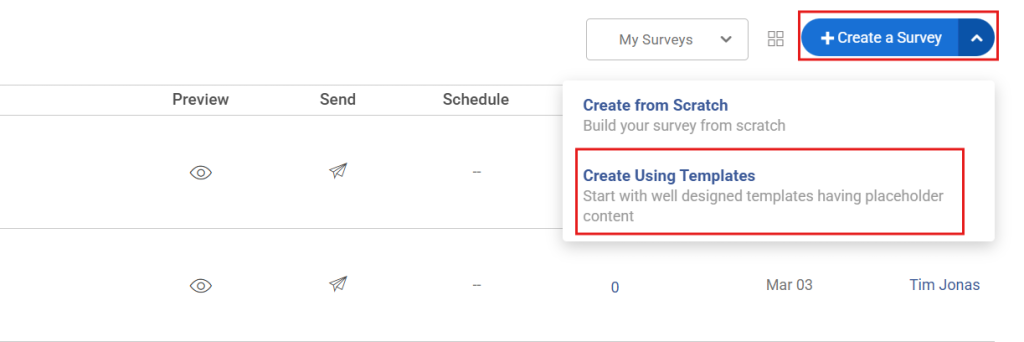
Either choose a course evaluation template from the library or type your survey goal into the AI survey maker, something like “end-of-term feedback survey for a corporate training course.”
Try the AI Survey Maker here:
Let ProProfs AI Build a Survey
Describe your survey and we'll create it for you
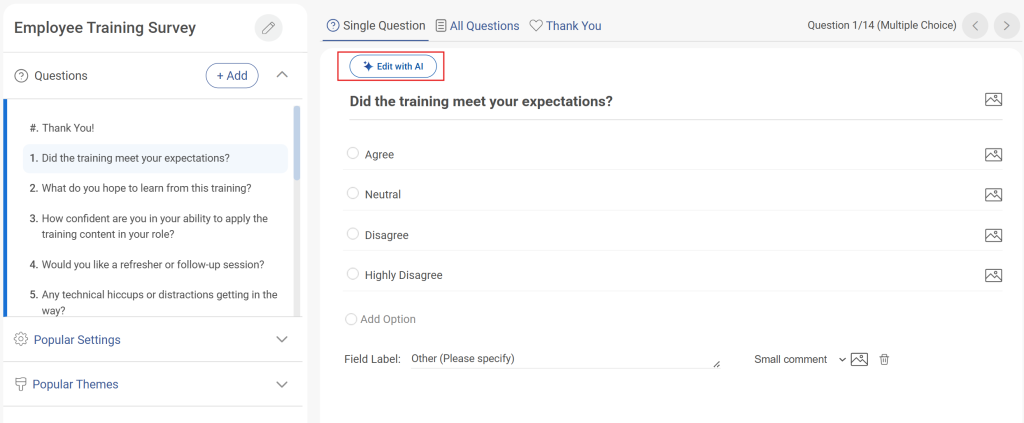
The tool generates a complete draft you can edit, reorder, or extend. No setup, no formatting from scratch.
Step 2: Set Up Your Question Formats
Use the 20+ question types to match format to function. Likert scales work best for instructor and course design questions. Multiple choice works for category-based learning questions.
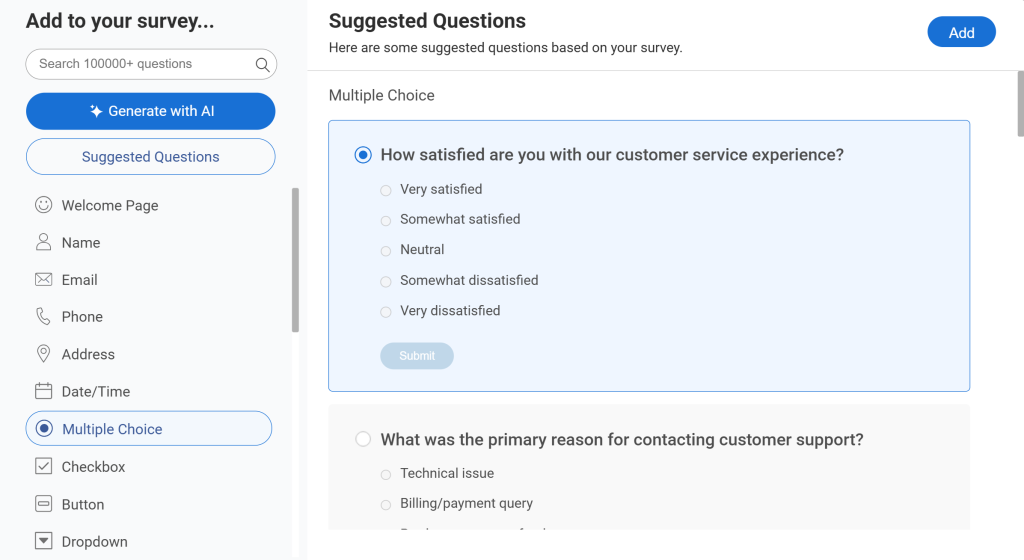
Open-ended fields go last for qualitative insight.
Add skip logic to route respondents to course-type-specific questions automatically.
Step 3: Configure Anonymity and Distribution
Set the survey to collect anonymous responses. Here’s how you can do it:
Distribute via direct link, embed in your LMS, send by email, or generate a QR code for in-class completion on respondent devices.
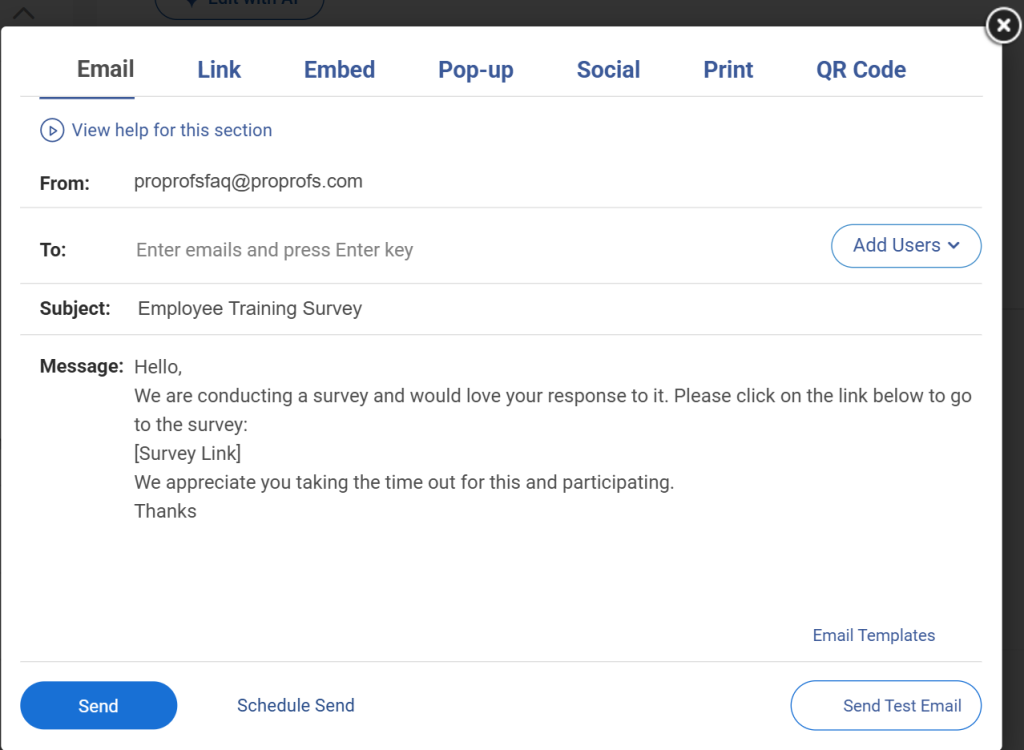
The platform supports 70+ languages, which matters for multilingual classrooms or global training programs.
Step 4: Analyze and Share Results
The real-time reporting dashboard breaks down responses by question, surfaces rating distributions, and organizes open-ended comments in a single view.
The AI-powered reporting automatically surfaces patterns across cohorts, so you are not reading 200 individual comments to find the three things that need fixing.
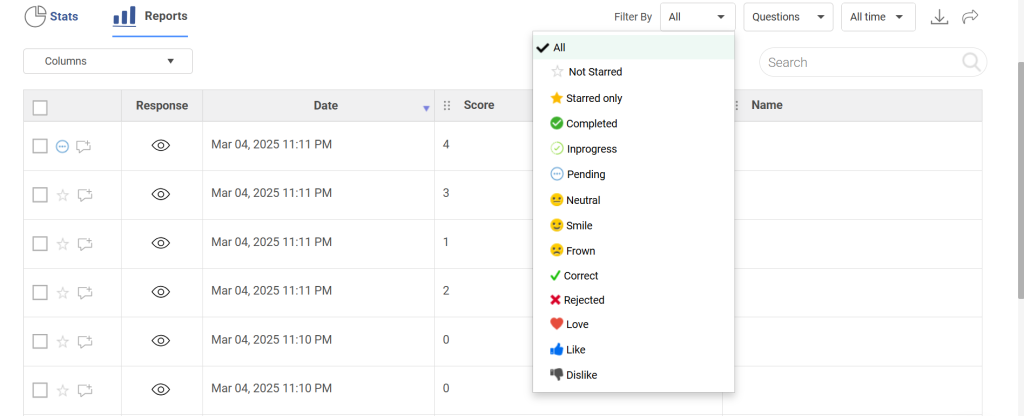
Export to Excel or connect to your CRM for longitudinal tracking across terms.
ProProfs Survey Maker’s free plan covers unlimited surveys with all premium features and up to 50 responses per survey, which is enough to run a pilot evaluation for a single course before committing to a paid tier.
Beth Brooks, an education professional using ProProfs Survey Maker, described it as making it “easy to gather functional outcome measures and training feedback,” which is exactly what a well-built training evaluation should do: give you outcome data and delivery feedback in the same instrument, without managing two separate tools.
When Should You Run a Course Evaluation Survey?
Timing determines whether your data can improve the current cohort’s experience or only the next one.
Most organizations still rely on a single post-program evaluation, which arrives after the delivery window has closed, and the only thing you can act on is the next iteration.
The most effective L&D programs run evaluations at four points.
Pre-Program:
3–5 questions are sent before the program begins.
- What do participants already know about this topic?
- What are they hoping to get out of it?
- What concerns do they have about relevance or difficulty?
This data helps facilitators calibrate the opening sessions and address concerns before they affect engagement.
Mid-Program:
Five to seven questions at the halfway point. What is working? What is not? What would make the second half more valuable?
According to the University of Alabama Teaching Academy (2025), programs that incorporate mid-point evaluations tend to produce more positive end-of-program ratings, and facilitators who use them make sustained improvements to their delivery over time.
End-of-Program:
Full evaluation covering all five question categories above (Q1 through Q28). Run it before participants leave the final session.
Evaluations sent by email after the program ends show significantly lower completion rates.
30-Day Follow-Up:
3–5 questions are sent 30 days after the program closes.
- Has the participant applied what they learned?
- Have they observed any change in their performance?
This is the data point that closes the ROI loop. It is the one most organizations skip, and the one leadership actually wants to see.
FREE. All Features. FOREVER!
Try our Forever FREE account with all premium features!
How Do You Get Higher Completion Rates on Training Evaluations?
Completion rate is the most common complaint L&D managers raise about evaluations, and it is almost always a design and communication problem, not a participant motivation problem.
According to a 2025 study published in Medical Science Educator (University of Minnesota Medical School), completion rates rose from about 50% to 94% after one institution made evaluations a required professional expectation, supported by dedicated in-session time and clear communication about how feedback would be used.
You do not need to make evaluations mandatory to move your numbers. These five practices produce the biggest lift.
- Complete It During the Session: Allocating 10 to 15 minutes at the end of the final session, while participants are still in the room, is the single highest-impact change. Participants who leave without completing the evaluation rarely return to it.
- Tell Participants What Will Change: Participants who believe their feedback leads to visible changes are significantly more likely to complete the evaluation and give substantive answers. If you redesigned the program based on the last cohort’s feedback, say so at the start of the current one.
- Send It at the Right Moment: Mid-program evaluations deliver best at the halfway point, before participants reach peak workload. End-of-program evaluations should be completed before the final session closes, not emailed afterward.
- Keep It Short: Aim for 15-20 questions in end-of-program evaluations. Every question past that threshold reduces completion rate. The 30-day follow-up should be no more than five questions.
- Close the Loop Publicly: Share a brief summary of what changed in the program based on the previous cohort’s feedback. This is the most underused lever for completion rates in corporate L&D programs.
Stop Measuring Satisfaction. Start Measuring Impact.
A 4.1 out of 5 tells you participants left the room feeling good.
It does not tell you whether your compliance training reduced risk, whether your leadership program changed how managers handle difficult conversations, or whether your onboarding program gave new hires the clarity they needed to contribute in their first 30 days.
The questions you ask determine what you can prove. The 44 questions in this guide are built to surface the specific feedback that tells you whether your program worked, not just whether people liked it.
If building and distributing the evaluation is still slower than it should be, ProProfs Survey Maker gives you the templates, AI generation, scored surveys, and skip logic to go from brief to live in minutes.
Frequently Asked Questions
What is a course evaluation survey?
A course evaluation survey is a structured questionnaire given to training participants to collect feedback on facilitator delivery, program design, and learning outcomes. Organizations use the results to improve program content, measure training ROI, and support decisions about program continuation or redesign.
What is a course evaluation questionnaire?
A course evaluation questionnaire and a course evaluation survey refer to the same thing. "Questionnaire" typically describes the written question set, while "survey" refers to the full instrument and its delivery. In corporate L&D contexts, both terms describe the same tool: a structured feedback form run at one or more points during a training cycle.
How many questions should a course evaluation survey have?
Aim for 15 to 20 questions for end-of-program evaluations, 5 to 7 for mid-program check-ins, and no more than 5 for 30-day follow-ups. Evaluations under 10 questions miss important dimensions. Evaluations over 25 see significantly lower completion rates and more abandoned responses.
When should you run a course evaluation survey?
The most effective programs use four touchpoints: a brief pre-program survey before the first session, a mid-program check-in at the halfway point, a full end-of-program evaluation at the close of the final session, and a 30-day follow-up to measure behavioral transfer. The 30-day follow-up is the one most organizations skip and the one that produces the most actionable ROI data.
Should training evaluations be anonymous?
Yes. Anonymous evaluations consistently yield more candid feedback, particularly on questions about facilitator delivery. Participants who know their identity is protected are more likely to flag genuine issues rather than give safe, socially acceptable answers.
Why are training evaluation completion rates so low?
The most common causes are evaluations sent by email after the program ends with no dedicated completion window, unclear communication about how feedback will be used, and surveys that are too long. Completing the evaluation during the final session, before participants leave, is the highest-impact fix.
What is a good course evaluation survey sample structure?
A strong training evaluation includes 5 to 7 facilitator delivery questions using Likert scales, 5 to 7 program design questions using rating scales, 4 to 6 learning outcome questions, 2 to 3 overall satisfaction questions, and 2 to 3 open-ended questions placed at the end. That is 18 to 26 questions total. ProProfs Survey Maker's training evaluation templates are pre-built to this structure, so you can deploy without starting from scratch.
Can the same evaluation questions be used for every program?
A core set of 15 to 18 questions works across most programs, but program-type-specific questions add meaningful signal. Onboarding programs need role clarity questions. Compliance programs need risk awareness questions. Leadership programs need situational applicability questions. Use the shared base and layer in 4 to 6 program-type questions for each context. ProProfs Survey Maker's skip logic handles this routing automatically within a single survey.
FREE. All Features. FOREVER!
Try our Forever FREE account with all premium features!

 We'd love your feedback!
What did you like & how can we make it even better?

 Thanks for your feedback!
 Ask Your Question
Have a question? Get expert help to make your decision easier.